


Page 2109 - Hematology_ Basic Principles and Practice ( PDFDrive )
P. 2109
1872   Part XII  Hemostasis and Thrombosis


                                          Tethering           tandem 13 amino acid repeats (one to four), may have a role in regu-
            Shear                                  Shear      lating platelet adhesion to VWF.
                                                                 In addition to serving as a receptor for VWF in the subendothe-
                                                              lium, GPIb–IX–V is also a receptor for the soluble agonist thrombin
                                                              (see section on Soluble Agonist Receptors). Other adhesive ligands
            GPIb-V-IX                                         for GPIb–IX–V include the counter-receptors P-selectin (CD62P),
                      vWF    vWF   vWF     vWF                expressed on activated platelets and endothelial cells, and leukocyte
                                                              integrin  Mac-1  (αMβ2),  which  is  involved  in  the  formation  of
        A                Subendothelial collagen              platelet-leukocyte conjugates. 18
                                                                 Platelets from patients with Bernard-Soulier syndrome (BSS) lack
                                                              GPIb–IX–V as a result of mutations in GPIb or GPIX that prevent
                                         Signaling            the  expression  of  the  complex  on  the  platelet  surface.  Decreased
                                                              expression of GPIb–IX–V impairs platelet adhesion to the subendo-
                                                              thelium and can result in a significant bleeding diathesis (see section
                                                              on Molecular Basis of Inherited Platelet Disorders).
              GPIb-V-IX
                                     GPVI
                     vWF
                                                              Collagen Receptors

        B                Subendothelial collagen              Subendothelial collagen has long been recognized as an important
                                                              initiator of platelet responses, serving as a substrate for platelet adhe-
                                                              sion, which ultimately results in platelet aggregation. Three different
                                                              receptors are involved in platelet responses to collagen: the GPIb–
                                                              IX–V complex, which binds to collagen via VWF, and GPVI and
                                         Adhesion             α2β1 (GPIa–IIa), which directly bind to collagen.
                                                                 GPVI,  with  approximately  4000–6000  copies  per  platelet,  is  a
                                                              transmembrane protein member of the immunoglobulin superfamily
                                                              and has two extracellular immunoglobulin domains. As an immuno-
                                                              receptor tyrosine-based activation motif (ITAM)-coupled receptor, its
                    GPVI                   2b1                cytoplasmic domain contains a proline-rich sequence that binds to
                                                              tyrosine  kinases  involved  in  platelet  signaling 12,19   (see  section  on
                                                              Activation Pathways). GPVI is noncovalently associated with the Fc
        C                Subendothelial collagen              receptor γ chain (FcRγ) dimer, which is required for GPVI surface
                                                              expression. There is in vitro and in vivo evidence of shedding of GPVI
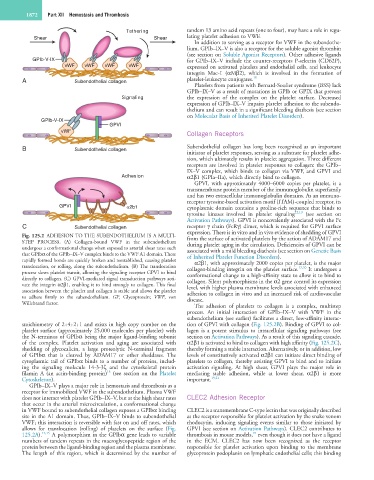
        Fig. 125.2  ADHESION TO THE SUBENDOTHELIUM IS A MULTI-  from the surface of activated platelets by the action of ADAM17 and
        STEP  PROCESS.  (A)  Collagen-bound  VWF  in  the  subendothelium   during platelet aging in the circulation. Deficiencies of GPVI can be
        undergoes a conformational change when exposed to arterial shear rates such   associated with a mild bleeding diathesis (see section on Genetic Basis
        that GPIbα of the GPIb–IX–V complex binds to the VWF A1 domain. These   of Inherited Platelet Function Disorders).
        rapidly formed bonds are quickly broken and reestablished, causing platelet   α2β1, with approximately 2000 copies per platelet, is the major
        translocation, or rolling, along the subendothelium. (B) The translocation   collagen-binding integrin on the platelet surface. 12,20  It undergoes a
        process slows platelet transit, allowing the signaling receptor GPVI to bind   conformational change to a high-affinity state to allow it to bind to
        directly to collagen. (C) GPVI-mediated signal transduction pathways acti-  collagen. Silent polymorphisms in the α2 gene control its expression
        vate the integrin α2β1, enabling it to bind strongly to collagen. This final   level, with higher plasma membrane levels associated with enhanced
        association between the platelet and collagen is stable and allows the platelet   adhesion to collagen in vitro and an increased risk of cardiovascular
        to  adhere  firmly  to  the  subendothelium.  GP,  Glycoprotein;  VWF,  von   disease.
        Willebrand factor.
                                                                 The  adhesion  of  platelets  to  collagen  is  a  complex,  multistep
                                                              process.  An  initial  interaction  of  GPIb–IX–V  with  VWF  in  the
                                                              subendothelium (see earlier) facilitates a direct, low-affinity interac-
        stoichiometry of 2 : 4 : 2 : 1 and exists in high copy number on the   tion of GPVI with collagen (Fig. 125.2B). Binding of GPVI to col-
        platelet surface (approximately 25,000 molecules per platelet) with   lagen  is  a  potent  stimulus  to  intracellular  signaling  pathways  (see
        the N-terminus of GPIbα being the major ligand-binding subunit   section on Activation Pathways). As a result of this signaling cascade,
        of  the  complex.  Platelet  activation  and  aging  are  associated  with   α2β1 is activated to bind to collagen with high affinity (Fig. 125.2C),
        shedding  of  glycocalicin,  a  large  proteolytic  N-terminal  fragment   thereby forming a stable interaction. Alternatively, or in addition, low
        of  GPIbα  that  is  cleaved  by  ADAM17  or  other  sheddases.  The   levels of constitutively activated α2β1 can initiate direct binding of
        cytoplasmic tail of GPIbα binds to a number of proteins, includ-  platelets to collagen, thereby assisting GPVI to bind and to initiate
        ing  the  signaling  molecule  14-3-3ζ  and  the  cytoskeletal  protein   activation  signaling.  At  high  shear,  GPVI  plays  the  major  role  in
                                    18
        filamin  A  (an  actin-binding  protein)   (see  section  on  the  Platelet   mediating  stable  adhesion,  while  at  lower  shear,  α2β1  is  more
        Cytoskeleton).                                        important. 19,21
           GPIb–IX–V plays a major role in hemostasis and thrombosis as a
        receptor for immobilized VWF in the subendothelium. Plasma VWF
        does not interact with platelet GPIb–IX–V, but at the high shear rates   CLEC2 Adhesion Receptor
        that occur in the arterial microcirculation, a conformational change
        in VWF bound to subendothelial collagen exposes a GPIbα binding   CLEC2 is a transmembrane C-type lectin that was originally described
        site in the A1 domain. Thus, GPIb–IX–V binds to subendothelial   as the receptor responsible for platelet activation by the snake venom
        VWF; this interaction is reversible with fast on and off rates, which   rhodocytin,  inducing  signaling  events  similar  to  those  initiated  by
        allows  for  translocation  (rolling)  of  platelets  on  the  surface  (Fig.   GPVI (see section on Activation Pathways). CLEC2 contributes to
                                                                                    22
        125.2A). 12,15  A polymorphism in the GPIbα gene leads to variable   thrombosis in mouse models,  even though it does not have a ligand
        numbers of tandem repeats in the macroglycopeptide region of the   in  the  ECM.  CLEC2  has  now  been  recognized  as  the  receptor
        protein between the ligand-binding region and the plasma membrane.   responsible  for  platelet  activation  upon  binding  to  the  membrane
        The length of this region, which is determined by the number of   glycoprotein podoplanin on lymphatic endothelial cells; this binding

