


Page 2108 - Hematology_ Basic Principles and Practice ( PDFDrive )
P. 2108
Chapter 125  Molecular Basis of Platelet Function  1871


                   A                                              B


                               ADP    TxA 2  Thrombin


                   C                                              D
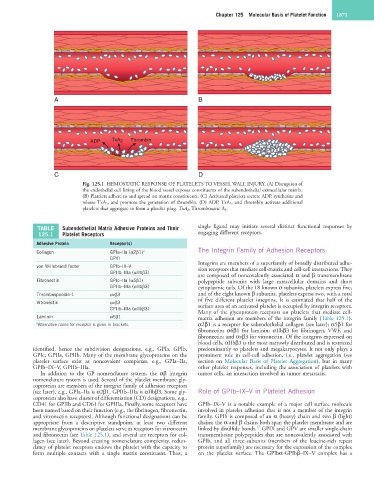
                            Fig. 125.1  HEMOSTATIC RESPONSE OF PLATELETS TO VESSEL WALL INJURY. (A) Disruption of
                            the endothelial cell lining of the blood vessel exposes constituents of the subendothelial extracellular matrix.
                            (B) Platelets adhere to and spread on matrix constituents. (C) Activated platelets secrete ADP, synthesize and
                            release TxA 2, and promote the generation of thrombin. (D) ADP, TxA 2, and thrombin activate additional
                            platelets that aggregate to form a platelet plug. TxA 2, Thromboxane A 2.


             TABLE   Subendothelial Matrix Adhesive Proteins and Their   single  ligand  may  initiate  several  distinct  functional  responses  by
              125.1  Platelet Receptors                           engaging different receptors.
             Adhesive Protein        Receptor(s)
             Collagen                GPIa–IIa (α2β1) a            The Integrin Family of Adhesion Receptors
                                     GPVI
                                                                  Integrins are members of a superfamily of broadly distributed adhe-
             von Willebrand factor   GPIb–IX–V                    sion receptors that mediate cell-matrix and cell-cell interactions. They
                                     GPIIb–IIIa (αIIbβ3)
                                                                  are composed of noncovalently associated α and β transmembrane
             Fibronectin             GPIc–IIa (α5β1)              polypeptide  subunits  with  large  extracellular  domains  and  short
                                     GPIIb–IIIa (αIIbβ3)          cytoplasmic tails. Of the 18 known α subunits, platelets express five,
             Thrombospondin-1        αvβ3                         and of the eight known β subunits, platelets express two, with a total
                                                                  of  five  different  platelet  integrins.  It  is  estimated  that  half  of  the
             Vitronectin             αvβ3                         surface area of an activated platelet is occupied by integrin receptors.
                                     GPIIb–IIIa (αIIbβ3)
                                                                  Many  of  the  glycoprotein  receptors  on  platelets  that  mediate  cell-
             Laminin                 α6β1                         matrix adhesion are members of the integrin family (Table 125.1).
             a Alternative name for receptor is given in brackets.  α2β1 is a receptor for subendothelial collagen (see later); α5β1 for
                                                                  fibronectin;  α6β1  for  laminin;  αIIbβ3  for  fibrinogen,  VWF,  and
                                                                  fibronectin; and αvβ3 for vitronectin. Of the integrins expressed on
                                                                  blood cells, αIIbβ3 is the most narrowly distributed and is restricted
            identified,  hence  the  subdivision  designations,  e.g.,  GPIa,  GPIb,   predominantly to platelets and megakaryocytes. It not only plays a
            GPIc; GPIIa, GPIIb. Many of the membrane glycoproteins on the   prominent  role  in  cell-cell  adhesion,  i.e.,  platelet  aggregation  (see
            platelet  surface  exist  as  noncovalent  complexes,  e.g.,  GPIa–IIa,   section  on  Molecular  Basis  of  Platelet  Aggregation),  but  in  many
            GPIb–IX–V, GPIIb–IIIa.                                other platelet responses, including the association of platelets with
              In  addition  to  the  GP  nomenclature  system,  the  αβ  integrin   tumor cells, an interaction involved in tumor metastasis.
            nomenclature system is used. Several of the platelet membrane gly-
            coproteins are members of the integrin family of adhesion receptors
            (see later), e.g., GPIa–IIa is α2β1, GPIIb–IIIa is αIIbβ3. Some gly-  Role of GPIb–IX–V in Platelet Adhesion
            coproteins also have cluster of differentiation (CD) designations, e.g.,
            CD41 for GPIIb and CD61 for GPIIIa. Finally, some receptors have   GPIb–IX–V is a notable example of a major cell surface molecule
            been named based on their function (e.g., the fibrinogen, fibronectin,   involved in platelet adhesion that is not a member of the integrin
            and vitronectin receptors). Although functional designations can be   family. GPIb is composed of an α (heavy) chain and two β (light)
            appropriate  from  a  descriptive  standpoint,  at  least  two  different   chains; the α and β chains both span the platelet membrane and are
                                                                                     17
            membrane glycoproteins on platelets serve as receptors for vitronectin   linked by disulfide bonds.  GPIX and GPV are smaller single-chain
            and fibronectin (see Table 125.1), and several are receptors for col-  transmembrane polypeptides that are noncovalently associated with
            lagen (see later). Beyond creating nomenclature complexity, redun-  GPIb,  and  all  three  subunits  (members  of  the  leucine-rich  repeat
            dancy of platelet receptors endows the platelet with the capacity to   protein superfamily) are necessary for the expression of the complex
            form  multiple  contacts  with  a  single  matrix  constituent.  Thus,  a   on  the  platelet  surface.  The  GPIbα-GPIbβ–IX–V  complex  has  a

