


Page 2104 - Hematology_ Basic Principles and Practice ( PDFDrive )
P. 2104
Chapter 124  Megakaryocyte and Platelet Structure  1867


            platelet microtubules with drugs such as vincristine, colchicine, or   Actin  is  the  most  abundant  of  all  the  platelet  proteins,  with  2
            nocodazole causes platelets to become round and to lose their discoid   million molecules expressed per platelet. Of these molecules, 800,000
            shape. Cooling the platelets also causes disassembly of the microtubule   assemble to form the 2000–5000 linear actin polymers that exist in
            coil and loss of the discoid shape. Mice lacking β 1 tubulin, the major   the  resting  cell  (see  Fig.  124.9A).  The  remainder  of  the  actin  is
            hematopoietic  β-tubulin  isoform,  produce  platelets  that  lack  their   maintained in storage as a 1 : 1 complex with β 4 thymosin, which can
            characteristic  discoid  shapes  and  have  defective  marginal  bands.   be  converted  to  filaments  during  platelet  activation  to  drive  cell
            Genetic elimination of β 1 tubulin in mice results in thrombocytopenia   spreading.  All  evidence  indicates  that  the  filaments  of  the  resting
            with circulating platelet counts below 50% of normal. β 1 -Tubulin–  platelet are interconnected at various points into a rigid cytoplasmic
            deficient platelets are spherical in shape, apparently due to shortened   network because platelets express high concentrations of actin cross-
                                                                                                      7
            marginal bands with fewer coilings. Whereas normal platelets possess   linking proteins, including filamin and α-actinin.  Both filamin and
            a  marginal  band  that  consists  of  8–12  coils,  β 1 -tubulin  knockout   α-actinin are homodimers in solution. Three filamin genes are located
            platelets  contain  only  2–3  coils.  A  human  β 1-tubulin  functional   on chromosomes 3, 7, and X. Filamin A (X) and filamin B (3) are
            substitution  (AG→CC)  inducing  both  structural  and  functional   expressed  in  platelets.  Filamin  A  is  expressed  at  levels  more  than
            platelet alterations has been described. Of note, the Q43P β 1-tubulin   10-fold higher than that of filamin B. Filamin subunits are elongated
            variant was found in 10.6% of the general population and in 24.2%   strands composed primarily of 24 repeats, each approximately 100
            of 33 unrelated patients with undefined congenital macrothrombo-  amino  acids  in  length  and  folded  into  immunoglobulin  G-like
            cytopenia. Electron microscopy revealed enlarged spherocytic platelets   β-barrels.  Each  strand  has  an  N-terminus  actin-binding  site  that
            with a disrupted marginal band and structural alterations. Platelets   shares homology with other actin-binding proteins, two rod domains
            with the Q43P β 1-tubulin variant showed mild platelet dysfunction   that are end-to-end assemblies of the repeat units, interrupted by two
            with reduced ATP secretion, attenuated thrombin receptor-activating   hinge domains between repeats 15 and 16, and 23 and 24, and a
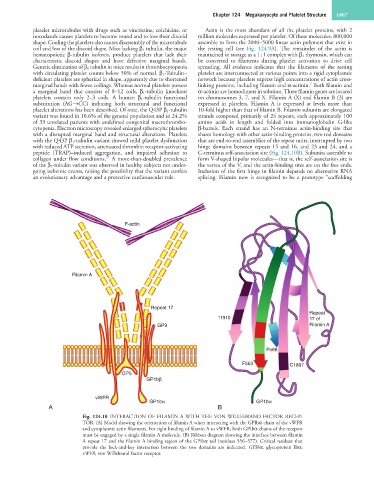
            peptide  (TRAP)–induced  aggregation,  and  impaired  adhesion  to   C-terminus self-association site (Fig. 124.10B). Subunits assemble to
                                    25
            collagen under flow conditions.  A more-than-doubled prevalence   form V-shaped bipolar molecules—that is, the self-association site is
            of the β 1 -tubulin variant was observed in healthy subjects not under-  the vertex of the V, and the actin-binding sites are on the free ends.
            going ischemic events, raising the possibility that the variant confers   Inclusion of the first hinge in filamin depends on alternative RNA
            an evolutionary advantage and a protective cardiovascular role.  splicing.  Filamin now is recognized  to  be  a  prototype “scaffolding


                                          F-actin


                         Filamin A


                                                  Repeat 17
                                                                                                      Repeat
                                                                        11910                         17 of
                                                    GP9                                               Filamin A


                                                                                        F568

                                                                                F563            C1897
                                         GP5
                                                 GP1bβ

                                vWFR
                                                  GP1bα                              GP1bα
                 A                                                      B
                            Fig. 124.10  INTERACTION OF FILAMIN A WITH THE VON WILLEBRAND FACTOR RECEP-
                            TOR. (A) Model showing the orientation of filamin A when interacting with the GPIbα chain of the vWFR
                            and cytoplasmic actin filaments. For tight binding of filamin A to vWFR, both GPIbα chains of the receptor
                            must be engaged by a single filamin A molecule. (B) Ribbon diagram showing the interface between filamin
                            A repeat 17 and the filamin A binding region of the GPIbα tail (residues 556–577). Critical residues that
                            provide  the  lock-and-key  interaction  between  the  two  domains  are  indicated.  GPIbα,  glycoprotein  Ibα;
                            vWFR, von Willebrand factor receptor.

