


Page 2142 - Hematology_ Basic Principles and Practice ( PDFDrive )
P. 2142
1                                                   2


                X


                     IXα


             3                                                   4


                                                           ATIII          ATIII
                  VIIa                                        IIa            Xa            IIa                IIa
                               Va            VIIIa
                               Va
               TF                                               HS            HS              TM           TM
                                 Xa             IXa                                                           PC


              TF•VIIa         Xa•Va         VIIIa•IXa      HS•ATIII•IIa   HS•ATIII•Xa      TM•IIa         TM•IIa•PC
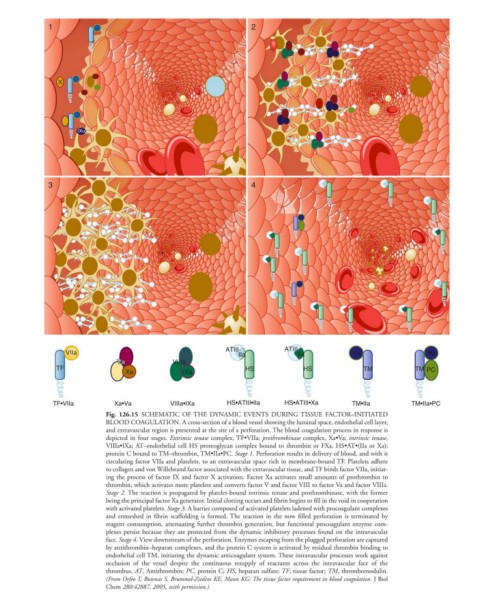
                            Fig.  126.15  SCHEMATIC OF THE DYNAMIC EVENTS DURING TISSUE FACTOR–INITIATED
                            BLOOD COAGULATION. A cross-section of a blood vessel showing the luminal space, endothelial cell layer,
                            and extravascular region is presented at the site of a perforation. The blood coagulation process in response is
                            depicted in four stages. Extrinsic tenase complex, TF•VIIa; prothrombinase complex, Xa•Va; intrinsic tenase,
                            VIIIa•IXa; AT–endothelial cell HS proteoglycan complex bound to thrombin or FXa, HS•AT•(IIa or Xa);
                            protein C bound to TM–thrombin, TM•IIa•PC. Stage 1. Perforation results in delivery of blood, and with it
                            circulating factor VIIa and platelets, to an extravascular space rich in membrane-bound TF. Platelets adhere
                            to collagen and von Willebrand factor associated with the extravascular tissue, and TF binds factor VIIa, initiat-
                            ing the process of factor IX and factor X activation. Factor Xa activates small amounts of prothrombin to
                            thrombin, which activates more platelets and converts factor V and factor VIII to factor Va and factor VIIIa.
                            Stage 2. The reaction is propagated by platelet-bound intrinsic tenase and prothrombinase, with the former
                            being the principal factor Xa generator. Initial clotting occurs and fibrin begins to fill in the void in cooperation
                            with activated platelets. Stage 3. A barrier composed of activated platelets ladened with procoagulant complexes
                            and enmeshed in fibrin scaffolding is formed. The reaction in the now filled perforation is terminated by
                            reagent consumption, attenuating further thrombin generation, but functional procoagulant enzyme com-
                            plexes persist because they are protected from the dynamic inhibitory processes found on the intravascular
                            face. Stage 4. View downstream of the perforation. Enzymes escaping from the plugged perforation are captured
                            by antithrombin–heparan complexes, and the protein C system is activated by residual thrombin binding to
                            endothelial cell TM, initiating the dynamic anticoagulant system. These intravascular processes work against
                            occlusion  of  the  vessel  despite  the  continuous  resupply  of  reactants  across  the  intravascular  face  of  the
                            thrombus. AT, Antithrombin; PC, protein C; HS, heparan sulfate; TF, tissue factor; TM, thrombomodulin.
                            (From Orfeo T, Butenas S, Brummel-Ziedins KE, Mann KG: The tissue factor requirement in blood coagulation. J Biol
                            Chem 280:42887, 2005, with permission.)

