


Page 2138 - Hematology_ Basic Principles and Practice ( PDFDrive )
P. 2138
Chapter 126  Molecular Basis of Blood Coagulation  1899


                           Plasminogen
                                                                     Plasminogen activators:
                                    Plasmin
                                                                          t-PA, u-PA

                           NH 2    AP     K1      K2     K3      K4     K5     Catalytic domain  COOH
                                                                             S     S
                                                                           S            S

                                                                     Plasmin
                           Tissue-plasminogen activator (t-PA)


                           NH 2    Finger domain  EGF       K1     K2     Catalytic domain  COOH

                           Single chain-urokinase plasminogen activator (sc-uPA)
                                           Plasma kallikrein,
                                         plasmin, and cathepsin-L


                           NH 2     EGF      K      Catalytic domain  COOH


                           Thrombin activatable fibrinolysis inhibitor (TAFI)
                                    Plm/GAG
                                     IIa/TM


                           NH 2    AP     Carboxypeptidase domain  COOH
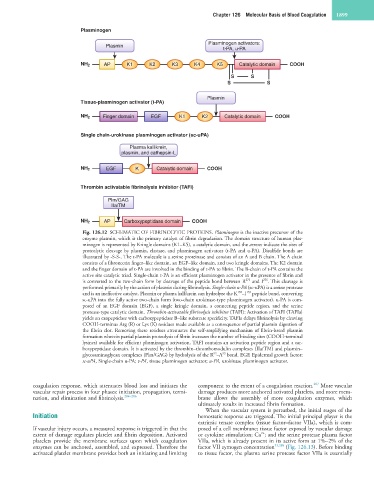
                            Fig. 126.12  SCHEMATIC OF FIBRINOLYTIC PROTEINS. Plasminogen is the inactive precursor of the
                            enzyme plasmin, which is the primary catalyst of fibrin degradation. The domain structure of human plas-
                            minogen is represented by Kringle domains (K1–K5), a catalytic domain, and the arrows indicate the sites of
                            proteolytic cleavage by plasmin, elastase, and plasminogen activators (t-PA and u-PA). Disulfide bonds are
                            illustrated by -S-S-. The t-PA molecule is a serine proteinase and consists of an A and B chain. The A chain
                            consists of a fibronectin finger–like domain, an EGF–like domain, and two kringle domains. The K2 domain
                            and the finger domain of t-PA are involved in the binding of t-PA to fibrin. The B-chain of t-PA contains the
                            active site catalytic triad. Single-chain t-PA is an efficient plasminogen activator in the presence of fibrin and
                                                                                 275
                            is converted to the two-chain form by cleavage of the peptide bond between R  and I . This cleavage is
                                                                                       276
                            performed primarily by the action of plasmin during fibrinolysis. Single-chain u-PA (sc-uPA) is a serine protease
                                                                                  159
                                                                               158
                            and is an ineffective catalyst. Plasmin or plasma kallikrein can hydrolyze the K –I  peptide bond, converting
                            sc-uPA into the fully active two-chain form (two-chain urokinase-type plasminogen activator). u-PA is com-
                            posed  of  an  EGF  domain  (EGF),  a  single  kringle  domain,  a  connecting  peptide  region,  and  the  serine
                            protease-type catalytic domain. Thrombin-activatable fibrinolysis inhibitor (TAFI): Activation of TAFI (TAFIa)
                            yields an exopeptidase with carboxypeptidase B–like substrate specificity. TAFIa delays fibrinolysis by cleaving
                            COOH-terminus Arg (R) or Lys (K) residues made available as a consequence of partial plasmin digestion of
                            the fibrin clot. Removing these residues attenuates the self-amplifying mechanism of fibrin-based plasmin
                            formation wherein partial plasmin proteolysis of fibrin increases the number of binding sites (COOH-terminal
                            lysines) available for efficient plasminogen activation. TAFI contains an activation peptide region and a car-
                            boxypeptidase domain. It is activated by the thrombin–thrombomodulin complexes (IIa/TM) and plasmin–
                                                                       92
                                                                          93
                            glycosaminoglycan complexes (Plm/GAG) by hydrolysis of the R –A  bond. EGF, Epidermal growth factor;
                            sc-uPA, Single-chain u-PA; t-PA, tissue plasminogen activator; u-PA, urokinase plasminogen activator.
                                                                                                        287
            coagulation response, which attenuates blood loss and initiates the   component to the extent of a coagulation reaction.  More vascular
            vascular repair process in four phases: initiation, propagation, termi-  damage produces more anchored activated platelets, and more mem-
            nation, and elimination and fibrinolysis. 284–286     brane  allows  the  assembly  of  more  coagulation  enzymes,  which
                                                                  ultimately results in increased fibrin formation.
                                                                    When the vascular system is perturbed, the initial stages of the
            Initiation                                            hemostatic response are triggered. The initial principal player is the
                                                                  extrinsic tenase complex (tissue factor–factor VIIa), which is com-
            If vascular injury occurs, a measured response is triggered in that the   posed of a cell membrane; tissue factor exposed by vascular damage
                                                                                      2+
            extent of damage regulates platelet and fibrin deposition. Activated   or cytokine stimulation; Ca ; and the serine protease plasma factor
            platelets  provide  the  membrane  surfaces  upon  which  coagulation   VIIa, which is already present in its active form at 1%–2% of the
            enzymes can be anchored, assembled, and expressed. Therefore the   factor VII zymogen concentration 53,288  (Fig. 126.13). Before binding
            activated platelet membrane provides both an initiating and limiting   to tissue factor, the plasma serine protease factor VIIa is essentially

