


Page 2139 - Hematology_ Basic Principles and Practice ( PDFDrive )
P. 2139
1900   Part XII  Hemostasis and Thrombosis


              A                   Initiation                  C                 Termination
                 TF  VIIa                                          VIIa  TFPI
                                              VIIIa              TF  Xa                       VIIIa
                    X  IX                          X                                               X
                                               IXa                                              IXa
                                   IXa                                             IXa
                          Xa


                        Xa                  Xa                           Xa                      Xa = ATIII

                                Va                                               Va
                                     II                                               II
                                 Xa                                                Xa


                                   IIa                                                 IIa = ATIII

              B
                    VIIa  TFPI  Propagation
                 TF                                                               IIa
                     Xa                       VIIIa
                                                   X                            TM  C
                                                IXa
                                   IXa


                        Xa                    Xa
                                Va
                                     II                                            APC
                                 Xa
                                                                                              A 2 NA 2 N
                                                                                              A 2 C
                                                                                                C
                                                                                              A 2
                                                                                        Va
                                   IIa                                                   APC


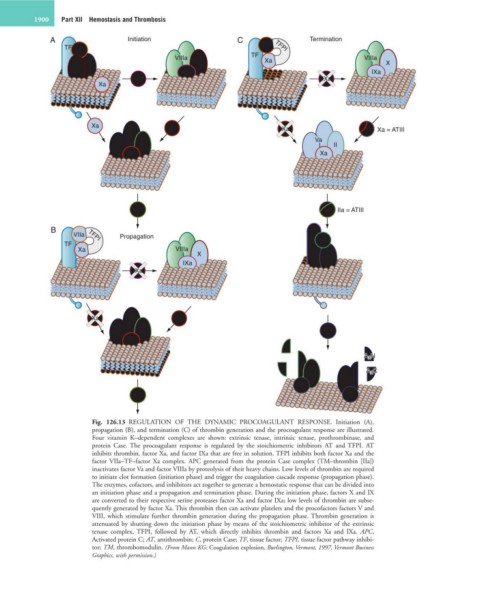
                        Fig.  126.13  REGULATION  OF  THE  DYNAMIC  PROCOAGULANT  RESPONSE.  Initiation  (A),
                        propagation (B), and termination (C) of thrombin generation and the procoagulant response are illustrated.
                        Four  vitamin  K–dependent  complexes  are  shown:  extrinsic  tenase,  intrinsic  tenase,  prothrombinase,  and
                        protein  Case. The  procoagulant  response  is  regulated  by  the  stoichiometric  inhibitors  AT  and TFPI.  AT
                        inhibits thrombin, factor Xa, and factor IXa that are free in solution. TFPI inhibits both factor Xa and the
                        factor VIIa–TF–factor Xa complex. APC generated from the protein Case complex (TM–thrombin [IIa])
                        inactivates factor Va and factor VIIIa by proteolysis of their heavy chains. Low levels of thrombin are required
                        to initiate clot formation (initiation phase) and trigger the coagulation cascade response (propagation phase).
                        The enzymes, cofactors, and inhibitors act together to generate a hemostatic response that can be divided into
                        an initiation phase and a propagation and termination phase. During the initiation phase, factors X and IX
                        are converted to their respective serine proteases factor Xa and factor IXa; low levels of thrombin are subse-
                        quently generated by factor Xa. This thrombin then can activate platelets and the procofactors factors V and
                        VIII, which stimulate further thrombin generation during the propagation phase. Thrombin generation is
                        attenuated by shutting down the initiation phase by means of the stoichiometric inhibitor of the extrinsic
                        tenase  complex, TFPI,  followed  by  AT,  which  directly  inhibits  thrombin  and  factors  Xa  and  IXa.  APC,
                        Activated protein C; AT, antithrombin; C, protein Case; TF, tissue factor; TFPI, tissue factor pathway inhibi-
                        tor; TM, thrombomodulin. (From Mann KG: Coagulation explosion, Burlington, Vermont, 1997, Vermont Business
                        Graphics, with permission.)

