


Page 2137 - Hematology_ Basic Principles and Practice ( PDFDrive )
P. 2137
1898   Part XII  Hemostasis and Thrombosis


                                                          FPA
                                                Thrombin
                                     D   E   D                 D   E   D
                                                 fXIII  fXIII a        D   E   D Solution


                                                          Thrombin
                                                  FPA


                                         D    E   D  D   E   D D   E   D
                                    D   E   D  D   E   D  D   E   D  D   E   D    Initial clot


                                                          Thrombin
                                                  FPA
                                                                     CPB
                                                                FPB       des-Arg FPB


                                    D   E   D  D   E   D  D   E   D  D   E   D
                                 D   E   D D  D  E  E  D  D D  D  E  E  D  D D  D  E  E  D  D  Final clot
                                       D   E   D  D   E   D  D   E   D
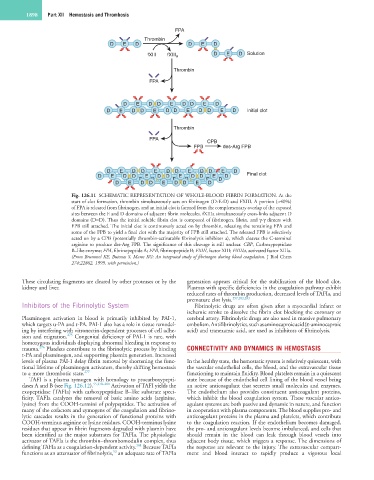
                        Fig. 126.11  SCHEMATIC REPRESENTATION OF WHOLE-BLOOD FIBRIN FORMATION. At the
                        start of clot formation, thrombin simultaneously acts on fibrinogen (D-E-D) and FXIII. A portion (≈40%)
                        of FPA is released from fibrinogen, and an initial clot is formed from the complementary overlap of the exposed
                        sites between the E and D domains of adjacent fibrin molecules. fXIIIa simultaneously cross-links adjacent D
                        domains (D=D). Thus the initial soluble fibrin clot is composed of fibrinogen, fibrin, and γ-γ dimers with
                        FPB still attached. The initial clot is continuously acted on by thrombin, releasing the remaining FPA and
                        some of the FPB to yield a final clot with the majority of FPB still attached. The released FPB is selectively
                        acted on by a CPB (potentially thrombin-activatable fibrinolysis inhibitor a), which cleaves the C-terminal
                        arginine to produce des-Arg FPB. The significance of this cleavage is still unclear. CBP, Carboxypeptidase
                        B–like enzyme; FPA, fibrinopeptide A; FPB, fibrinopeptide B; FXIII, factor XIII; FXIIIa, activated factor XIIIa.
                        (From Brummel KE, Butenas S, Mann KG: An integrated study of fibrinogen during blood coagulation. J Biol Chem
                        274:22862, 1999, with permission.)


        These circulating fragments are cleared by other proteases or by the   generation  appears  critical  for  the  stabilization  of  the  blood  clot.
        kidney and liver.                                     Plasmas with specific deficiencies in the coagulation pathway exhibit
                                                              reduced rates of thrombin production, decreased levels of TAFIa, and
                                                              premature clot lysis. 257,282,283
        Inhibitors of the Fibrinolytic System                    Fibrinolytic  drugs  are  often  given  after  a  myocardial  infarct  or
                                                              ischemic stroke to dissolve the fibrin clot blocking the coronary or
        Plasminogen  activation  in  blood  is  primarily  inhibited  by  PAI-1,   cerebral artery. Fibrinolytic drugs are also used in massive pulmonary
        which targets u-PA and t-PA. PAI-1 also has a role in tissue remodel-  embolism. Antifibrinolytics, such as aminocaproic acid (ε-aminocaproic
        ing by interfering with vitronectin-dependent processes of cell adhe-  acid) and tranexamic acid, are used as inhibitors of fibrinolysis.
                       275
        sion and migration.  Congenital deficiency of PAI-1 is rare, with
        homozygous individuals displaying abnormal bleeding in response to
              276
        trauma.  Platelets contribute to the fibrinolytic process by binding   CONNECTIVITY AND DYNAMICS IN HEMOSTASIS
        t-PA and plasminogen, and supporting plasmin generation. Increased
        levels of plasma PAI-1 delay fibrin removal by shortening the func-  In the healthy state, the hemostatic system is relatively quiescent, with
        tional lifetime of plasminogen activators, thereby shifting hemostasis   the vascular endothelial cells, the blood, and the extravascular tissue
        to a more thrombotic state. 277                       functioning to maintain fluidity. Blood platelets remain in a quiescent
           TAFI is a plasma zymogen with homology to procarboxypepti-  state because of the endothelial cell lining of the blood vessel being
        dases A and B (see Fig. 126.12). 55,278–280  Activation of TAFI yields the   an active anticoagulant that secretes small molecules and enzymes.
        exopeptidase (TAFIa) with carboxypeptidase B–like substrate speci-  The endothelium also provides constituent anticoagulant proteins,
        ficity. TAFIa  catalyzes  the  removal  of  basic  amino  acids  (arginine,   which inhibit the blood coagulation system. These vascular antico-
        lysine) from the COOH-termini of polypeptides. The activation of   agulant systems are both passive and dynamic in nature, and function
        many of the cofactors and zymogens of the coagulation and fibrino-  in cooperation with plasma components. The blood supplies pro- and
        lytic  cascades  results  in  the  generation  of  functional  proteins  with   anticoagulant proteins in the plasma and platelets, which contribute
        COOH-terminus arginine or lysine residues. COOH-terminus lysine   to the coagulation reaction. If the endothelium becomes damaged,
        residues that appear in fibrin fragments degraded with plasmin have   the pro- and anticoagulant levels become imbalanced, and cells that
        been identified as the major substrates for TAFIa. The physiologic   should  remain  in  the  blood  can  leak  through  blood  vessels  into
        activator of TAFIa is the thrombin–thrombomodulin complex, thus   adjacent body tissue, which triggers a response. The dimensions of
                                              281
        defining TAFIa as a coagulation-dependent activity.  Because TAFIa   the response are relevant to the injury. The extravascular compart-
                                      53
        functions as an attenuator of fibrinolysis,  an adequate rate of TAFIa   ment  and  blood  interact  to  rapidly  produce  a  vigorous  local

