


Page 215 - Hematology_ Basic Principles and Practice ( PDFDrive )
P. 215
Chapter 16  Cytokine/Receptor Families and Signal Transduction  167


                           Cytokine


                                                                                                    CD45
                 Cytoplasmic membrane


                                                                          SHP-1
                                                                       p
                                                                         Y                     Y  p

                                                                                       SOCS3
                               JAK        JAK
                           p                    p                           JAK               SOCS1  Y
                            Y                  Y                         CIS              JAK
                                                                  STAT
                                                                                                  STAT
                         STAT                  STAT
                              p              p                             p
                               Y            Y                               Y
                              p               p                                                          STAT
                               Y            Y                             SHP-1                     STAT
                                                                                                           PIAS


                                 p
                                         p           SOCS family of cytokine
                                                        signaling inhibitors
                    Nucleus
                                STAT
                                    STAT
                                                    Transcription                        Proteasome


                                                   Cytokine response genes


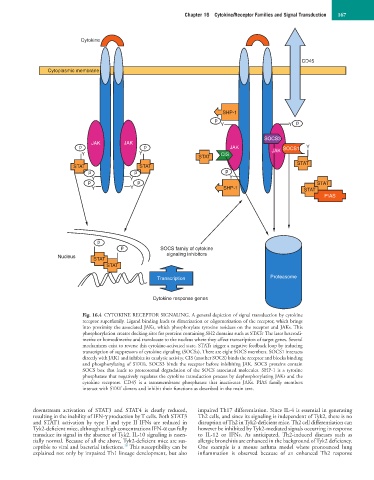
                            Fig. 16.4  CYTOKINE RECEPTOR SIGNALING. A general depiction of signal transduction by cytokine
                            receptor superfamily. Ligand binding leads to dimerization or oligomerization of the receptor, which brings
                            into proximity the associated JAKs, which phosphorylate tyrosine residues on the receptor and JAKs. This
                                                                                       .
                            phosphorylation creates docking sites for proteins containing SH2 domains such as STATs  The later heterodi-
                            merize or homodimerize and translocate to the nucleus where they affect transcription of target genes. Several
                            mechanisms exist to reverse this cytokine-activated state. STATs trigger a negative feedback loop by inducing
                            transcription of suppressors of cytokine signaling (SOCSs). There are eight SOCS members. SOCS1 interacts
                            directly with JAK1 and inhibits its catalytic activity. CIS (another SOCS) binds the receptor and blocks binding
                            and phosphorylating of STATs. SOCS3 binds the receptor before inhibiting JAK. SOCS proteins contain
                            SOCS box that leads to proteosomal degradation of the SOCS associated molecules. SHP-1 is a tyrosine
                            phosphatase that negatively regulates the cytokine transduction process by dephosphorylating JAKs and the
                            cytokine  receptors.  CD45  is  a  transmembrane  phosphatase  that  inactivates  JAKs.  PIAS  family  members
                            interact with STAT dimers and inhibit their functions as described in the main text.


            downstream  activation  of  STAT3  and  STAT4  is  clearly  reduced,   impaired Th17 differentiation. Since IL-4 is essential in generating
            resulting in the inability of IFN-γ production by T cells. Both STAT3   Th2 cells, and since its signaling is independent of Tyk2, there is no
            and  STAT1  activation  by  type  I  and  type  II  IFNs  are  reduced  in   disruption of Th2 in Tyk2-deficient mice. Th2 cell differentiation can
            Tyk2-deficient mice, although at high concentrations IFN-α can fully   however be inhibited by Tyk2-mediated signals occurring in response
            transduce its signal in the absence of Tyk2. IL-10 signaling is essen-  to  IL-12  or  IFNs.  As  anticipated,  Th2-induced  diseases  such  as
            tially normal. Because of all the above, Tyk2-deficient mice are sus-  allergic bronchitis are enhanced in the background of Tyk2 deficiency.
                                          18
            ceptible to viral and bacterial infections.  This susceptibility can be   One  example  is  a  mouse  asthma  model  where  pronounced  lung
            explained not only by impaired Th1 lineage development, but also   inflammation  is  observed  because  of  an  enhanced  Th2  response

