


Page 217 - Hematology_ Basic Principles and Practice ( PDFDrive )
P. 217
Chapter 16  Cytokine/Receptor Families and Signal Transduction  169


                                                     Kinase


                                                                p-kinase
                             “Open”
                                                     SH2
                                                                 FERM


                                                                        SH2


                                                                      10 nm


                                                                        SH2


                                                     p-kinase
                                                                    Kinase
                                                                                         SH2
                             “Closed”
                                                   FERM          SH2


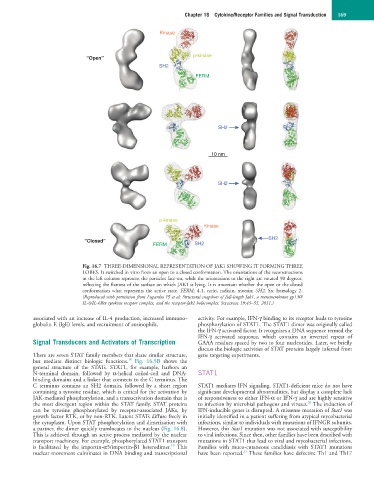
                            Fig. 16.7  THREE-DIMENSIONAL REPRESENTATION OF JAK1 SHOWING IT FORMING THREE
                            LOBES. It switched in vitro from an open to a closed conformation. The orientations of the reconstructions
                            in the left column represent the particles face-on, while the orientations to the right are rotated 90 degrees,
                            reflecting the flatness of the surface on which JAK1 is lying. It is uncertain whether the open or the closed
                            conformation  what  represents  the  active  state.  FERM,  4.1,  ezrin,  radixin,  moesin;  SH2,  Src  homology  2.
                            (Reproduced with permission from Lupardus PJ et al: Structural snapshots of full-length Jak1, a transmembrane gp130/
                            IL-6/IL-6Rα cytokine receptor complex, and the receptor-Jak1 holocomplex. Structure 19:45–55, 2011.)

            associated with an increase of IL-4 production, increased immuno-  activity. For example, IFN-γ binding to its receptor leads to tyrosine
            globulin E (IgE) levels, and recruitment of eosinophils.  phosphorylation of STAT1. The STAT1 dimer was originally called
                                                                  the IFN-γ activated factor. It recognizes a DNA sequence termed the
                                                                  IFN-γ  activated  sequence,  which  contains  an  inverted  repeat  of
            Signal Transducers and Activators of Transcription    GAAA residues spaced by two to four nucleotides. Later, we briefly
                                                                  discuss the biologic activities of STAT proteins largely inferred from
            There are seven STAT family members that share similar structure,   gene targeting experiments.
                                           18
            but  mediate  distinct  biologic  functions.   Fig.  16.5B  shows  the
            general  structure  of  the  STATs.  STAT1,  for  example,  harbors  an
            N-terminal  domain,  followed  by  α-helical  coiled-coil  and  DNA-  STAT1
            binding domains and a linker that connects to the C terminus. The
            C  terminus  contains  an  SH2  domain,  followed  by  a  short  region   STAT1 mediates IFN signaling. STAT1-deficient mice do not have
            containing a tyrosine residue, which is critical for the activation by   significant developmental abnormalities, but display a complete lack
            JAK-mediated phosphorylation, and a transactivation domain that is   of responsiveness to either IFN-α or IFN-γ and are highly sensitive
                                                                                                      20
            the most divergent region within the STAT family. STAT proteins   to infection by microbial pathogens and viruses.  The induction of
            can  be  tyrosine  phosphorylated  by  receptor-associated  JAKs,  by   IFN-inducible genes is disrupted. A missense mutation of Stat1 was
            growth factor RTK, or by non-RTK. Latent STATs diffuse freely in   initially identified in a patient suffering from atypical mycobacterial
            the cytoplasm. Upon STAT phosphorylation and dimerization with   infections, similar to individuals with mutations of IFNGR subunits.
            a partner, the dimer quickly translocates to the nucleus (Fig. 16.8).   However, this Stat1 mutation was not associated with susceptibility
            This is achieved through an active process mediated by the nuclear   to viral infections. Since then, other families have been described with
            transport machinery. For example, phosphorylated STAT1 transport   mutations in STAT1 that lead to viral and mycobacterial infections.
                                                         19
            is  facilitated  by  the  importin-α5/importin-β1  heterodimer.   This   Families  with  muco-cutaneous  candidiasis  with  STAT1  mutations
                                                                                 21
            nuclear movement culminates in DNA binding and transcriptional   have been reported.  These families have defective Th1 and Th17

