


Page 2212 - Hematology_ Basic Principles and Practice ( PDFDrive )
P. 2212
Chapter 132  Thrombocytopenia Caused by Platelet Destruction, Hypersplenism, or Hemodilution  1959


              The  anatomy  of  the  spleen  is  uniquely  suited  for  its  function;   Physiologic Platelet Sequestration
            progressive branching of the splenic artery into trabecular and central
            arteries  helps  separate  the  plasma  from  the  cellular  elements  (see   Radiolabeled platelet studies have shown that approximately 30% of
            Chapter  160).  The  central  arteries  arise  perpendicularly  from  the   the  total  platelet  mass  exists  as  a  freely  exchangeable  pool  in  the
            trabecular arteries and skim the plasma layer from the cells. Soluble   spleen. Because the normal platelet life span is 9–10 days, platelets
            antigens in the plasma are delivered to the white pulp, where phago-  spend approximately one-third of their lives, or 3 days, within the
            cytic cells process them and antibody production is initiated.  spleen. In patients with hypersplenism, up to 90% of the platelets
              A cell-rich, hemoconcentrated fraction of the blood is delivered   can be found in the spleen.
            to the red pulp. Some of this blood flows directly to the splenic veins   After labeled platelets are injected, there is accumulation in both
            (the closed system), but most moves into the splenic cords (the open   the  liver  and  the  spleen.  An  initial,  irreversible  phase  of  hepatic
            system). Here, the cellular elements percolate through a meshwork   uptake occurs. This equilibrates during the first 5 minutes and may
            of reticulum fibers, reticuloendothelial cells, and supporting cells to   reflect  hepatic  clearance  of  platelets  damaged  during  the  labeling
            reach  the  splenic  sinuses.  The  cells  enter  the  sinuses  by  passing   procedure. Simultaneously, there is a slow increase in activity over the
            through  narrow  fenestrations  in  the  basement  membrane  of  the   spleen that peaks in about 20 minutes. Splenic platelet uptake is thus
            endothelial  cells  lining  the  sinuses.  The  blood  exits  through  the   dependent on input (spleen blood flow) and output (clearance).
            splenic vein into the portal system. Because the veins in the portal   The splenic platelet pool size can be decreased and the platelet
            system lack valves, any increase in portal pressure is transmitted to   count increased with intravenous infusions of epinephrine in normal
            the splenic microcirculation.                         persons and in patients with splenomegaly. By contrast, isoprenaline
              The spleen plays a number of important roles. It is the largest   increases  the  splenic  pool  size.  Splenic  blood  flow  increases  with
            lymphoid  organ  in  the  body  and  contributes  to  host  defense  by   increasing  spleen  size,  although  perfusion  (flow  per  unit  of  tissue
            clearing microorganisms and antibody-coated cells. The spleen is also   volume)  falls.  Blood  flow  can  be  increased  in  some  inflammatory
            important  for  antibody  synthesis,  especially  antibodies  directed   disorders (e.g., SLE) without an increase in spleen size. A marked
            against soluble antigens. The filtering function of the spleen includes   increase  or  decrease  in  splenic  perfusion  alters  the  proportion  of
            (1) culling (removal of damaged or senescent cells and bacteria), (2)   platelets within the spleen.
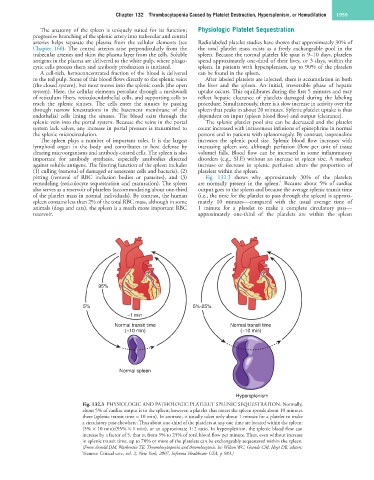
            pitting  (removal  of  RBC  inclusion  bodies  or  parasites),  and  (3)   Fig.  132.3  shows  why  approximately  30%  of  the  platelets
                                                                                             1
            remodeling (reticulocyte sequestration and maturation). The spleen   are  normally  present  in  the  spleen.   Because  about  5%  of  cardiac
            also serves as a reservoir of platelets (accommodating about one-third   output goes to the spleen and because the average splenic transit time
            of the platelet mass in normal individuals). By contrast, the human   (i.e., the time for the platelet to pass through the spleen) is approxi-
            spleen contains less than 2% of the total RBC mass, although in some   mately  10  minutes—compared  with  the  usual  average  time  of
            animals (dogs and cats), the spleen is a much more important RBC   1  minute  for  a  platelet  to  make  a  complete  circulatory  pass—
            reservoir.                                            approximately  one-third  of  the  platelets  are  within  the  spleen


                                 95%


                            5%                                  5%-25%
                                           ~1 min
                                       Normal transit time                  Normal transit time
                                          (~10 min)                             (~10 min)


                                        Normal spleen


                                                                              Hypersplenism
                            Fig. 132.3  PHYSIOLOGIC AND PATHOLOGIC PLATELET SPLENIC SEQUESTRATION. Normally,
                            about 5% of cardiac output is to the spleen; however, a platelet that enters the spleen spends about 10 minutes
                            there (splenic transit time = 10 min). In contrast, it usually takes only about 1 minute for a platelet to make
                            a circulatory pass elsewhere. Thus about one-third of the platelets at any one time are located within the spleen:
                            (5% × 10 min):(95% × 1 min), or an approximate 1 : 2 ratio. In hypersplenism, the splenic blood flow can
                            increase by a factor of 5, that is, from 5% to 25% of total blood flow per minute. Thus, even without increase
                            in splenic transit time, up to 70% or more of the platelets can be exchangeably sequestered within the spleen.
                            (From Arnold DM, Warkentin TE: Thrombocytopenia and thrombocytosis. In: Wilson WC, Grande CM, Hoyt DB, editors:
                            Trauma: Critical care, vol. 2, New York, 2007, Informa Healthcare USA, p 983.)

