


Page 2213 - Hematology_ Basic Principles and Practice ( PDFDrive )
P. 2213
1960   Part XII  Hemostasis and Thrombosis


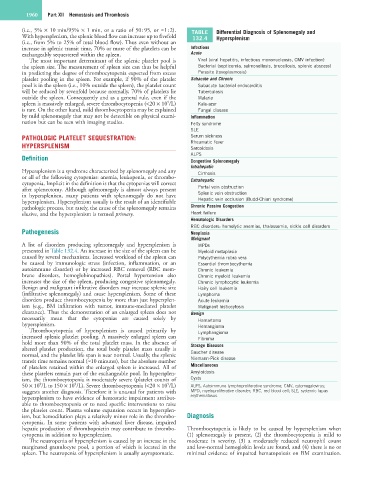
        (i.e., 5% × 10 min/95% × 1 min, or a ratio of 50 : 95, or ≈1 : 2).   TABLE   Differential Diagnosis of Splenomegaly and
        With hypersplenism, the splenic blood flow can increase up to fivefold   132.4  Hypersplenism
        (i.e., from 5% to 25% of total blood flow). Thus even without an
        increase in splenic transit time, 70% or more of the platelets can be   Infections
        exchangeably sequestered within the spleen.            Acute
           The most important determinant of the splenic platelet pool is   Viral (viral hepatitis, infectious mononucleosis, CMV infection)
        the spleen size. The measurement of spleen size can thus be helpful   Bacterial (septicemia, salmonellosis, brucellosis, splenic abscess)
        in predicting the degree of thrombocytopenia expected from excess   Parasite (toxoplasmosis)
        platelet pooling in the spleen. For example, if 90% of the platelet   Subacute and Chronic
        pool is in the spleen (i.e., 10% outside the spleen), the platelet count   Subacute bacterial endocarditis
        will be reduced by sevenfold because normally, 70% of platelets lie   Tuberculosis
        outside the spleen. Consequently and as a general rule, even if the   Malaria
                                                        9
        spleen is massively enlarged, severe thrombocytopenia (<20 × 10 /L)   Kala-azar
        is rare. On the other hand, mild thrombocytopenia may be explained   Fungal disease
        by mild splenomegaly that may not be detectible on physical exami-  Inflammation
        nation but can be seen with imaging studies.           Felty syndrome
                                                               SLE
        PATHOLOGIC PLATELET SEQUESTRATION:                     Serum sickness
        HYPERSPLENISM                                          Rheumatic fever
                                                               Sarcoidosis
                                                               ALPS
        Definition                                             Congestive Splenomegaly
                                                               Intrahepatic
        Hypersplenism is a syndrome characterized by splenomegaly and any   Cirrhosis
        or all of the following cytopenias: anemia, leukopenia, or thrombo-  Extrahepatic
        cytopenia. Implicit in the definition is that the cytopenias will correct
        after splenectomy. Although splenomegaly is almost always present   Portal vein obstruction
        in  hypersplenism,  many  patients  with  splenomegaly  do  not  have   Splenic vein obstruction
        hypersplenism. Hypersplenism usually is the result of an identifiable   Hepatic vein occlusion (Budd-Chiari syndrome)
        pathologic process, but rarely, the cause of the splenomegaly remains   Chronic Passive Congestion
        elusive, and the hypersplenism is termed primary.      Heart failure
                                                               Hematologic Disorders
                                                               RBC disorders: hemolytic anemias, thalassemia, sickle cell disorders
        Pathogenesis                                           Neoplasia
                                                               Malignant
        A  list  of  disorders  producing  splenomegaly  and  hypersplenism  is   MPDs
        presented in Table 132.4. An increase in the size of the spleen can be   Myeloid metaplasia
        caused by several mechanisms. Increased workload of the spleen can   Polycythemia rubra vera
        be  caused  by  immunologic  stress  (infection,  inflammation,  or  an   Essential thrombocythemia
        autoimmune  disorder)  or  by  increased  RBC  removal  (RBC  mem-  Chronic leukemia
        brane  disorders,  hemoglobinopathies).  Portal  hypertension  also   Chronic myeloid leukemia
        increases the size of the spleen, producing congestive splenomegaly.   Chronic lymphocytic leukemia
        Benign and malignant infiltrative disorders may increase splenic size   Hairy cell leukemia
        (infiltrative splenomegaly) and cause hypersplenism. Some of these   Lymphoma
        disorders produce thrombocytopenia by more than just hypersplen-  Acute leukemia
        ism  (e.g.,  BM  infiltration  with  tumor,  immune-mediated  platelet   Malignant histiocytosis
        clearance). Thus the demonstration of an enlarged spleen does not   Benign
        necessarily  mean  that  the  cytopenias  are  caused  solely  by   Hamartoma
        hypersplenism.                                            Hemangioma
           Thrombocytopenia  of  hypersplenism  is  caused  primarily  by   Lymphangioma
        increased splenic platelet pooling. A massively enlarged spleen can   Fibroma
        hold more than 90% of the total platelet mass. In the absence of   Storage Diseases
        altered  platelet  production,  the  total  body  platelet  mass  usually  is
        normal, and the platelet life span is near normal. Usually, the splenic   Gaucher disease
        transit time remains normal (≈10 minutes), but the absolute number   Niemann-Pick disease
        of platelets retained within the enlarged spleen is increased. All of   Miscellaneous
        these platelets remain part of the exchangeable pool. In hypersplen-  Amyloidosis
        ism, the thrombocytopenia is moderately severe (platelet counts of   Cysts
                                                        9
              9
                         9
        50 × 10 /L to 150 × 10 /L). Severe thrombocytopenia (<20 × 10 /L)   ALPS, Autoimmune lymphoproliferative syndrome; CMV, cytomegalovirus;
        suggests another diagnosis. Therefore it is unusual for patients with   MPD, myeloproliferative disorder; RBC, red blood cell; SLE, systemic lupus
        hypersplenism to have evidence of hemostatic impairment attribut-  erythematosus.
        able to thrombocytopenia or to need specific interventions to raise
        the platelet count. Plasma volume expansion occurs in hypersplen-
        ism, but hemodilution plays a relatively minor role in the thrombo-  Diagnosis
        cytopenia.  In  some  patients  with  advanced  liver  disease,  impaired
        hepatic production of thrombopoietin may contribute to thrombo-  Thrombocytopenia  is  likely  to  be  caused  by  hypersplenism  when
        cytopenia in addition to hypersplenism.               (1)  splenomegaly  is  present,  (2)  the  thrombocytopenia  is  mild  to
           The neutropenia of hypersplenism is caused by an increase in the   moderate  in  severity,  (3)  a  moderately  reduced  neutrophil  count
        marginated granulocyte pool, a portion of which is located in the   and low-normal hemoglobin levels are found, and (4) there is no or
        spleen. The neutropenia of hypersplenism is usually asymptomatic.  minimal evidence of impaired hematopoiesis on BM examination.

