


Page 2215 - Hematology_ Basic Principles and Practice ( PDFDrive )
P. 2215
1962   Part XII  Hemostasis and Thrombosis


                          Drug-induced antibody production
                                                                        Platelet clearance by
                                                                         phagocytic cells
                                                      (See enlargement below)


                                                  Ibα                                             Monocyte
                B lymphocyte                                 IIb               IIb

                        Ibα                                            IIIa               IIIa


                                                Ibβ
                                            IX
                               V
                     Ibβ
                 IX
                                                                                                Platelet

                                                                               Neoepitope
                                               Drug–glycoprotein complex  (ligand-induced bonding site)
                                                  e.g., quinine (     )     e.g., eptifibatide (      )
                     Autoantibody        GPIbα, GPIX, GPIIb, and GPIIIa implicated
                     (e.g., gold)
                                                 Platelet activation     Drug binds to GPIIb/IIIa
                       GPV implicated                                    exposing a neoepitope (        )
                                                                         on GPIIIa


                     Procoagulant                                 HIT
                    platelet-derived
                     microparticles                               IgG recognizes PF4 (          ) Bound to heparin (             )
                                                                  FcγIIa receptor (         ) clustering causes platelet activation


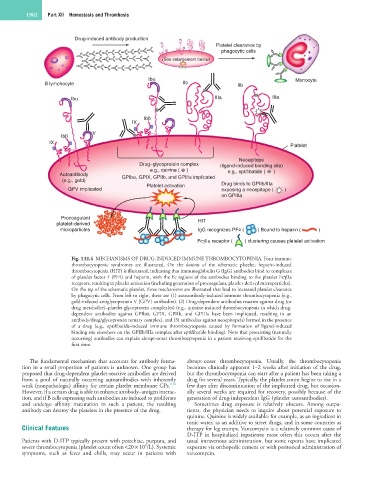
                        Fig. 132.4  MECHANISMS OF DRUG-INDUCED IMMUNE THROMBOCYTOPENIA. Four immune
                        thrombocytopenic  syndromes  are  illustrated.  On  the  bottom  of  the  schematic  platelet,  heparin-induced
                        thrombocytopenia (HIT) is illustrated, indicating that immunoglobulin G (IgG) antibodies bind to complexes
                        of platelet factor 4 (PF4) and heparin, with the Fc regions of the antibodies binding to the platelet FcγIIa
                        receptors, resulting in platelet activation (including generation of procoagulant, platelet-derived microparticles).
                        On the top of the schematic platelet, three mechanisms are illustrated that lead to increased platelet clearance
                        by phagocytic cells. From left to right, these are (1) autoantibody-induced immune thrombocytopenia (e.g.,
                        gold-induced antiglycoprotein V [GPV] antibodies). (2) Drug-dependent antibodies reactive against drug (or
                        drug metabolite)–platelet glycoprotein complex(es) (e.g., quinine-induced thrombocytopenia in which drug-
                        dependent  antibodies  against  GPIbα,  GPIX,  GPIIb,  and  GPIIIa  have  been  implicated,  resulting  in  an
                        antibody/drug/glycoprotein ternary complex), and (3) antibodies against neoepitope(s) formed in the presence
                        of  a  drug  (e.g.,  eptifibatide-induced  immune  thrombocytopenia  caused  by  formation  of  ligand-induced
                        binding site elsewhere on the GPIIb/IIIa complex after eptifibatide binding). Note that preexisting (naturally
                        occurring) antibodies can explain abrupt-onset thrombocytopenia in a patient receiving eptifibatide for the
                        first time.

           The fundamental mechanism that accounts for antibody forma-  abrupt-onset  thrombocytopenia.  Usually,  the  thrombocytopenia
        tion in a small proportion of patients is unknown. One group has   becomes clinically apparent 1–2 weeks after initiation of the drug,
        proposed that drug-dependent platelet-reactive antibodies are derived   but the thrombocytopenia can start after a patient has been taking a
        from  a  pool  of  naturally  occurring  autoantibodies  with  inherently   drug for several years. Typically, the platelet count begins to rise in a
        weak (nonpathologic) affinity for certain platelet membrane GPs. 8,16    few days after discontinuation of the implicated drug, but occasion-
        However, if a certain drug is able to enhance antibody–antigen interac-  ally several weeks are required for recovery, possibly because of the
        tion, and if B cells expressing such antibodies are induced to proliferate   generation of drug-independent IgG (platelet autoantibodies).
        and  undergo  affinity  maturation  in  such  a  patient,  the  resulting   Sometimes  drug  exposure  is  relatively  obscure.  Among  outpa-
        antibody can destroy the platelets in the presence of the drug.  tients,  the  physician  needs  to  inquire  about  potential  exposure  to
                                                              quinine. Quinine is widely available: for example, as an ingredient in
                                                              tonic water, as an additive to street drugs, and in some countries as
        Clinical Features                                     therapy for leg cramps. Vancomycin is a relatively common cause of
                                                              D-ITP  in  hospitalized  inpatients;  most  often  this  occurs  after  the
        Patients with D-ITP typically present with petechiae, purpura, and   usual intravenous administration, but some reports have implicated
                                                9
        severe thrombocytopenia (platelet count often <20 × 10 /L). Systemic   exposure via orthopedic cement or with peritoneal administration of
        symptoms,  such  as  fever  and  chills,  may  occur  in  patients  with   vancomycin.

