


Page 2234 - Hematology_ Basic Principles and Practice ( PDFDrive )
P. 2234
Chapter 133  Heparin-Induced Thrombocytopenia  1981


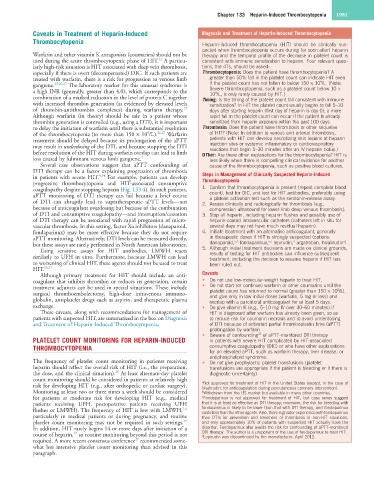
            Caveats in Treatment of Heparin-Induced                Diagnosis and Treatment of Heparin-Induced Thrombocytopenia
            Thrombocytopenia                                       Heparin-induced  thrombocytopenia  (HIT)  should  be  clinically  sus-
                                                                   pected when thrombocytopenia occurs during (or soon after) heparin
            Warfarin and other vitamin K antagonists (coumarins) should not be   therapy and the temporal profile of the decrease in platelet count is
                                                     12
            used during the acute thrombocytopenic phase of HIT.  A particu-  consistent with immune sensitization to heparin. Four relevant ques-
            larly high-risk situation is HIT associated with deep vein thrombosis,   tions, the 4Ts, should be asked:
            especially if there is overt (decompensated) DIC. If such patients are   Thrombocytopenia: Does the patient have thrombocytopenia? A
            treated with warfarin, there is a risk for progression to venous limb   greater than 50% fall in the platelet count can indicate HIT even
                                                                                                          9
            gangrene. 12,26,27  The laboratory marker for this unusual syndrome is   if the platelet count has not fallen to below 150 × 10 /L. (Note:
            a high INR (generally, greater than 4.0), which corresponds to the   Severe thrombocytopenia, such as a platelet count below 10 ×
                                                                      10 /L, is only rarely caused by HIT.)
                                                                       9
            combination of a marked reduction in the level of protein C together   Timing: Is the timing of the platelet count fall consistent with immune
            with increased thrombin generation (as evidenced by elevated levels   sensitization? In HIT the platelet count usually begins to fall 5–10
                                                             12
            of  thrombin-antithrombin  complexes)  during  warfarin  therapy.    days after starting heparin (first day of heparin is day 0); a more
            Although  warfarin  (in  theory)  should  be  safe  in  a  patient  whose   rapid fall in the platelet count can occur if the patient is already
            thrombin generation is controlled (e.g., using a DTI), it is important   sensitized from heparin exposure within the past 100 days.
            to delay the initiation of warfarin until there is substantial resolution   Thrombosis: Does the patient have thrombosis or other sequelae
                                                 9
            of the thrombocytopenia (to more than 150 × 10 /L). 26,27  Warfarin   of HIT? (Note: In addition to venous and arterial thrombosis,
            treatment should be delayed because its prolongation of the aPTT   patients with HIT can develop necrotizing skin lesions at heparin
            may result in underdosing of the DTI, and because stopping the DTI   injection sites or systemic inflammatory or cardiorespiratory
                                                                      reactions that begin 5–30 minutes after an IV heparin bolus.)
            before resolution of the HIT during warfarin overlap can lead to limb   OTher: Are there other explanations for the thrombocytopenia? HIT is
            loss caused by fulminant venous limb gangrene. 4          less likely when there is compelling clinical evidence for another
              Several  case  observations  suggest  that  aPTT  confounding  of   cause of the thrombocytopenia, such as positive blood cultures.
            DTI therapy can be a factor explaining progression of thrombosis
            in  patients  with  severe  HIT. 4,34   For  example,  patients  can  develop   Steps in Management of Clinically Suspected Heparin-Induced
            progressive  thrombocytopenia  and  HIT-associated  consumptive   Thrombocytopenia
            coagulopathy despite stopping heparin (Fig. 133.4). In such patients,   1.  Confirm that thrombocytopenia is present (repeat complete blood
            aPTT  monitoring  of  DTI  therapy  can  fail  because  a  brief  course   count), test for DIC, and test for HIT antibodies, preferably using
                                                                      a platelet activation test such as the serotonin-release assay.
            of  DTI  can  abruptly  lead  to  supratherapeutic  aPTT  levels—not   2.  Assess clinically and radiologically for thrombosis (e.g.,
            because of anticoagulant overdosing but because of the combination   compression ultrasound for lower-limb deep venous thrombosis).
            of DTI and consumptive coagulopathy—and interruption/cessation   3.  Stop all heparin, including heparin flushes and possibly use of
            of DTI therapy can be associated with rapid progression of micro-  heparin-coated intravascular catheters (catheters left in situ for
            vascular thrombosis. In this setting, factor Xa inhibitors (danaparoid,   several days may not have much residual heparin).
            fondaparinux)  may  be  more  effective  because  they  do  not  require   4.  Initiate treatment with an alternative anticoagulant, generally
            aPTT monitoring. Alternatively, DTI levels can be measured directly,   in therapeutic doses if HIT is strongly suspected (options:   a
                                                                                         a,c
                                                                              a,b
                                                                                                 d
            but these assays are rarely performed in North American laboratories.  danaparoid,  fondaparinux,  lepirudin,  argatroban, bivalirudin ).
              Using  sensitive  assays  for  HIT  antibodies,  LMWH  reacts   5.  Although initial treatment decisions are made on clinical grounds,
            similarly to UFH in vitro. Furthermore, because LMWH can lead   results of testing for HIT antibodies can influence subsequent
                                                                      treatment, including the decision to resume heparin if HIT has
            to worsening of clinical HIT, these agents should not be used to treat     been ruled out.
            HIT. 26,27
              Although  primary  treatment  for  HIT  should  include  an  anti-  Caveats
            coagulant that inhibits thrombin or reduces its generation, certain   •  Do not use low-molecular-weight heparin to treat HIT.
            treatment adjuncts can be used in special situations. These include   •  Do not start (or continue) warfarin or other coumarins until the
                                                                                                               9
            surgical  thromboembolectomy,  high-dose  intravenous  immuno-  platelet count has returned to normal (greater than 150 × 10 /L),
                                                                      and give only in low initial doses (warfarin, 5 mg or less) and
            globulin, antiplatelet drugs such as aspirin, and therapeutic plasma   overlap with a parenteral anticoagulant for at least 5 days.
            exchange.                                              •  Do give vitamin K (e.g., 5–10 mg IV over 30–60 minutes) if
              These caveats, along with recommendations for management of   HIT is diagnosed after warfarin has already been given, so as
            patients with suspected HIT, are summarized in the box on Diagnosis   to reduce risk for coumarin necrosis and to avoid underdosing
            and Treatment of Heparin-Induced Thrombocytopenia.        of DTI because of activated partial thromboplastin time (aPTT)
                                                                      prolongation by warfarin.
                                                                                     34
                                                                   •  Beware of confounding  of aPTT-monitored DTI therapy
            PLATELET COUNT MONITORING FOR HEPARIN-INDUCED             in patients with severe HIT complicated by HIT-associated
            THROMBOCYTOPENIA                                          consumptive coagulopathy (DIC) or who have other explanations
                                                                      for an elevated aPTT, such as warfarin therapy, liver disease, or
                                                                      antiphospholipid syndrome.
            The  frequency  of  platelet  count  monitoring  in  patients  receiving   •  Do not give prophylactic platelet transfusions (platelet
            heparin should reflect the overall risk of HIT (i.e., the preparation,   transfusions are appropriate if the patient is bleeding or if there is
                                       26
            the dose, and the clinical situation).  At least alternate-day platelet   diagnostic uncertainty).
            count monitoring should be considered in patients at relatively high   a
                                                                    Not approved for treatment of HIT in the United States (except, in the case of
            risk for developing HIT (e.g., after orthopedic or cardiac surgery).   bivalirudin, for anticoagulation during percutaneous coronary intervention).
            Monitoring at least two or three times a week should be considered   b Withdrawn from the US market but available in many other countries.
            for  patients  at  moderate  risk  for  developing  HIT  (e.g.,  medical   c Fondaparinux  is  not  approved  for  treatment  of  HIT,  but  case  series  suggest
            patients  receiving  UFH,  postoperative  patients  receiving  UFH   that it is at least as effective as DTI therapy; moreover, the risk for bleeding with
                                                             1,6
            flushes or LMWH). The frequency of HIT is low with LMWH,    fondaparinux is likely to be lower than that with DTI therapy, and fondaparinux
                                                                   costs less than the other agents. Also, there is greater experience with fondaparinux
            particularly  in  medical  patients  or  during  pregnancy,  and  routine   than  DTIs  for  prevention  and  treatment  of  thrombosis  in  non-HIT  situations,
                                                             26
            platelet  count  monitoring  may  not  be  required  in  such  settings.    and only approximately 10% of patients with suspected HIT actually have the
            In addition, HIT rarely begins 14 or more days after initiation of a   disorder. Fondaparinux also avoids the risk for confounding of aPTT-monitored
                         17
            course of heparin,  so routine monitoring beyond this period is not   DTI therapy. The author is a proponent of the use of fondaparinux to treat HIT.
                                                                    Lepirudin was discontinued by the manufacturer, April 2012.
                                                                   d
                                             27
            required. A more recent consensus conference  recommended some-
            what  less  intensive  platelet  count  monitoring  than  advised  in  this
            paragraph.

