


Page 2261 - Hematology_ Basic Principles and Practice ( PDFDrive )
P. 2261
2008   Part XII  Hemostasis and Thrombosis


        mild deficiency state of all of the vitamin K–dependent proteins is
        an  inherited  defect  in  the  γ-carboxylase  enzyme  required  for  the
        posttranslational modification of these proteins.

        CLINICAL FEATURES OF HEMOPHILIA

        The clinical symptoms and signs of hemophilia A and B are essentially
        identical  and  relate  to  the  propensity  for  prolonged  and  excessive
        bleeding. The bleeding tendency in hemophilia is determined in large
        part by the baseline activity level of the deficient or defective clotting
        factor. Thus in severe hemophilia (A and B), in which the baseline
        activity level of clotting factor is below 1% (0.01 IU/mL), spontane-
        ous bleeding usually occurs multiple times each year. With a moderate
        factor deficiency state of 1% to 5% (0.01–0.05 IU/mL), spontaneous
        bleeding is typically infrequent, but excessive and prolonged bleeding
        can occur with trauma and invasive surgical or dental procedures.
        Finally,  in  mild  disease,  with  factor  levels  of  5%  to  40%  (0.05–
        0.40 IU/ml),  excessive  bleeding  is  usually  only  documented  with
        trauma or invasive procedures.
           Pathologic bleeding can occur in the neonatal period, when intra-
        cranial  bleeding  can  develop  after  traumatic  delivery,  especially  in
        infants  with  severe  hemophilia.  However,  most  frequently,  severe
        disease manifests with easy bruising or soft tissue or joint bleeding
        between 6 and 18 months of age when the young child becomes more
        mobile. In mild hemophilia, the disease may remain silent for many
        years, and occasionally a new diagnosis of hemophilia may be made
        in those older than 60 years of age when challenged with a surgical
        procedure.
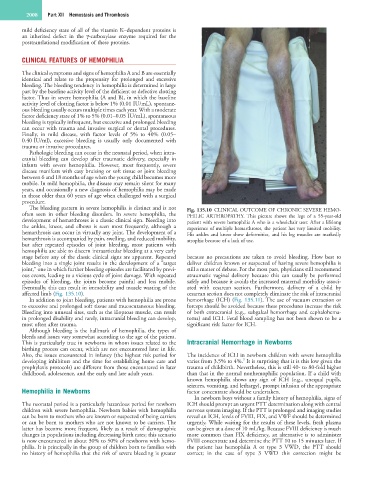
           The bleeding pattern in severe hemophilia is distinct and is not   Fig. 135.10  CLINICAL OUTCOME OF CHRONIC SEVERE HEMO-
        often  seen  in  other  bleeding  disorders.  In  severe  hemophilia,  the   PHILIC  ARTHROPATHY.  This  picture  shows  the  legs  of  a  55-year-old
        development of hemarthroses is a classic clinical sign. Bleeding into   patient with severe hemophilia A who is a wheelchair user. After a lifelong
        the  ankles,  knees,  and  elbows  is  seen  most  frequently,  although  a   experience of multiple hemarthroses, the patient has very limited mobility.
        hemarthrosis can occur in virtually any joint. The development of a   His  ankles  and  knees  show  deformities,  and  his  leg  muscles  are  markedly
        hemarthrosis is accompanied by pain, swelling, and reduced mobility,   atrophic because of a lack of use.
        but  after  repeated  episodes  of  joint  bleeding,  most  patients  with
        hemophilia are able to discern intraarticular bleeding at a very early
        stage before any of the classic clinical signs are apparent. Repeated   because  no  precautions  are  taken  to  avoid  bleeding.  How  best  to
        bleeding into a single joint results in the development of a “target   deliver children known or suspected of having severe hemophilia is
        joint,” one in which further bleeding episodes are facilitated by previ-  still a matter of debate. For the most part, physicians still recommend
        ous events, leading to a vicious cycle of joint damage. With repeated   atraumatic  vaginal  delivery  because  this  can  usually  be  performed
        episodes  of  bleeding,  the  joints  become  painful  and  less  mobile.   safely and because it avoids the increased maternal morbidity associ-
        Eventually, this can result in immobility and muscle wasting of the   ated  with  cesarean  section.  Furthermore,  delivery  of  a  child  by
        affected limb (Fig. 135.10).                          cesarean section does not completely eliminate the risk of intracranial
           In addition to joint bleeding, patients with hemophilia are prone   hemorrhage (ICH) (Fig. 135.11). The use of vacuum extraction or
        to excessive and prolonged soft tissue and mucocutaneous bleeding.   forceps should be avoided because these procedures increase the risk
        Bleeding into unusual sites, such as the iliopsoas muscle, can result   of both extracranial (e.g., subgaleal hemorrhage and cephalohema-
        in prolonged disability and rarely, intracranial bleeding can develop,   toma) and ICH. Fetal blood sampling has not been shown to be a
        most often after trauma.                              significant risk factor for ICH.
           Although  bleeding  is  the  hallmark  of  hemophilia,  the  types  of
        bleeds and issues vary somewhat according to the age of the patient.
        This is particularly true in newborns in whom issues related to the   Intracranial Hemorrhage in Newborns
        birthing process can occur, which are not encountered later in life.
        Also, the issues encountered in infancy (the highest risk period for   The incidence of ICH in newborn children with severe hemophilia
                                                                                 9
        developing inhibitors and the time for establishing home care and   varies from 3.5% to 4%.  It is surprising that it is this low given the
        prophylaxis protocols) are different from those encountered in later   trauma of childbirth. Nevertheless, this is still 40- to 80-fold higher
        childhood, adolescence, and the early and late adult years.  than that in the normal nonhemophilic population. If a child with
                                                              known  hemophilia  shows  any  sign  of  ICH  (e.g.,  unequal  pupils,
                                                              seizures, vomiting, and lethargy), prompt infusion of the appropriate
        Hemophilia in Newborns                                factor concentrate should be undertaken.
                                                                 In newborn boys without a family history of hemophilia, signs of
        The neonatal period is a particularly hazardous period for newborn   ICH should prompt an urgent PTT determination along with central
        children with severe hemophilia. Newborn babies with hemophilia   nervous system imaging. If the PTT is prolonged and imaging studies
        can be born to mothers who are known or suspected of being carriers   reveal an ICH, levels of FVIII, FIX, and VWF should be determined
        or can be born to mothers who are not known to be carriers. The   urgently. While waiting for the results of these levels, fresh plasma
        latter has become more frequent, likely as a result of demographic   can be given at a dose of 10 mL/kg. Because FVIII deficiency is much
        changes in populations including decreasing birth rates; this scenario   more common than FIX deficiency, an alternative is to administer
        is now encountered in about 30% to 50% of newborns with hemo-  FVIII concentrate and determine the PTT 10 to 15 minutes later. If
        philia. It is principally in the group of children born to families with   the  patient  has  hemophilia  A  or  type  3  VWD,  the  PTT  should
        no history of hemophilia that the risk of severe bleeding is greater   correct;  in  the  case  of  type  3  VWD  this  correction  might  be

