


Page 2316 - Hematology_ Basic Principles and Practice ( PDFDrive )
P. 2316
2058   Part XII  Hemostasis and Thrombosis

        Clinical Manifestations                                  Type  1  VWD  accounts  for  up  to  70%  of  VWD.  It  typically
                                                              manifests as mild mucocutaneous bleeding; however, symptoms may
        The bleeding history depends on disease severity; type 3 VWD is   be  more  severe  if  VWF  levels  are  below  15 IU/dL.  Epistaxis  and
        often diagnosed early in life, whereas mild type 1 VWD may not be   bruising are common symptoms in children. Menorrhagia is the most
        diagnosed until adulthood. Individuals with VWD primarily com-  common finding in women of reproductive age.
        plain  of  excessive  mucocutaneous  bleeding,  such  as  spontaneous,   Type 2 VWD accounts for about 25% of all VWD. The relative
        recurrent epistaxis, and prolonged bleeding after dental cleaning or   frequency of the subtypes is 2A > 2N > 2M > 2B in European popula-
        extraction. In addition, prolonged or excessive bleeding after surgery   tions. Individuals with type 2A, 2B, and 2M VWD usually present
        or trauma is often reported. Affected females frequently experience   with mild to moderate mucocutaneous bleeding, but bleeding epi-
        menorrhagia from the time of menarche, and can have prolonged or   sodes  can  be  severe,  particularly  when  VWF : RCo  is  very  low  or
        excessive  bleeding  after  childbirth.  Musculoskeletal  bleeding  is   absent. In many patients with type 2B VWD, thrombocytopenia can
        unusual, except in type 2N or type 3 VWD when the FVIII : C level   develop or worsen with infection, surgery, pregnancy, or treatment
        may be below 10 IU/dL. Bleeding assessment tools (BATs) help to   with DDAVP. The symptoms of type 2N VWD are similar to those
        standardize and quantify the bleeding history. BATs are helpful for   seen in mild hemophilia A (see Chapter 135) because both disorders
        making a VWD diagnosis. In addition, high scores are predictive of   are associated with reduced levels of FVIII : C.
        the risk of future bleeding. (see Chapter 128)           Type 3 VWD is the rarest subtype and accounts for less than 5%
                                                              of VWD. Prevalence estimates range from 0.55 to 6 per million, with
                                                              higher rates seen with consanguineous marriage. Type 3 VWD mani-
         Example of the Presentation and Impact of Type 1 von    fests with severe bleeding, including excessive mucocutaneous bleed-
         Willebrand Disease                                   ing and musculoskeletal bleeding.
          J.C., a 26-year-old female, presents with delayed postpartum hemor-
          rhage (PPH) after the delivery of her first child. The pregnancy and   Penetrance
          delivery were unremarkable. One week postpartum, the patient expe-
          rienced heavy bleeding, and required a dilation and curettage. At the   In autosomal dominant type 1 VWD, mutations resulting in plasma
          same time, she was started on tranexamic acid, which was continued   VWF  level  less  than  25 IU/dL  are  often  fully  penetrant,  whereas
          for 2 weeks. By approximately 3 weeks postpartum, there was com-  those resulting in higher VWF levels are often incompletely penetrant.
          plete cessation of bleeding. A bleeding history was significant for the
          following: excessive postsurgical bleeding following tonsillectomy and   Mutations responsible for autosomal dominant types of VWD (2A,
          adenoidectomy, which required red blood cell transfusion; excessive   2B, and 2M) are often fully penetrant. Thus in contrast to the vari-
          bleeding postdental extractions, requiring consultation with the dentist   ably positive family histories in patients with type 1 VWD, those
          and repacking; and menorrhagia from the time of menarche, which   with type 2 VWD usually have a positive family history.
          had  been  well  controlled  with  the  combined  oral  contraceptive  pill.
          There was no family history of VWD. Investigations revealed VWF : Ag
          0.40 IU/dL, VWF : RCo 0 : 39 IU/dL, and FVIII : C 0.60 IU/dL. Multimer   Laboratory Investigations
          gel  was  unremarkable.  A  DDAVP  challenge  demonstrated  that  the
          patient was a responder. She became pregnant again 4 years later. At   The laboratory evaluation for VWD involves a battery of qualitative
          the time of delivery she was treated with tranexamic acid and a dose
          of  DDAVP  after  the  cord  was  clamped.  Her  postpartum  course  was   and quantitative measurements of VWF and FVIII that should be
          uncomplicated.                                      interpreted  by  a  physician  with  experience  in  this  area  given  the
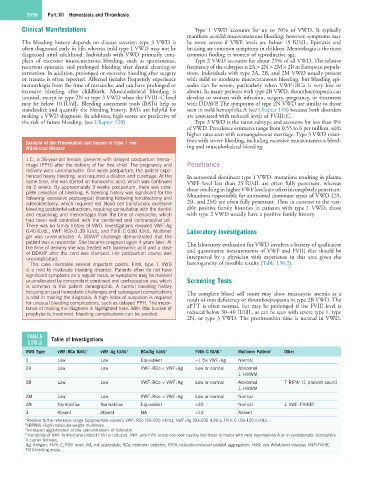
           This  case  illustrates  several  important  points.  First,  type  1  VWD   heterogeneity of possible results (Table 138.2).
          is  a  mild  to  moderate  bleeding  disorder.  Patients  often  do  not  have
          significant symptoms on a regular basis, or symptoms may be masked
          or ameliorated by concomitant combined oral contraceptive use, which   Screening Tests
          is  common  in  this  patient  demographic.  A  careful  bleeding  history
          focusing on past hemostatic challenges and subsequent complications   The  complete  blood  cell  count  may  show  microcytic  anemia  as  a
          is vital in making the diagnosis. A high index of suspicion is required   result of iron deficiency or thrombocytopenia in type 2B VWD. The
          for unusual bleeding complications, such as delayed PPH. The impor-
          tance of making the diagnosis is highlighted here. With little burden of   aPTT is often normal, but may be prolonged if the FVIII level is
          prophylactic treatment, bleeding complications can be avoided.  reduced below 30–40 IU/dL, as can be seen with severe type 1, type
                                                              2N, or type 3 VWD. The prothrombin time is normal in VWD.


          TABLE   Table of Investigations
          138.2
         VWD Type   vWF : RCo IU/dL a  vWF : Ag IU/dL a  RCo/Ag IU/dL a  FVIII : C IU/dL a  Multimer Pattern b  Other
         1          Low           Low          Equivalent        ~1.5× VWF : Ag  Normal
         2A         Low           Low          VWF : RCo < VWF : Ag  Low or normal  Abnormal
                                                                               ↓ HMWM
                                                                                                   c
         2B         Low           Low          VWF : RCo < VWF : Ag  Low or normal  Abnormal  ↑ RIPA  (↓ platelet count)
                                                                               ↓ HMWM
         2M         Low           Low          VWF : RCo < VWF : Ag  Low or normal  Normal
         2N         Normal/low    Normal/low   Equivalent        <30           Normal         ↓ VWF : FVIIIB d
         3          Absent        Absent       NA                <10           Absent
         a Relative to the reference range (approximate values); VWF : RCo (50–200 IU/dL); VWF : Ag (50–200 IU/dL); FVIII : C (50–150 IU/dL).
         b HMWM, High-molecular-weight multimers.
         c Increased agglutination at low concentrations of ristocetin.
         d The ability of VWF to bind and protect FVIII is reduced. VWF and FVIII levels can look exactly like those in males with mild haemophilia A or in symptomatic hemophilia
         A carrier females.
         Ag, Antigen, FVIII : C, FVIII level; NA, not applicable; RCo, ristocetin cofactor; RIPA, ristocetin-induced platelet aggregation; VWD, von Willebrand disease; VWF:FVIIIB,
         FVIII-binding assay.

