


Page 2564 - Hematology_ Basic Principles and Practice ( PDFDrive )
P. 2564
Chapter 158  Hematologic Aspects of Parasitic Diseases  2287


            procedure is examination of thick and thin blood films by an expert   Artemisinin-based combination treatments have been the main-
            to detect and speciate the malarial parasites. However, P. falciparum   stay of treatment for falciparum malaria in Southeast Asia for more
            and P. vivax malaria can be diagnosed almost as accurately using rapid   than  10  years  and  are  now  recommended  as  first-line  treatment
                                                                                         122
            diagnostic tests (RDTs) that detect plasmodial antigens, depending   throughout the rest of the world.  However, resistance to these drugs
            upon the product. However, RDTs for other Plasmodium species are   is emerging, and very young children (particularly those underweight
            not as reliable. 116                                  for age), patients with high parasitemias, and patients in very low
              Amplification  of  circulating  parasite  DNA  using  the  repeated   transmission intensity areas with emerging parasite resistance are at
            ribosomal RNA (rRNA) genes is an extremely sensitive method of   risk for treatment failure and should be monitored closely. 120,121  The
                          117
            malaria  diagnosis.   The  sensitivity  may  be  as  low  as  0.005   hematologic side effects of antimalarial drugs in use today are few.
            parasites/µL or 5 parasites/mL. 118,119  Undoubtedly, this is a useful tool   Amodiaquine  is  associated  with  neutropenia  and  agranulocytosis.
            for reference laboratories and epidemiologic surveys.  Artemisinin-based  treatments  may  cause  reticulocytopenia  and
                                                                  hemolysis in approximately 10% to 15% patients following intrave-
                                                                  nous  artesunate  treatment.  Hemoglobin  concentrations  should  be
            Treatment                                             checked approximately 14 days following treatment in those treated
                                                                  with intravenous artemisinins. 116
            Malaria requires urgent effective chemotherapy to prevent progres-  In severely ill patients, good nursing care is vital. Monitoring and
            sion of disease and may be the most crucial public health intervention   treatment  of  fits  and  hypoglycemia  are  essential,  and  antipyretics
                                                                               123
            to  reduce  global  mortality  from  malaria.  The  drug  treatment  of   should  be  given.   Certainly,  blood  transfusion  is  in  principle  a
            malaria must take account of the expected pattern of drug resistance   straightforward solution to the treatment of severe malarial anemia,
            in the area where infection was contracted, the severity of clinical   although controversy exists over the trigger for transfusion and the
            disease, and the species of parasite. The spread of drug-resistant para-  rate of administration of blood. The standard regimens of cautious
            sites and the optimal use of affordable, effective drugs are of continual   and slow delivery of blood have been challenged by the demonstra-
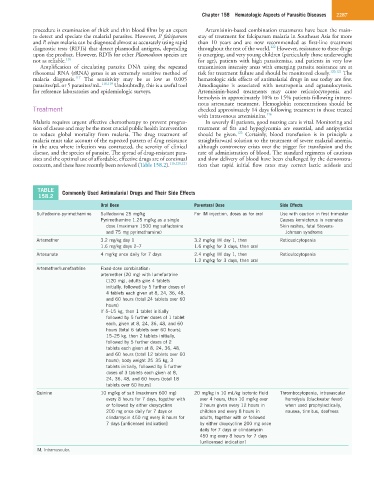
            concern, and these have recently been reviewed (Table 158.2). 116,120,121  tion  that  rapid  initial  flow  rates  may  correct  lactic  acidosis  and


             TABLE   Commonly Used Antimalarial Drugs and Their Side Effects
              158.2
                                  Oral Dose                      Parenteral Dose             Side Effects
             Sulfadoxine-pyrimethamine  Sulfadoxine 25 mg/kg     For IM injection, doses as for oral  Use with caution in first trimester
                                  Pyrimethamine 1.25 mg/kg as a single                       Causes kernicterus in neonates
                                    dose (maximum 1500 mg sulfadoxine                        Skin rashes, fatal Stevens-
                                    and 75 mg pyrimethamine)                                  Johnson syndrome
             Artemether           3.2 mg/kg day 1                3.2 mg/kg IM day 1, then    Reticuolcytopenia
                                  1.6 mg/kg days 2–7             1.6 mg/kg for 3 days, then oral
             Artesunate           4 mg/kg once daily for 7 days  2.4 mg/kg IM day 1, then    Reticulocytopenia
                                                                 1.2 mg/kg for 3 days, then oral
             Artemether/lumefantrine  Fixed-dose combination:
                                  artemether (20 mg) with lumefantrine
                                    (120 mg), adults give 4 tablets
                                    initially, followed by 5 further doses of
                                    4 tablets each given at 8, 24, 36, 48,
                                    and 60 hours (total 24 tablets over 60
                                    hours)
                                  If 5–15 kg, then 1 tablet initially
                                    followed by 5 further doses of 1 tablet
                                    each, given at 8, 24, 36, 48, and 60
                                    hours (total 6 tablets over 60 hours);
                                    15–25 kg, then 2 tablets initially,
                                    followed by 5 further doses of 2
                                    tablets each given at 8, 24, 36, 48,
                                    and 60 hours (total 12 tablets over 60
                                    hours); body weight 25–35 kg, 3
                                    tablets initially, followed by 5 further
                                    doses of 3 tablets each given at 8,
                                    24, 36, 48, and 60 hours (total 18
                                    tablets over 60 hours)
             Quinine              10 mg/kg of salt (maximum 600 mg)   20 mg/kg in 10 mL/kg isotonic fluid   Thrombocytopenia, intravascular
                                    every 8 hours for 7 days, together with   over 4 hours, then 10 mg/kg over   hemolysis (blackwater fever)
                                    or followed by either doxycycline   2 hours given every 12 hours in   when used prophylactically,
                                    200 mg once daily for 7 days or   children and every 8 hours in   nausea, tinnitus, deafness
                                    clindamycin 450 mg every 8 hours for   adults, together with or followed
                                    7 days [unlicensed indication]  by either doxycycline 200 mg once
                                                                  daily for 7 days or clindamycin
                                                                  450 mg every 8 hours for 7 days
                                                                  [unlicensed indication]
             IM, Intramuscular.

