


Page 2565 - Hematology_ Basic Principles and Practice ( PDFDrive )
P. 2565
2288   Part XIII  Consultative Hematology


        hypovolemia.  However,  in  nonimmune  patients  and  in  pregnant   TABLE   UK Donor Selection Guidelines for Donors at Risk of
        women, blood transfusion must be accompanied by careful hemody-  158.3  Transmitting Malaria
        namic monitoring to avoid precipitating or exacerbating pulmonary
        edema. A recent randomized clinical trial showed that red cell longer-  Donor Risk Category  Guidelines
        storage RBC units are not inferior to shorter-storage RBC units for   Resident  Defined as having lived in sub-Saharan Africa
        tissue oxygenation as measured by reduction in blood lactate levels      (except South Africa) or Papua New Guinea
        and improvement in cerebral tissue oxygen saturation among children      for a continuous period of 6 months at any
        with severe anemia. 124                                                  time of life
           Whatever clinical guidelines emerge, in reality blood transfusion   Permanent deferral unless malaria antibody test
        in the heartland of malaria-endemic areas is beset by many practical     results are negative at least 6 months after
        and theoretic problems. First, the absence of well-characterized donor   returning from a malarious area
        panels (and thus systematic blood collection) frequently jeopardizes   Any subsequent visits to any malarious area
        the  supply  of  blood.  Second,  even  when  standard  screening  for   each require a 6-month deferral period and
        human immunodeficiency virus (HIV) is in place, the residual risk        negative antibody test results before
        for HIV transmission in the serologic window of infectivity remains      reinstatement
        at  1  in  2500  to  1  in  6000.  At  a  practical  level,  positive  indirect
        antiglobulin test results in the setting of acute infection may make   History of malaria  Permanent deferral unless malarial antibody test
        the exclusion of alloantibodies difficult. Depending on the clinical     results are negative at least 3 years after
        urgency and transfusion history, the least serologically incompatible    cessation of treatment or last negative test
        blood may have to be given.                                              results
           One therapeutic option available in North America and in Europe   Undiagnosed   While abroad or within 4 weeks of return
        for the urgent treatment of nonimmune patients with severe disease   febrile illness  Deferral for 12 months or 6 months if malarial
        would  be  an  exchange  blood  transfusion. This  procedure  removes    antibody test results are negative
        nonsequestered, infected erythrocytes and possibly circulating toxins.   All other risks  Deferral for 12 months or 6 months if malarial
        In the absence of evidence from trials for the use of exchange transfu-  antibody test results are negative
        sion in malaria, some have suggested that this treatment could be
        given  for  hyperparasitemia  (>20%)  in  severely  ill  nonimmune
        patients. 125,126  The salient features that make this clinical problem a   and that significant immunity to falciparum malaria may be acquired
        major public health concern are the very large numbers of children   by residence after 6 months in a malarious area.
        affected and the difficulty of satisfactory treatment by blood transfu-  The criteria also require that residents, as well as those having had
        sion outside specialist centers.                      malaria or an undiagnosed febrile illness, may be reinstated , after six
                                                              months  without  malaria  or  a  fever  that  could  have  been  due  to
                                                              malaria or three years after treatment for an episode of malaria, if
        Malaria as a Transfusion-Transmitted Infection        antimalarial antibodies cannot be detected. The importance of anti-
                                                              malarial antibody testing rests on the fact that it is a very sensitive
        Malaria  is  undoubtedly  the  most  common  transfusion-transmitted   method  to  detect  chronic  infection,  whereas  the  identification  of
        infection in the world. In endemic areas a large proportion of adult   circulating malarial antigens or nucleic acids or microscopy would
        donors will be parasitemic, perhaps 20% to 80%, depending on the   fail to detect a level of 1 parasite/mL, which would still give a highly
        rate of transmission. Here donor deferral is impractical, and treat-  infectious dose in a unit of blood.
        ment of recipients with a course of effective antimalarials is the most   The  assays  for  antimalarial  antibodies  previously  used  indirect
        practical alternative. In nonendemic areas, transmission of malaria is   immunofluorescence antibody tests (IFATs) to detect reactivity to a
        an  occasional  but  potentially  devastating  complication  of  blood   crude parasite lysate as a target antigen. However, an enzyme-linked
        transfusion, and considerable thought and resources are required to   immunosorbent assay (ELISA) using recombinant malarial antigens
        combat the problem effectively.                       has proved to be a more practical if slightly less sensitive alternative
           The first case of transfusion-transmitted malaria (TTM) was in   to  IFATs. 131,134,135  These  tests  detect  antimalarial  antibodies  in  less
            127
        1911.  Between 1911 and the mid-1970s the incidence of TTM   than 2% of donors who have visited endemic areas. It has been cal-
        rose to more than 140 cases per year, with P. vivax the most common   culated that the return of 90% of malarial antibody–positive visitors
        species causing infection, although the proportion of cases from P.   to the donor pool releases an extra 50,000 units per year in the United
        falciparum  has  steadily  increased,  perhaps  reflecting  the  speed  and   Kingdom,  and  this  is  a  highly  cost-effective  process  to  reduce  the
        destination of international travel. It is striking that the background   attrition of eligible blood donors. In the United States, over 200,000
        problem, namely malaria in returned travelers, is much more common   donors per year are deferred after travel to malaria-endemic areas.
        in the United Kingdom than in the United States, with the per capita   Donor deferral is based on the potential of a donor to carry malaria
        incidence differing by nearly a factor of 10 and a higher proportion   and is therefore based on the area of travel, length of stay or residence,
        of  cases  from  P.  falciparum  in  Europe  and  the  United  Kingdom   elapsed time since leaving the endemic area, and history of malaria. It
        compared with the United States. 128                  has been repeatedly shown that application of even the most thorough
           Recent experience in the United Kingdom and the United States   donor questionnaires allows some of those carrying malaria to give
        has emphasized the seriousness of TTM. Two of the last five cases of   blood because guidelines are frequently incorrectly applied or ques-
        malaria  owing  to  blood  transfusion  in  the  United  Kingdom  were   tions are answered inaccurately in routine practice. 133,136
        fatal. 129–131   In  the  United  States,  14  cases  of  TTM  were  reported   In  Canada  donors  reporting  diagnosis  or  treatment  of  malaria
        between  1990  and  1999,  but  only  5  cases  were  reported  between   defer permanently, and in the United States donors are deferred for
                                                                               133
        2000 and 2009. 132,133  Detecting these cases after transfusion is fre-  3 years after treatment.  The criteria will inevitably cause unneces-
        quently delayed because malarial infection acquired in nonendemic   sary deferral of those who never actually had malaria but also permit
        countries  rarely  figures  in  immediate  differential  diagnosis  and   some individuals with low-level chronic infection to donate because
        requires careful examination of the blood film.       malaria not infrequently presents more than 3 years after travelers
           The  mainstay  of  preventing  TTM  in  the  United  Kingdom  is   return from endemic areas. 132,133  The last case of malaria transmitted
        donor deferral backed up by detection of circulating antibodies to   in the United Kingdom was by someone who had left a malarious
        malaria  antigens. The  guidelines  for  donor  deferral  were  carefully   area 8 years previously, and the longest recorded case of recrudescence
                                                         134
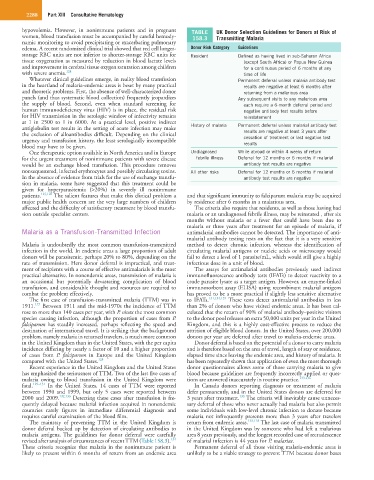
        revised after analysis of circumstances of recent TTM (Table 158.3).    of malarial infection is 44 years for P. malariae.
        These criteria recognize that malaria in the nonimmune patient is   Permanent deferral of all those visiting malaria-endemic areas is
        likely to present within 6 months of return from an endemic area   unlikely to be a viable strategy to prevent TTM because donor bases

