


Page 2566 - Hematology_ Basic Principles and Practice ( PDFDrive )
P. 2566
Chapter 158  Hematologic Aspects of Parasitic Diseases  2289


            are declining. Preventing malaria transmission through blood transfu-  is increasingly seen in association with HIV infection, where infection
            sion  requires  comprehensive,  regularly  reviewed,  and  effectively   rates in HIV-infected people may be as high as 10%.
            implemented  guidelines  for  donor  deferral  and  laboratory  testing.   VL is caused by a number of species of the Leishmania donovani
            Even the best strategy is a compromise, and medical laboratory staff   complex. 138,139  In the Mediterranean region and areas in the Middle
            should be aware of the rare but potentially serious possibility of fever   East and Central Asia through to China, Leishmania infantum pre-
            after transfusion that could be caused by malaria.    dominates, whereas L. donovani is more prevalent in India. Leishmania
                                                                  tropica is a less common cause of VL in these areas. Throughout their
                                                                  range  in  the  Old  World,  parasites  are  transmitted  by  the  female
            VISCERAL LEISHMANIASIS                                sandfly of the Phlebotomus genus. Leishmaniasis is caused by different
                                                                  parasites and vectors in the New World, where Leishmania chagasi
            Leishmaniasis is a generic term for infection by 30 or so species of   and Leishmania amazonensis are transmitted by the Lutzomyia genus
            the obligate intracellular parasites from the genus Leishmania. Visceral   of sandfly.
            leishmaniasis (VL), or kala-azar, presents with a wide spectrum of   Leishmania organisms are present in blood, and so the disease can
            systemic and hematologic features.                    be transmitted by blood transfusion, as a sexually transmitted disease,
                                                                  as  a  congenital  infection,  by  needle  sharing  for  intravenous  drug
                                                                  abuse, or within a laboratory by intradermal inoculation of L. don-
            Epidemiology                                          ovani  promastigotes. 140,141   Very  few  cases  of  leishmaniasis  have
                                                                  occurred  as  transfusion-transmitted  infections  in  Europe  or  North
            VL  occurs  in  all  countries  bordering  the  Mediterranean  Sea  and   America,  with  under  10  cases  in  infants  or  immunocompromised
            across the Middle East, including Saudi Arabia and Yemen. Indian   patients reported over the last 50 years. In endemic areas, this problem
            VL occurs in the eastern regions of India (particularly Assam, Bengal,   represents a much greater but unquantified risk.
            Bihar, Uttar Pradesh, Tamil Nadu, and Sikkim) and in Nepal and
            Bangladesh. African kala-azar is endemic in Kenya, Ethiopia, and the
            Sudan and sporadically elsewhere in tropical Africa. In the Americas,   Parasitology
            VL occurs in foci across Mexico, Central America, Colombia, Ven-
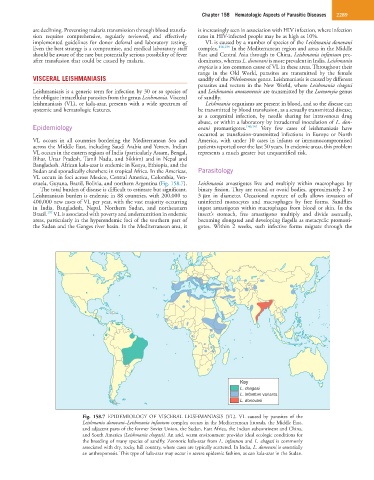
            ezuela, Guyana, Brazil, Bolivia, and northern Argentina (Fig. 158.7).  Leishmania  amastigotes  live  and  multiply  within  macrophages  by
              The total burden of disease is difficult to estimate but significant.   binary fission. They are round or ovoid bodies, approximately 2 to
            Leishmaniasis burden is endemic in 88 countries, with 200,000 to   3 µm  in  diameter.  Occasional  rupture  of  cells  allows  invasion  of
            400,000 new cases of VL per year, with the vast majority occurring   uninfected  monocytes  and  macrophages  by  free  forms.  Sandflies
            in  India,  Bangladesh,  Nepal,  Northern  Sudan,  and  northeastern   ingest amastigotes within macrophages from blood or skin. In the
                137
            Brazil.  VL is associated with poverty and undernutrition in endemic   insect’s  stomach,  free  amastigotes  multiply  and  divide  asexually,
            areas, particularly in the hyperendemic foci of the southern part of   becoming elongated and developing flagella as metacyclic promasti-
            the Sudan and the Ganges river basin. In the Mediterranean area, it   gotes.  Within  2  weeks,  such  infective  forms  migrate  through  the


                                                                                Key
                                                                                L. chagasi
                                                                                L. infantum variants
                                                                                L. donovani

                            Fig.  158.7  EPIDEMIOLOGY  OF  VISCERAL  LEISHMANIASIS  (VL).  VL  caused  by  parasites  of  the
                            Leishmania donovani–Leishmania infantum complex occurs in the Mediterranean littorals, the Middle East,
                            and adjacent parts of the former Soviet Union, the Sudan, East Africa, the Indian subcontinent and China,
                            and South America (Leishmania chagasi). An arid, warm environment provides ideal ecologic conditions for
                            the breeding of many species of sandfly. Zoonotic kala-azar from L. infantum and L. chagasi is commonly
                            associated with dry, rocky, hill country, where cases are typically scattered. In India, L. donovani is essentially
                            an anthroponosis. This type of kala-azar may occur in severe epidemic fashion, as can kala-azar in the Sudan.

