


Page 2573 - Hematology_ Basic Principles and Practice ( PDFDrive )
P. 2573
2296   Part XIII  Consultative Hematology


           Patients  require  prolonged  specialist  follow-up  over  2  years,
        including blood and CSF examination for parasites. A rising CSF
        leukocyte count is a good guide to CSF relapse even in the absence
        of a demonstration of parasites. 211
           In treatment for early-stage T. b. rhodesiense, suramin is given as
        five intravenous injections (20 mg/kg, up to 1.5 g) on days 1, 3, 6,
        14,  and  21.  Adverse  effects  include  fever,  proteinuria,  paresthesia,
        pruritus,  and  urticaria.  Hemolytic  anemia,  agranulocytosis,  and
        thrombocytopenia have been reported as side effects. Combination
        therapies of the antitrypanosomal drugs nifurtimox and eflornithine,
        and also the combination of melarsoprol and nifurtimox, are under
        trial for the treatment of second-stage disease to increase the efficacy
        of treatment and to overcome increasing drug resistance. 212


        African Trypanosomiasis as a Transfusion-
        Transmitted Infection

        Trypanosomiasis is a transfusion-transmitted infection. Asymptomatic
        or early-stage patients with trypanosomiasis are clearly a threat to the
        blood supply. Patients are excluded in the United Kingdom, Europe,
        and North America by the general donor queries relating to fever and
        constitutional  symptoms.  In  endemic  areas,  exclusion  of  infected
        donors  with  early-stage  T.  b.  gambiense  is  clearly  a  more  complex
        problem because patients may be asymptomatic for long periods if the
        degree of risk is unknown and no specific screening procedures are in
        place.  In  summary,  hematologic  involvement  in  trypanosomiasis  is
        peripheral to the main two features of the disease, but examination of
        lymph node aspirates, blood, and CSF is essential for diagnosis and
        management  of  the  disease.  Occasionally,  patients  may  become
        severely ill and have complex hematologic abnormalities. In endemic
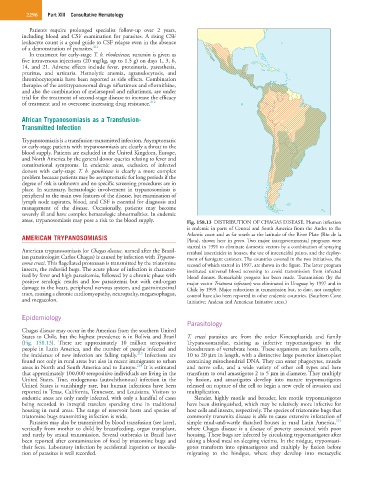
        areas, trypanosomiasis may pose a risk to the blood supply.  Fig. 158.13  DISTRIBUTION OF CHAGAS DISEASE. Human infection
                                                              is endemic in parts of Central and South America from the Andes to the
        AMERICAN TRYPANOSOMIASIS                              Atlantic coast and as far south as the latitude of the River Plate (Río de la
                                                              Plata),  shown  here  in  green. Two  major  intergovernmental  programs  were
                                                              started in 1991 to eliminate domestic vectors by a combination of spraying
        American trypanosomiasis (or Chagas disease, named after the Brazil-  residual insecticides in houses, the use of insecticidal paints, and the deploy-
        ian parasitologist Carlos Chagas) is caused by infection with Trypano-  ment of fumigant canisters. The countries covered in the two initiatives, the
        soma cruzi. This flagellated protozoan is transmitted by the triatomine   second of which started in 1997, are shown in the figure. The latter program
        insects, the reduviid bugs. The acute phase of infection is character-  instituted  universal  blood  screening  to  avoid  transmission  from  infected
        ized by fever and high parasitemia, followed by a chronic phase with   blood  donors.  Remarkable  progress  has  been  made. Transmission  (by  the
        positive  serologic  results  and  low  parasitemia  but  with  end-organ   major vector Triatoma infestans) was eliminated in Uruguay by 1997 and in
        damage to the heart, peripheral nervous system, and gastrointestinal   Chile by 1999. Major reductions in transmission but, to date, not complete
        tract, causing a chronic cardiomyopathy, neuropathy, megaesophagus,   control have also been reported in other endemic countries. (Southern Cone
        and megacolon.                                        Initiative; Andean and American Initiative areas.)


        Epidemiology
                                                              Parasitology
        Chagas disease may occur in the Americas from the southern United
        States to Chile, but the highest prevalence is in Bolivia and Brazil   T.  cruzi  parasites  are  from  the  order  Kinetoplastida  and  family
        (Fig.  158.13).  There  are  approximately  10  million  seropositive   Trypanosomatidae,  existing  as  infective  trypomastigotes  in  the
        people  in  Latin  America,  and  the  number  of  people  infected  and   bloodstream of vertebrate hosts. These organisms are fusiform cells,
                                              213
        the incidence of new infection are falling rapidly.  Infections are   10 to 20 µm in length, with a distinctive large posterior kinetoplast
        found not only in rural areas but also in recent immigrants to urban   containing mitochondrial DNA. They can enter phagocytes, muscle
                                              214
        areas in North and South America and to Europe.  It is estimated   and  nerve  cells,  and  a  wide  variety  of  other  cell  types  and  here
        that approximately 100,000 seropositive individuals are living in the   transform to oval amastigotes 2 to 5 µm in diameter. They multiply
        United  States. True,  endogenous  (autochthonous)  infection  in  the   by  fission,  and  amastigotes  develop  into  mature  trypomastigotes
        United States is vanishingly rare, but human infections have been   released on rupture of the cell to begin a new cycle of invasion and
        reported in Texas, California, Tennessee, and Louisiana. Visitors to   multiplication.
        endemic areas are only rarely infected, with only a handful of cases   Slender,  highly  motile  and  broader,  less  motile  trypomastigotes
        being  recorded  in  intrepid  travelers  spending  time  in  traditional   have been distinguished, which may be relatively more infective for
        housing in rural areas. The range of reservoir hosts and species of   host cells and insects, respectively. The species of triatomine bugs that
        triatomine bugs transmitting infection is wide.       commonly transmits disease is able to cause extensive infestation of
                                                                                                               215
           Parasites may also be transmitted by blood transfusion (see later),   simple  mud-and-wattle  thatched  houses  in  rural  Latin  America,
        vertically from mother to child by breastfeeding, organ transplant,   where  Chagas  disease  is  a  disease  of  poverty  associated  with  poor
        and rarely by sexual transmission. Several outbreaks in Brazil have   housing. These bugs are infected by circulating trypomastigotes after
        been reported after contamination of food by triatomine bugs and   taking a blood meal on sleeping victims. In the midgut, trypomasti-
        their feces. Laboratory infection by accidental ingestion or inocula-  gotes  transform  into  epimastigotes  and  multiply  by  fission  before
        tion of parasites is well recorded.                   migrating  to  the  hindgut,  where  they  develop  into  metacyclic

