


Page 2609 - Hematology_ Basic Principles and Practice ( PDFDrive )
P. 2609
2322   Part XIII  Consultative Hematology


        Distensible  splenic  tissues  results  in  pooling  of  a  large  amount  of   Reticuloendothelial blockade, or occupancy of these receptors, refers
        blood, whereas the venous drainage is occluded by sickled hypoxic   to the impaired ability of the spleen to recognize and remove other
        erythrocytes. Patients with sickle cell disease who have not yet had   IgG-coated  particles,  including  bacteria,  in  the  presence  of  these
        multiple episodes of infarction and whose spleens have not undergone   agents.
        fibrosis are susceptible to this syndrome. Unlike the chronic process
        of smaller vessel infarction, the acute splenic sequestration crisis can
        be life threatening because a large amount of blood can collect in the   SPLENOMEGALY AND HYPERSPLENISM
        highly distended spleen. The tendency for recurrence and the poten-
        tial for fatal outcome have resulted in the common recommendation   An enlarged spleen is not a disease state in itself but usually indicates
                                                                                        16
        for splenectomy in a patient who has had one severe splenic sequestra-  some  underlying  pathologic  state.   The  processes  run  the  gamut
        tion crisis, or more than one less severe crisis. Occlusion of venous   from minor to life threatening, from congenital disorders to those at
        drainage also occurs in the liver, but the less distensible capsule of the   the end of life. It is useful to approach the differential diagnosis of
        liver and the options for venous drainage through the portal system   splenomegaly  by  considering  the  processes  that  may  cause  splenic
        make this less likely to be life threatening.         enlargement and then to focus on the specific diagnoses within those
                                                              categories. The  spleen  may  be  enlarged  as  a  result  of  infiltration,
                                                              hypertrophy of normal elements (macrophages and lymphoid com-
        Immunologic and Autoimmune Diseases                   ponents), extramedullary hematopoiesis, inflammatory or immuno-
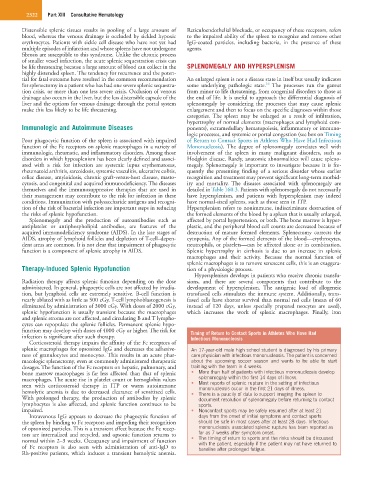
                                                              logic processes, and systemic or portal congestion (see box on Timing
        Poor phagocytic function of the spleen is associated with impaired   of Return to Contact Sports in Athletes Who Have Had Infectious
        function of the Fc receptors on splenic macrophages in a variety of   Mononucleosis).  The  degree  of  splenomegaly  correlates  well  with
        immunologic, rheumatic, and inflammatory disorders. Among those   involvement  of  the  spleen  in  many  malignant  disorders,  such  as
        disorders in which hyposplenism has been clearly defined and associ-  Hodgkin disease. Rarely, anatomic abnormalities will cause spleno-
        ated  with  a  risk  for  infection  are  systemic  lupus  erythematosus,   megaly. Splenomegaly is important to investigate because it is fre-
        rheumatoid arthritis, sarcoidosis, systemic vasculitis, ulcerative colitis,   quently  the  presenting  finding  of  a  serious  disorder  whose  earlier
        celiac disease, amyloidosis, chronic graft-versus-host disease, masto-  recognition and treatment may prevent significant long-term morbid-
        cytosis, and congenital and acquired immunodeficiency. The diseases   ity  and  mortality.  The  diseases  associated  with  splenomegaly  are
        themselves  and  the  immunosuppressive  therapies  that  are  used  in   detailed in Table 160.3. Patients with splenomegaly do not necessarily
        their management may contribute to the risk for infection in these   have  hypersplenism,  and  patients  with  hypersplenism  may  indeed
        conditions. Immunization with polysaccharide antigens and recogni-  have normal-sized spleens, such as those seen in ITP.
        tion of the risk of bacterial infection are important steps in reducing   Hypersplenism refers to nonimmune, indiscriminate destruction of
        the risks of splenic hypofunction.                    the formed elements of the blood by a spleen that is usually enlarged,
           Splenomegaly  and  the  production  of  autoantibodies  such  as   affected by portal hypertension, or both. The bone marrow is hyper-
        antiplatelet  or  antiphospholipid  antibodies,  are  features  of  the   plastic, and the peripheral blood cell counts are decreased because of
        acquired immunodeficiency syndrome (AIDS). In the late stages of   destruction  of  mature  formed  elements.  Splenectomy  corrects  the
        AIDS, atrophy of lymphoid follicles and depletion of T-cell–depen-  cytopenia. Any of the formed elements of the blood—erythrocytes,
        dent areas are common. It is not clear that impairment of phagocytic   neutrophils, or platelets—can be affected alone or in combination.
        function is a component of splenic atrophy in AIDS.   Splenic  hypertrophy  in  cirrhosis  is  due  to  an  increase  in  splenic
                                                              macrophages  and  their  activity.  Because  the  normal  function  of
                                                              splenic macrophages is to remove senescent cells, this is an exaggera-
        Therapy-Induced Splenic Hypofunction                  tion of a physiologic process.
                                                                 Hypersplenism develops in patients who receive chronic transfu-
        Radiation  therapy  affects  splenic  function  depending  on  the  dose   sions,  and  there  are  several  components  that  contribute  to  the
        administered. In general, phagocytic cells are not affected by irradia-  development  of  hypersplenism.  The  antigenic  load  of  allogeneic
        tion,  but  lymphoid  cells  are  extremely  sensitive.  B-cell  function  is   transfused cells stimulates the immune system. Additionally, trans-
        nearly ablated with as little as 500 cGy. T-cell lymphoblastogenesis is   fused cells have shorter survival than normal red cells (mean of 60
        eliminated by administration of 3000 cGy. With doses of 2000 cGy,   instead  of  120  days,  unless  specially  prepared  neocytes  are  used),
        splenic  hypofunction  is  usually  transient  because  the  macrophages   which  increases  the  work  of  splenic  macrophages.  Finally,  iron
        and splenic stroma are not affected, and circulating B and T lympho-
        cytes can repopulate the splenic follicles. Permanent splenic hypo-
        function may develop with doses of 4000 cGy or higher. The risk for   Timing of Return to Contact Sports in Athletes Who Have Had
        infection is significant after such therapy.           Infectious Mononucleosis
           Corticosteroid therapy impairs the affinity of the Fc receptors of
        splenic macrophages for opsonized IgG and decreases the adhesive-  An 17-year-old male high school student is diagnosed by his primary
        ness of granulocytes and monocytes. This results in an acute phar-  care physician with infectious mononucleosis. The patient is concerned
        macologic splenectomy, even at commonly administered therapeutic   about  the  upcoming  soccer  season  and  wants  to  be  able  to  start
        dosages. The function of the Fc receptors on hepatic, pulmonary, and   training with the team in 4 weeks.
        bone  marrow  macrophages  is  far  less  affected  than  that  of  splenic   •  More than half of patients with infectious mononucleosis develop
        macrophages. The acute rise in platelet count or hemoglobin values   splenomegaly within the first 14 days of illness.
        seen  with  corticosteroid  therapy  in  ITP  or  warm  autoimmune   •  Most reports of splenic rupture in the setting of infectious
                                                                  mononucleosis occur in the first 21 days of illness.
        hemolytic  anemia  is  due  to  decreased  clearance  of  sensitized  cells.   •  There is a paucity of data to support imaging the spleen to
        With  prolonged  therapy,  the  production  of  antibodies  by  splenic   document resolution of splenomegaly before returning to contact
        lymphocytes is also affected, and splenic function continues to be   sports.
        impaired.                                               •  Noncontact sports may be safely resumed after at least 21
           Intravenous IgG appears to decrease the phagocytic function of   days from the onset of initial symptoms and contact sports
        the spleen by binding to Fc receptors and impeding their recognition   should be safe in most cases after at least 28 days. Infectious
        of opsonized particles. This is a transient effect because the Fc recep-  mononucleosis–associated splenic rupture has been reported as
        tors are internalized and recycled, and opsonic function returns to   far as 7 weeks after symptom onset.
        normal within 2–3 weeks. Occupancy and impairment of function   •  The timing of return to sports and the risks should be discussed
                                                                  with the patient, especially if the patient may not have returned to
        of  Fc  receptors  is  also  seen  with  administration  of  anti-IgD  to   baseline after prolonged fatigue.
        Rh-positive  patients,  which  induces  a  transient  hemolytic  anemia.

