


Page 2610 - Hematology_ Basic Principles and Practice ( PDFDrive )
P. 2610
Chapter 160  The Spleen and Its Disorders  2323

                                                                  SPLENECTOMY
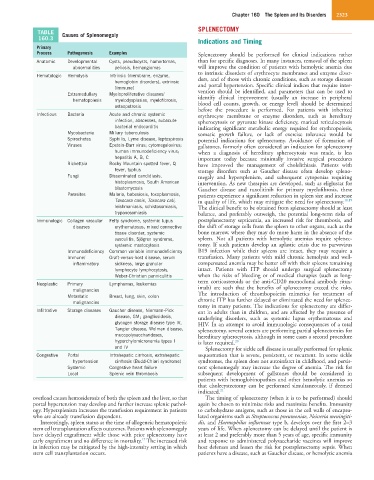
             TABLE   Causes of Splenomegaly
              160.3                                               Indications and Timing
             Primary
             Process   Pathogenesis  Examples                     Splenectomy  should  be  performed  for  clinical  indications  rather
             Anatomic  Developmental   Cysts, pseudocysts, hamartomas,   than for specific diagnoses. In many instances, removal of the spleen
                         abnormalities  peliosis, hemangiomas     will improve the condition of patients with hemolytic anemia due
                                                                  to intrinsic disorders of erythrocyte membranes and enzyme disor-
             Hematologic  Hemolysis  Intrinsic (membrane, enzyme,   ders, and of those with chronic conditions, such as storage diseases
                                       hemoglobin disorders), extrinsic   and portal hypertension. Specific clinical indices that require inter-
                                       (immune)
                       Extramedullary   Myeloproliferative diseases/  vention  should  be  identified,  and  parameters  that  can  be  used  to
                                                                  identify  clinical  improvement  (usually  an  increase  in  peripheral
                         hematopoiesis  myelodysplasias, myelofibrosis,   blood  cell  counts,  growth,  or  energy  level)  should  be  determined
                                       osteopetrosis
                                                                  before  the  procedure  is  performed.  For  patients  with  inherited
             Infectious  Bacteria    Acute and chronic systemic   erythrocyte  membrane  or  enzyme  disorders,  such  as  hereditary
                                       infection, abscesses, subacute   spherocytosis  or  pyruvate  kinase  deficiency,  marked  reticulocytosis
                                       bacterial endocarditis     indicating  significant  metabolic  energy  required  for  erythropoiesis,
                       Mycobacteria  Miliary tuberculosis         somatic  growth  failure,  or  lack  of  exercise  tolerance  would  be
                       Spirochetes   Syphilis, Lyme disease, leptospirosis  potential  indications  for  splenectomy.  Avoidance  of  formation  of
                       Viruses       Epstein-Barr virus; cytomegalovirus;   gallstones, formerly often considered an indication for splenectomy
                                       human immunodeficiency virus;   when  a  diagnosis  of  hereditary  spherocytosis  was  made,  is  less
                                       hepatitis A, B, C          important  today  because  minimally  invasive  surgical  procedures
                       Rickettsia    Rocky Mountain spotted fever, Q   have  improved  the  management  of  cholelithiasis.  Patients  with
                                       fever, typhus              storage  disorders  such  as  Gaucher  disease  often  develop  spleno-
                       Fungi         Disseminated candidiasis,    megaly  and  hypersplenism,  and  subsequent  cytopenias  requiring
                                       histoplasmosis, South American   intervention. As new therapies are developed, such as eliglustat for
                                       blastomycosis              Gaucher  disease  and  ruxolitinib  for  primary  myelofibrosis,  these
                       Parasites     Malaria, babesiosis, toxoplasmosis,   patients experience a significant reduction in spleen size and increase
                                       Toxocara canis, Toxocara cati,   in quality of life, which may mitigate the need for splenectomy. 18,19
                                       leishmaniasis, schistosomiasis,   The clinical benefit to be obtained from splenectomy should at least
                                       trypanosomiasis            balance,  and  preferably  outweigh,  the  potential  long-term  risks  of
             Immunologic  Collagen vascular   Felty syndrome, systemic lupus   postsplenectomy  septicemia,  an  increased  risk  for  thrombosis,  and
                         diseases      erythematosus, mixed connective   the shift of storage cells from the spleen to other organs, such as the
                                       tissue disorder, systemic   bone marrow, where they may do more harm in the absence of the
                                       vasculitis, Sjögren syndrome,   spleen.  Not  all  patients  with  hemolytic  anemias  require  splenec-
                                       systemic mastocytosis      tomy.  If  such  patients  develop  an  aplastic  crisis  due  to  parvovirus
                       Immunodeficiency  Common variable immunodeficiency  B19  infection  while  their  spleens  are  intact,  they  may  require  a
                       Immune/       Graft-versus-host disease, serum   transfusion. Many patients with mild chronic hemolysis and well-
                         inflammatory  sickness, large granular   compensated anemia may be better off with their spleens remaining
                                       lymphocyte lymphocytosis,   intact.  Patients  with  ITP  should  undergo  surgical  splenectomy
                                       Weber-Christian panniculitis  when  the  risks  of  bleeding  or  of  medical  therapies  (such  as  long-
                                                                  term corticosteroids or the anti-CD20 monoclonal antibody ritux-
             Neoplastic  Primary     Lymphomas, leukemias         imab)  are  such  that  the  benefits  of  splenectomy  exceed  the  risks.
                         malignancies
                       Metastatic    Breast, lung, skin, colon    The  introduction  of  thrombopoietin  mimetics  for  treatment  of
                                                                  chronic ITP has further delayed or eliminated the need for splenec-
                         malignancies
                                                                  tomy in many patients. The indications for splenectomy are differ-
             Infiltrative  Storage diseases  Gaucher disease, Niemann-Pick   ent in adults than in children, and are affected by the presence of
                                       disease, GM 1  gangliosidosis,   underlying  disorders,  such  as  systemic  lupus  erythematosus  and
                                       glycogen storage disease type IV,   HIV. In an attempt to avoid immunologic consequences of a total
                                       Tangier disease, Wolman disease,   splenectomy, several centers are performing partial splenectomies for
                                       mucopolysaccharidoses,     hereditary spherocytosis, although in some cases a second procedure
                                       hyperchylomicronemia types I   is later required. 20
                                       and IV                       Splenectomy for sickle cell disease is usually performed for splenic
             Congestive  Portal      Intrahepatic cirrhosis, extrahepatic   sequestration that is severe, persistent, or recurrent. In some sickle
                         hypertension  cirrhosis (Budd-Chiari syndrome)  syndromes, the spleen does not autoinfarct in childhood, and persis-
                       Systemic      Congestive heart failure     tent splenomegaly may increase the degree of anemia. The risk for
                       Local         Splenic vein thrombosis      subsequent  development  of  gallstones  should  be  considered  in
                                                                  patients with hemoglobinopathies and other hemolytic anemias so
                                                                  that  cholecystectomy  can  be  performed  simultaneously,  if  deemed
                                                                  indicated. 21
            overload causes hemosiderosis of both the spleen and the liver, so that   The timing of splenectomy (when it is to be performed) should
            portal hypertension may develop and further increase splenic pathol-  again be chosen to minimize risks and maximize benefits. Immunity
            ogy. Hypersplenism increases the transfusion requirement in patients   to carbohydrate antigens, such as those in the cell walls of encapsu-
            who are already transfusion dependent.                lated organisms such as Streptococcus pneumoniae, Neisseria meningiti-
              Interestingly, spleen status at the time of allogeneic hematopoietic   dis, and Haemophilus influenzae type b, develops over the first 2–3
            stem cell transplantation affects outcomes. Patients with splenomegaly   years of life. When splenectomy can be delayed until the patient is
            have delayed engraftment while those with prior splenectomy have   at least 2 and preferably more than 5 years of age, specific immunity
                                               17
            early engraftment and no difference in mortality.  The increased risk   and response to administered polysaccharide vaccines will improve
            in infection may be mitigated by the high-intensity setting in which   host defenses and lessen the risk for postsplenectomy sepsis. When
            stem cell transplantation occurs.                     patients have a disease, such as Gaucher disease, or hemolytic anemia

