


Page 2608 - Hematology_ Basic Principles and Practice ( PDFDrive )
P. 2608
Chapter 160  The Spleen and Its Disorders  2321


            and examination under interference optics should reveal endocytic   1.0
            vesicles containing hemoglobin, ferritin, and remnants of mitochon-         HbSS
            dria. These form in mature erythrocytes and are normally removed by   0.9
            the functioning spleen. The number of pitted cells (not the number
            of pits per cell) is inversely proportional to splenic function, with
                                                 14
            normal persons having less than 2% pitted cells.  The absence of   0.8             HbS/b thal
                                                                                                    0
            Howell-Jolly bodies on a peripheral blood smear cannot be used as
            evidence of adequate splenic immune function. 15         0.7
            ASPLENIA AND HYPOSPLENIA                                 0.6
            Congenital  asplenia  may  be  an  isolated  lesion  or  associated  with  Percentage of Patients with “pocked” RBC >3.5%  0.5
            severe cyanotic congenital heart disease and bilateral right-sidedness.              HbSC
            Life-threatening cardiac lesions, including transposition of the great   0.4
            vessels, pulmonary artery atresia or stenosis, septal defects, anomalous
            venous drainage, and a single atrioventricular valve, are components   0.3
            of bilateral right-sidedness. The liver is central, and both lungs have
                                                                                                    +
            three lobes. The peripheral blood smear shows Howell-Jolly bodies                  HbS/b thal
            and other signs of hyposplenism. There is considerable variation in   0.2
            the anatomic and functional findings, and it is difficult to predict
            with accuracy the degree of splenic dysfunction on the basis of the   0.1
            anatomy alone. Children who survive the cardiac difficulties in the
            neonatal period have a significant incidence of sepsis secondary to a   0.0
            variety of organisms.                                        0  2   4   6   8  10  12  14  16  18  20
              Polysplenia is associated with bilateral left-sidedness. Dextrocardia,
            bilateral superior venae cavae, septal defects, and anomalous pulmo-          Age (years)
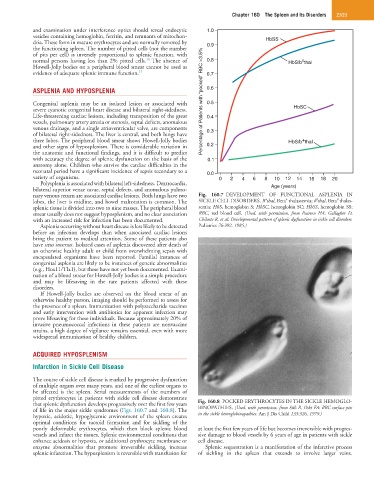
            nary venous return are associated cardiac lesions. Both lungs have two   Fig.  160.7  DEVELOPMENT  OF  FUNCTIONAL  ASPLENIA  IN
                                                                                              +
                                                                                        +
                                                                                                               0
                                                                                                        0
            lobes, the liver is midline, and bowel malrotation is common. The   SICKLE CELL DISORDERS. B thal, Beta  thalassemia; b thal, Beta  thalas-
            splenic tissue is divided into two to nine masses. The peripheral blood   semia; HbS, hemoglobin S; HbSC, hemoglobin SC; HbSS, hemoglobin SS;
            smear usually does not suggest hyposplenism, and no clear association   RBC,  red  blood  cell.  (Used,  with  permission,  from  Pearson  HA,  Gallagher  D,
            with an increased risk for infection has been documented.  Chilcote R, et al: Developmental pattern of splenic dysfunction in sickle cell disorders.
              Asplenia occurring without heart disease is less likely to be detected   Pediatrics 76:392, 1985.)
            before  an  infection  develops  than  when  associated  cardiac  lesions
            bring the patient to medical attention. Some of these patients also
            have situs inversus. Isolated cases of asplenia discovered after death of
            an otherwise healthy adult or child from overwhelming sepsis with
            encapsulated  organisms  have  been  reported.  Familial  instances  of
            congenital asplenia are likely to be instances of genetic abnormalities
            (e.g., Hox11/Tlx1), but these have not yet been documented. Exami-
            nation of a blood smear for Howell-Jolly bodies is a simple procedure
            and  may  be  lifesaving  in  the  rare  patients  affected  with  these
            disorders.
              If  Howell-Jolly  bodies  are  observed  on  the  blood  smear  of  an
            otherwise healthy person, imaging should be performed to assess for
            the presence of a spleen. Immunization with polysaccharide vaccines
            and  early intervention with  antibiotics for  apparent infection  may
            prove lifesaving for these individuals. Because approximately 20% of
            invasive  pneumococcal  infections  in  these  patients  are  nonvaccine
            strains, a high degree of vigilance remains essential, even with more
            widespread immunization of healthy children.

            ACQUIRED HYPOSPLENISM

            Infarction in Sickle Cell Disease

            The course of sickle cell disease is marked by progressive dysfunction
            of multiple organs over many years, and one of the earliest organs to
            be  affected  is  the  spleen.  Serial  measurements  of  the  numbers  of
            pitted  erythrocytes  in  patients  with  sickle  cell  disease  demonstrate
            that splenic dysfunction develops progressively over the first few years   Fig. 160.8  POCKED ERYTHROCYTES IN THE SICKLE HEMOGLO-
            of life in the major sickle syndromes (Figs. 160.7 and 160.8). The   BINOPATHIES. (Used, with permission, from Sills R, Oski FA: RBC surface pits
            hypoxic, acidotic, hypoglycemic environment of the spleen creates   in the sickle hemoglobinopathies. Am J Dis Child 133:526, 1979.)
            optimal  conditions  for  tactoid  formation  and  for  sickling  of  the
            poorly  deformable  erythrocytes,  which  then  block  splenic  blood   at least the first few years of life but becomes irreversible with progres-
            vessels and infarct the tissues. Splenic environmental conditions that   sive damage to blood vessels by 6 years of age in patients with sickle
            enhance acidosis or hypoxia, or additional erythrocyte membrane or   cell disease.
            enzyme  abnormalities  that  promote  irreversible  sickling,  increase   Splenic sequestration is a manifestation of the infarctive process
            splenic infarction. The hyposplenism is reversible with transfusion for   of  sickling  in  the  spleen  that  extends  to  involve  larger  veins.

