


Page 2611 - Hematology_ Basic Principles and Practice ( PDFDrive )
P. 2611
2324   Part XIII  Consultative Hematology


        predisposing to iron overload, such as thalassemia, the presence of   that preserve or restore splenic function. Even large cysts that were
        the  spleen  as  a  preferential  site  for  the  storage  of  harmful  cellular   indications for splenectomy until recently have been managed with
        breakdown products may protect other organs from damage. Delay-  spleen-conserving procedures, such as partial or total cyst removal,
                                                                                                 23
        ing splenectomy until a clear clinical indication is present will balance   which can often be performed laparoscopically.  Pancreatic surgery
        risks and benefits to an optimal degree. The recently developed oral   often requires sacrifice of the spleen; however, increasing numbers of
        substrate inhibitor, eliglustat, has shown promising success in reduc-  procedures are being performed with salvage of the spleen.
                                              18
        ing splenomegaly in patients with Gaucher disease.  As this drug is   Splenic  transplantation  is  being  used  as  a  means  of  developing
        studied further, it is possible that splenectomy may not be needed     immune tolerance, as well as a means of reducing the risk for infec-
                                                                                           24
        as often.                                             tion  following  organ  transplantation.   Allograft  spleen  has  been
                                                              transplanted  within  multivisceral  grafts  with  only  minimal  graft-
                                                              versus-host disease. To date there are more animal than human data,
        Surgical Options                                      and  it  is  unclear  how  large  an  impact  this  approach  will  have  on
                                                                                                               25
                                                              visceral, especially small-bowel and pancreatic, allotransplantation.
        When splenectomy is clearly indicated, acute complications are rarely   If protection against infection is the main consideration, an intact
        a  consideration  in  the  decision  to  perform  surgery.  Nevertheless,   spleen is superior to a repaired or autotransplanted spleen, whereas
        advances in surgical procedures have minimized the short-term risks   accessory spleens and splenosis may be only marginally better than
        of  the  procedure  itself  and  of  postoperative  complications  such  as   asplenia. 15
        intestinal obstruction from adhesions. Subtotal splenectomy can be
        performed when total splenectomy is not desirable, such as for the
        removal  of  a  cyst,  a  pseudocyst,  or  tumors,  after  trauma,  or  for   Complications After Splenectomy
        Gaucher disease. Wedge resection with mattress sutures and cyano-
        acrylate  adhesives  and  microfibrillar  collagen  omental  packs  have   Acute complications in the perioperative period include rupture of
        greatly improved partial splenectomy procedures in the past decade.   the spleen, the development of a subphrenic abscess, and injury to
        Laparotomy  is  required  when  extensive  peritoneal  adhesions  are   the pancreas during the operative procedure. In a healthy patient, the
        present and for removal of massively enlarged spleens. A sufficiently   immediate risk of splenectomy is limited. The degree of splenomegaly
        large incision to permit full visualization and mobilization is essential   greatly affects the risk for rupture and pancreatic injury. The technical
        when the spleen is very large or when inspection is a major part of   difficulty  of  performing  a  splenectomy  is  much  greater  when  the
        the surgical procedure. A retroperitoneal approach is useful when the   spleen is massively enlarged than when the spleen is small. Once the
        spleen is not massively enlarged but needs to be fully removed, such   arterial supply is ligated, rupture of the spleen is rarely a problem.
        as  when  cytopenias  are  the  indication  for  the  procedure.  This   The splenic hilum is retroperitoneal, so if the spleen is very large,
        approach shortens the postoperative recovery time and avoids induc-  mobilization  to  gain  access  to  the  splenic  artery  and  vein  can  be
        tion of peritoneal adhesions.                         difficult. After recovery from surgery, intestinal obstruction due to
           Minimally  invasive  procedures  have  become  standard  for  most   formation of peritoneal adhesions is a complication that, if it is to
        splenectomies.  Laparoscopy  is  now  the  procedure  of  choice  for   occur at all, usually occurs within the first few months.
        splenectomy. Although the operative time is significantly greater than   Two  late  complications  of  splenectomy  give  the  greatest
        for laparotomy, the postoperative recovery time, risk for damage to   concern: overwhelming postsplenectomy septicemia and atheroscle-
        the  pancreas,  likelihood  of  developing  a  subphrenic  abscess  and   rotic heart disease. Both of these complications may develop many
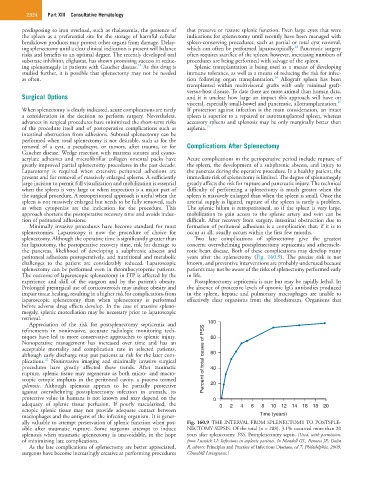
        peritoneal adhesions postoperatively, and nutritional and metabolic   years  after  the  splenectomy  (Fig.  160.9).  The  precise  risk  is  not
        challenges  to  the  patient  are  considerably  reduced.  Laparoscopic   known, and preventive interventions are probably underused because
        splenectomy can be performed even in thrombocytopenic patients.   patients may not be aware of the risks of splenectomy performed early
        The outcome of laparoscopic splenectomy in ITP is affected by the   in life.
        experience  and  skill  of  the  surgeon  and  by  the  patient’s  obesity.   Postsplenectomy septicemia is rare but may be rapidly lethal. In
        Prolonged presurgical use of corticosteroids may induce obesity and   the absence of protective levels of opsonic IgG antibodies produced
        impair tissue healing, resulting in a higher risk for complications from   in  the  spleen,  hepatic  and  pulmonary  macrophages  are  unable  to
        laparoscopic  splenectomy  than  when  splenectomy  is  performed   effectively  clear  organisms  from  the  bloodstream.  Organisms  that
        before adverse drug effects develop. In the case of massive spleno-
        megaly, splenic morcellation may be necessary prior to laparoscopic
        retrieval.
           Appreciation  of  the  risk  for  postsplenectomy  septicemia  and
        refinements  in  noninvasive,  accurate  radiologic  monitoring  tech-
        niques have led to more conservative approaches to splenic injury.   80
        Nonoperative  management  has  increased  over  time  and  has  an
        acceptable  mortality  and  complication  rate  in  selected  patients,
                                                                      60
        although early discharge may put patients at risk for the later com-  Percent of total cases of PSS 100
                22
        plications.   Noninvasive  imaging  and  minimally  invasive  surgical
        procedures  have  greatly  affected  these  trends.  After  traumatic   40
        rupture,  splenic  tissue  may  regenerate  as  both  micro-  and  macro-
        scopic  ectopic  implants  in  the  peritoneal  cavity,  a  process  termed
        splenosis.  Although  splenosis  appears  to  be  partially  protective   20
        against  overwhelming  postsplenectomy  infection  in  animals,  its
        protective value in humans is not known and may depend on the   0
        adequacy  of  splenic  tissue  perfusion.  If  poorly  vascularized,  the   0  2  4  6  8  10  12  14  16  18  20
        ectopic  splenic  tissue  may  not  provide  adequate  contact  between
        macrophages and the antigens of the infecting organism. It is gener-          Time (years)
        ally valuable to attempt preservation of splenic function when pos-  Fig. 160.9  THE INTERVAL FROM SPLENECTOMY TO POSTSPLE-
        sible  after  traumatic  rupture.  Some  surgeons  attempt  to  induce   NECTOMY SEPSIS. Of the total (n = 288), 3.1% occurred more than 20
        splenosis when traumatic splenectomy is unavoidable, in the hope   years after splenectomy. PSS, Postsplenectomy sepsis. (Used, with permission,
        of minimizing late complications.                     from Lutwick LI: Infections in asplenic patients. In Mandell GL, Bennett JE, Dolin
           As the late complications of splenectomy are better appreciated,   R, editors: Principles and Practice of Infectious Diseases, ed 7, Philadelphia, 2009,
        surgeons have become increasingly creative at performing procedures   Churchill Livingstone.)

