


Page 274 - Hematology_ Basic Principles and Practice ( PDFDrive )
P. 274
Chapter 21  T-Cell Immunity  225


                                                                                   TCR complex
                                                                                       α  β


                                     PKC θ     DAG

                                                      PIP 2  Hydrolysis
                                        RasGRP
                               NK-κB             IP 3                          LAT
                              activation  Ras                       Itk  PLCγ1  P
                                                       P        P
                                     Erk   Ca 2+   Vav   P                  P
                                                      Nck     SLP-76  Gads
                                                                                       PTK
                                    AP-1                                             Activation
                                  activation NFAT                        P
                                         activation                         ADAP
                                                Cytoskeletal                         Integrin activation
                                               Reorganization
                               Transcriptional
                                 activation
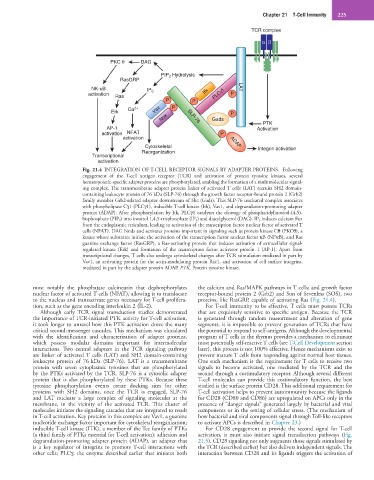
                            Fig. 21.4  INTEGRATION OF T-CELL RECEPTOR SIGNALS BY ADAPTER PROTEINS.  Following
                            engagement  of  the  T-cell  antigen  receptor  (TCR)  and  activation  of  protein  tyrosine  kinases,  several
                            hematopoietic-specific adapter proteins are phosphorylated, enabling the formation of a multimolecular signal-
                            ing complex. The transmembrane adapter protein linker of activated T cells (LAT) recruits SH2 domain-
                            containing leukocyte protein of 76 kDa (SLP-76) through the growth factor receptor-bound protein 2 (Grb2)
                            family member Grb2-related adaptor downstream of Shc (Gads). This SLP-76 nucleated complex associates
                            with phospholipase Cγ1 (PLCγ1), inducible T-cell kinase (Itk), Vav1, and degranulation-promoting adapter
                            protein (ADAP). After phosphorylation by Itk, PLCγ1 catalyzes the cleavage of phosphatidylinositol-(4,5)-
                            bisphosphate (PIP 2) into inositol 1,4,5-trisphosphate (IP 3) and diacylglycerol (DAG). IP 3 induces calcium flux
                            from the endoplasmic reticulum, leading to activation of the transcription factor nuclear factor of activated T
                            cells (NFAT). DAG binds and activates proteins important in signaling such as protein kinase Cθ (PKCθ), a
                            kinase whose substrates initiate the activation of the transcription factor nuclear factor κB (NFκB), and Ras
                            guanine exchange factor (RasGRP), a Ras-activating protein that induces activation of extracellular signal-
                            regulated  kinase  (Erk)  and  formation  of  the  transcription  factor  activator  protein  1  (AP-1).  Apart  from
                            transcriptional changes, T cells also undergo cytoskeletal changes after TCR stimulation mediated in part by
                            Vav1, an activating protein for the actin-modulating protein Rac1, and activation of cell surface integrins,
                            mediated in part by the adapter protein ADAP. PTK, Protein tyrosine kinase.


            most  notably  the  phosphatase  calcineurin  that  dephosphorylates   the calcium and Ras/MAPK pathways in T cells; and growth factor
            nuclear factor of activated T cells (NFAT), allowing it to translocate   receptor-bound protein 2 (Grb2) and Son of Sevenless (SOS), two
            to the nucleus and transactivate genes necessary for T-cell prolifera-  proteins, like RasGRP, capable of activating Ras (Fig. 21.4).
            tion, such as the gene encoding interleukin 2 (IL-2).   For T-cell immunity to be effective, T cells must possess TCRs
              Although  early  TCR  signal  transduction  studies  demonstrated   that  are  exquisitely  sensitive  to  specific  antigen.  Because  the TCR
            the importance of TCR-initiated PTK activity for T-cell activation,   is  generated  through  random  reassortment  and  alteration  of  gene
            it took longer to unravel how this PTK activation drove the many   segments, it is impossible to prevent generation of TCRs that have
            critical second-messenger cascades. This mechanism was elucidated   the potential to respond to self-antigens. Although the developmental
            with  the  identification  and  characterization  of  adapter  proteins,   program of T cells in the thymus provides a mechanism to eliminate
            which  possess  modular  domains  important  for  intermolecular   most potentially self-reactive T cells (see T-Cell Development section
            interactions.  Two  central  adapters  in  the  TCR  signaling  pathway   later), this process is not 100% effective. Hence mechanisms exist to
            are  linker  of  activated T  cells  (LAT)  and  SH2  domain-containing   prevent mature T cells from responding against normal host tissues.
            leukocyte  protein  of  76 kDa  (SLP-76).  LAT  is  a  transmembrane   One such mechanism is the requirement for T cells to receive two
            protein  with  seven  cytoplasmic  tyrosines  that  are  phosphorylated   signals  to  become  activated,  one  mediated  by  the  TCR  and  the
            by the PTKs activated by the TCR. SLP-76 is a cytosolic adapter   second through a costimulatory receptor. Although several different
            protein  that  is  also  phosphorylated  by  these  PTKs.  Because  these   T-cell  molecules  can  provide  this  costimulatory  function,  the  best
            tyrosine  phosphorylation  events  create  docking  sites  for  other   studied is the surface protein CD28. This additional requirement for
            proteins  with  SH2  domains,  once  the  TCR  is  engaged,  SLP-76   T-cell activation helps to prevent autoimmunity because the ligands
            and  LAT  nucleate  a  large  complex  of  signaling  molecules  at  the   for CD28 (CD80 and CD86) are upregulated on APCs only in the
            membrane,  in  the  vicinity  of  the  activated  TCR.  This  cluster  of   presence of “danger signals” generated largely by bacterial and viral
            molecules initiates the signaling cascades that are integrated to result   components or in the setting of cellular stress. (The mechanism of
            in T-cell activation. Key proteins in this complex are Vav1, a guanine   how bacterial and viral components signal through Toll-like receptors
            nucleotide exchange factor important for cytoskeletal reorganization;   to activate APCs is described in Chapter 23.)
            inducible T-cell kinase (ITK), a member of the Tec family of PTKs   For  CD28  engagement  to  provide  the  second  signal  for T-cell
            (a third family of PTKs essential for T-cell activation); adhesion and   activation,  it  must  also  initiate  signal  transduction  pathways  (Fig.
            degranulation-promoting adapter protein (ADAP), an adapter that   21.5). CD28 signaling not only augments those signals stimulated by
            is  a  key  regulator  of  integrins  to  promote T-cell  interactions  with   the TCR (described earlier) but also delivers independent signals. The
            other  cells;  PLCγ,  the  enzyme  described  earlier  that  initiates  both   interaction between CD28 and its ligands triggers the activation of

