


Page 273 - Hematology_ Basic Principles and Practice ( PDFDrive )
P. 273
224    Part III  Immunologic Basis of Hematology


        became  apparent  that  although  sufficient  to  bind  peptide–MHC,   the T cells. Exactly how TCR engagement initiates PTK activation
        the α/β heterodimer was not capable of transmitting an intracellular   remains  unclear;  however,  clustering  of  TCRs  on  the  cell  surface
        signal once ligand was bound. A series of studies, first in cell lines   with resultant conformational changes in the CD3 proteins appears
        and then in mouse models, demonstrated that the signal transduction   critical in the process. Src family (Lck and Fyn) PTKs are activated
        function  of  the  TCR  complex  resides  in  a  protein  complex  that   first following TCR stimulation, and the tyrosines within the CD3
        associates noncovalently with the α/β dimer. This complex, CD3, is   and ζ ITAMs are substrates of these kinases. Phosphorylation of the
        required both for stable expression of the ligand-binding components   ITAM tyrosines makes these residues able to bind to Src homology 2
        of the TCR and for signal transduction. CD3 is composed of three   (SH2) domains of other proteins. The most important SH2 domain-
        subunits, δ, ε, and γ, expressed as heterodimers (γ/ε and δ/ε) along   containing  protein  that  is  recruited  to  the  ITAMs  is  ζ-associated
        with the ζ subunit, which is present as a homodimer. Each subunit   protein of 70 kDa (ZAP-70), a PTK itself and a member of the Syk
        contains immunoreceptor tyrosine-based activation motifs (ITAMs),   family of proteins. Thus binding of the TCR by ligand converts an
        a stretch of amino acids with discretely placed tyrosine residues: one   enzymatically inactive receptor complex into an active PTK through
        ITAM in δ, ε, and γ and three ITAMS in ζ. The ITAM tyrosines   recruitment and activation of cytosolic proteins.
        are  key  for  the  CD3  and  ζ  chains  to  transduce  signals  and  are   Activation  of  ZAP-70  leads  to  tyrosine  phosphorylation  of  a
        inducibly phosphorylated upon engagement of the α/β TCR chains   number  of  substrates,  including  enzymes  that  catalyze  reactions
        by peptide–MHC. Upon their phosphorylation, the ITAMs become   generating second messengers important for T-cell activation. Phos-
        docking sites for other proteins that initiate the signaling cascade for   pholipase Cγ1 (PLCγ1) is activated by its tyrosine phosphorylation to
        T-cell activation. Notably, the CD4 or CD8 protein also plays a role   cleave phosphatidylinositol-(4,5)-bisphosphate (PIP 2) into the second
        in mediating signal transduction. These coreceptors bind both the   messengers  diacylglycerol  (DAG)  and  inositol-(1,4,5)-triphosphate
        appropriate MHC complex (MHC I for CD8, MHC II for CD4)   (IP 3). DAG is a lipid second messenger that binds to and activates
        and, via their cytoplasmic tails, the signaling molecule Lck, one of the   downstream  signaling  components,  including  protein  kinase  C  θ
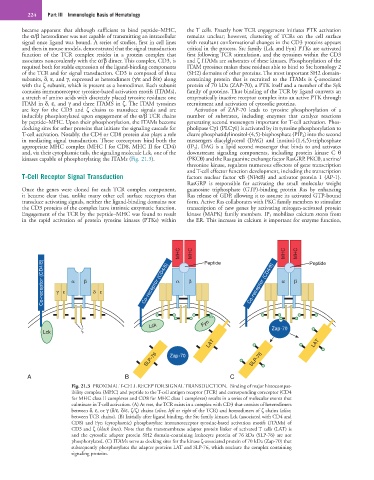
        kinases capable of phosphorylating the ITAMs (Fig. 21.3).  (PKCθ) and the Ras guanine exchange factor RasGRP. PKCθ, a serine/
                                                              threonine kinase, regulates numerous effectors of gene transcription
                                                              and T-cell effector function development, including the transcription
        T-Cell Receptor Signal Transduction                   factors  nuclear  factor  κB  (NFκB)  and  activator  protein  1  (AP-1).
                                                              RasGRP  is  responsible  for  activating  the  small  molecular  weight
        Once  the  genes  were  cloned  for  each  TCR  complex  component,   guanosine  triphosphate  (GTP)-binding  protein  Ras  by  enhancing
        it became clear that, unlike many other cell surface receptors that   Ras release of GDP, allowing it to assume its activated GTP-bound
        transduce activating signals, neither the ligand-binding domains nor   form. Active Ras collaborates with PKC family members to stimulate
        the CD3 proteins of the complex have intrinsic enzymatic function.   transcription of new genes by activating mitogen-activated protein
        Engagement of the TCR by the peptide–MHC was found to result   kinase (MAPK) family members. IP 3  mobilizes calcium stores from
        in  the  rapid  activation  of  protein  tyrosine  kinases  (PTKs)  within   the ER. This increase in calcium is important for enzyme function,


                                                            MHC  MHC  Peptide                 MHC  MHC  Peptide
               Co-receptor (CD4/8)  γ  ε  α  β  δ ε  Co-receptor (CD4/8)  α  β     Co-receptor (CD4/8)  α  β


                                                  Lck              Fyn                    Zap-70
               Lck          ζ
                                                                     LAT                                LAT

                                                 SLP-76  Zap-70                    SLP-76


          A                               B                                 C
                        Fig. 21.3  PROXIMAL T-CELL RECEPTOR SIGNAL TRANSDUCTION.  Binding of major histocompat-
                        ibility complex (MHC) and peptide to the T-cell antigen receptor (TCR) and corresponding coreceptor (CD4
                        for MHC class II complexes and CD8 for MHC class I complexes) results in a series of molecular events that
                        culminate in T-cell activation. (A) At rest, the TCR exists in a complex with CD3 that consists of heterodimers
                        between δ, ε, or γ (δ/ε, δ/ε, ζ/ζ) chains (olive, left or right of the TCR) and homodimers of ζ chains (olive,
                        between TCR chains). (B) Initially after ligand binding, the Src family kinases Lck (associated with CD4 and
                        CD8)  and  Fyn  (cytoplasmic)  phosphorylate  immunoreceptor  tyrosine-based  activation  motifs  (ITAMs)  of
                        CD3 and ζ (black lines). Note that the transmembrane adapter protein linker of activated T cells (LAT) is
                        and  the  cytosolic  adapter  protein  SH2  domain-containing  leukocyte  protein  of  76 kDa  (SLP-76)  are  not
                        phosphorylated. (C) ITAMs serve as docking sites for the kinase ζ-associated protein of 70 kDa (Zap-70) that
                        subsequently phosphorylates the adapter proteins LAT and SLP-76, which nucleate the complex containing
                        signaling proteins.

