


Page 275 - Hematology_ Basic Principles and Practice ( PDFDrive )
P. 275
226    Part III  Immunologic Basis of Hematology


               APC              APC             APC           with the activated integrins forming the peripheral supramolecular
                                                              activation  complex  (pSMAC),  a  ring  around  the  clustered TCRs.
         MHC                          CD80/           CD80/   Although ligands on the APC initially direct the formation of the
                                      CD86            CD86    IS, changes within the T cell, including reorganization of the actin
                                                              cytoskeleton,  are  also  critical  for  stabilization  of  this  structure.  As
             α  β             α  β                            sophistication  of  imaging  in  real  time  has  advanced  and  with  the
        TCR           CD28                                    advent of tools to visualize smaller and smaller numbers of molecules,
                                                              it has become clear that the IS is a dynamic structure that includes not
                                                              only the TCR and integrins but also many of the signaling molecules
                                                              essential for T-cell activation.
                                                                 When first described, it was assumed that the purpose of the IS is
              Anergy          Activation       No effect      to cluster the TCR together with key signaling molecules to initiate
                                                              and  sustain  the  T-cell  activation  program.  Recent  work  indicates
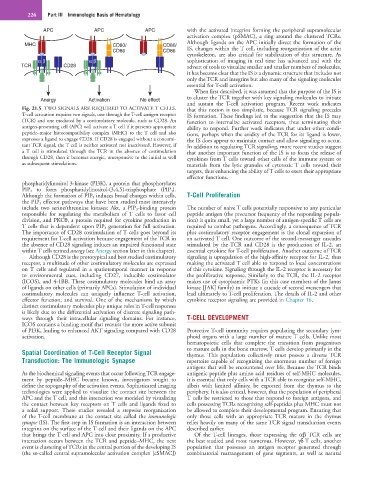
        Fig. 21.5  TWO SIGNALS ARE REQUIRED TO ACTIVATE T CELLS.     that  this  notion  is  too  simplistic,  because TCR  signaling  precedes
        T-cell activation requires two signals, one through the T-cell antigen receptor   IS formation. These findings led to the suggestion that the IS may
        (TCR) and one mediated by a costimulatory molecule, such as CD28. An   function  to  internalize  activated  receptors,  thus  terminating  their
        antigen-presenting cell (APC) will activate a T cell if it presents appropriate   ability to respond. Further work indicates that under other condi-
        peptide–major  histocompatibility  complex  (MHC)  to  the T  cell  and  also   tions, perhaps when the avidity of the TCR for its ligand is lower,
        expresses a ligand to engage CD28. If CD28 is engaged without a concomi-  the IS does appear to maintain contact and allow signaling to occur.
        tant TCR signal, the T cell is neither activated nor inactivated. However, if   In addition to regulating TCR signaling, more recent studies suggest
        a  T  cell  is  stimulated  through  the  TCR  in  the  absence  of  costimulation   that another important function of the IS is to focus the release of
        through CD28, then it becomes anergic, unresponsive to the initial as well   cytokines from T cells toward other cells of the immune system or
        as subsequent stimulations.                           materials  from  the  lytic  granules  of  cytotoxic T  cells  toward  their
                                                              targets, thus enhancing the ability of T cells to exert their appropriate
                                                              effector functions.
        phosphatidylinositol 3-kinase (PI3K), a protein that phosphorylates
        PIP 2   to  form  phosphatidylinositol-(3,4,5)-trisphosphate  (PIP 3 ).
        Although the formation of PIP 3  induces broad changes within cells,   T-Cell Proliferation
        the PIP 3  effector pathways that have been studied most intensively
        include  two  serine/threonine  kinases:  Akt,  a  PIP 3 -binding  protein   The number of naive T cells potentially responsive to any particular
        responsible  for  regulating  the  metabolism  of  T  cells  to  favor  cell   peptide antigen (the precursor frequency of the responding popula-
        division, and PKCθ, a protein required for cytokine production in   tion) is quite small, yet a large number of antigen-specific T cells are
        T cells that is dependent upon PIP 3  generation for full activation.   required to combat pathogens. Accordingly, a consequence of TCR
        The importance of CD28 costimulation of T cells goes beyond its   plus costimulatory receptor engagement is the clonal expansion of
        requirement for T-cell activation because engagement of the TCR in   an activated T cell. One outcome of the second-messenger cascades
        the absence of CD28 signaling induces an impaired functional state   stimulated  by  the TCR  and  CD28  is  the  production  of  IL-2,  an
        within T cells termed anergy (see Anergy section later in this chapter).  essential cytokine for T-cell proliferation. Another outcome of TCR
           Although CD28 is the prototypical and best studied costimulatory   signaling is upregulation of the high-affinity receptor for IL-2, thus
        receptor, a multitude of other costimulatory molecules are expressed   making the activated T cell able to respond to local concentrations
        on T  cells  and  regulated  in  a  spatiotemporal  manner  in  response   of this cytokine. Signaling through the IL-2 receptor is necessary for
        to  environmental  cues,  including  CD27,  inducible  costimulator   the proliferative response. Similarly to the TCR, the IL-2 receptor
        (ICOS), and 4-1BB. These costimulatory molecules bind an array   makes use of cytoplasmic PTKs (in this case members of the Janus
        of ligands on other cells (primarily APCs). Stimulation of individual   kinase [JAK] family) to initiate a cascade of second messengers that
        costimulatory  molecules  can  uniquely  influence  T-cell  activation,   lead ultimately to T-cell proliferation. The details of IL-2 and other
        effector  function,  and  survival.  One  of  the  mechanisms  by  which   cytokine receptor signaling are provided in Chapter 16.
        distinct costimulatory molecules play unique roles in T-cell responses
        is likely due to the differential activation of discrete signaling path-
        ways  through  their  intracellular  signaling  domains.  For  instance,   T-CELL DEVELOPMENT
        ICOS contains a binding motif that recruits the more active subunit
        of PI3K, leading to enhanced AKT signaling compared with CD28   Protective T-cell immunity requires populating the secondary lym-
        activation.                                           phoid organs with a large number of mature T cells. Unlike most
                                                              hematopoietic  cells  that  complete  the  transition  from  progenitors
        Spatial Coordination of T-Cell Receptor Signal        to mature cells in the bone marrow, T cells develop primarily in the
                                                              thymus.  This  population  collectively  must  possess  a  diverse  TCR
        Transduction: The Immunologic Synapse                 repertoire capable of recognizing the enormous number of foreign
                                                              antigens that will be encountered over life. Because the TCR binds
        As the biochemical signaling events that occur following TCR engage-  antigenic peptide plus amino acid residues of self-MHC molecules,
        ment  by  peptide–MHC  became  known,  investigators  sought  to   it is essential that only cells with a TCR able to recognize self-MHC,
        define the topography of the activation events. Sophisticated imaging   albeit  with  limited  affinity,  be  exported  from  the  thymus  to  the
        technologies were applied to visualize the contact site between the   periphery. It is also critical, however, that the population of peripheral
        APC and the T cell, and this interaction was modeled by visualizing   T cells be restricted to those that respond to foreign antigens, and
        the  contact  between  key  receptors  on T  cells  and  ligands  fixed  to   cells possessing TCRs recognizing self-peptides plus MHC must not
        a  solid  support.  These  studies  revealed  a  stepwise  reorganization   be allowed to complete their developmental program. Ensuring that
        of  the T-cell  membrane  at  the  contact  site  called  the  immunologic   only  those  cells  with  an  appropriate  TCR  mature  in  the  thymus
        synapse (IS). The first step in IS formation is an interaction between   relies heavily on many of the same TCR signal transduction events
        integrins on the surface of the T cell and their ligands on the APC   described earlier.
        that brings the T cell and APC into close proximity. If a productive   Of  the  T-cell  lineages,  those  expressing  the  αβ  TCR  cells  are
        interaction occurs between the TCR and peptide–MHC, the next   the best studied and most numerous. However, γδ T cells, another
        event is clustering of TCRs in the central portion of the developing IS   population  that  possesses  an  antigen  receptor  generated  through
        (the so-called central supramolecular activation complex [cSMAC])   combinatorial  rearrangement  of  gene  segments,  as  well  as  natural

