


Page 328 - Hematology_ Basic Principles and Practice ( PDFDrive )
P. 328
270    Part III  Immunologic Basis of Hematology


                                                               SCR1
                                                             C3d  SCR2
                                                       Ag
                                                                        CR2
                                        κ


                              BCR complex
                                            µ                                      CD19
                                                                              CD81
                                  β   α


                               P Y   Y  P
                          lyn    Y   Y                                                 Y  P  PI3K
                               P       P  syk         Augmented signaling              Y
                                                                                  syk  Y
                                                                                          P
                                                                                       Y     vav
                       A

                                                   Cytosol
                                        FDC plasma membrane                         SCR1
                          FcγR
                                                                                         S18
                                                                              L44      K57
                                                                                 V26
                                                                                       Y16  Q50
                                              CD21/CR2
                                                                                  R28
                                                                       E166               R49
                                                                     K108  D163       R13
                                             C3d                                   S30
                                         Ag
                                                          SCR2                  K41
                                              SCR2 SCR1
                                 κ                                                   E37
                                                                      R83
                                                                                         E39
                          BCR complex                                       D92
                                    µ                                     K251
                              β  α
                                      B cell centrocyte plasma membrane
                         lyn  P Y  Y  P            Cytosol
                       B    P Y  Y  P  syk                 C
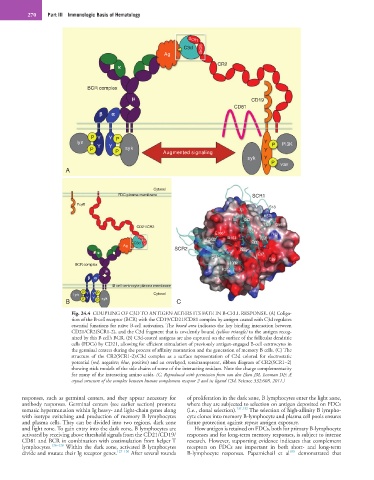
                        Fig. 24.4  COUPLING OF C3D TO ANTIGEN ALTERS ITS FATE IN B-CELL RESPONSE. (A) Coliga-
                        tion of the B-cell receptor (BCR) with the CD19/CD21/CD81 complex by antigen coated with C3d regulates
                        essential functions for naïve B-cell activation. The boxed area indicates the key binding interaction between
                        CD21/CR2(SCR1-2), and the C3d fragment that is covalently bound (yellow triangle) to the antigen recog-
                        nized by this B cell’s BCR. (B) C3d-coated antigens are also captured on the surface of the follicular dendritic
                        cells (FDCs) by CD21, allowing for efficient stimulation of previously antigen-engaged B-cell centrocytes in
                        the germinal centers during the process of affinity maturation and the generation of memory B cells. (C) The
                        structure  of  the  CR2(SCR1-2):C3d  complex  as  a  surface  representation  of  C3d  colored  for  electrostatic
                        potential (red, negative; blue, positive) and an overlayed, semitransparent, ribbon diagram of CR2(SCR1–2)
                        showing stick models of the side chains of some of the interacting residues. Note the charge complementarity
                        for many of the interacting amino acids. (C, Reproduced with permission from van den Elsen JM, Isenman DE: A
                        crystal structure of the complex between human complement receptor 2 and its ligand C3d. Science 332:608, 2011.)

        responses, such as germinal centers, and they appear necessary for   of proliferation in the dark zone, B lymphocytes enter the light zone,
        antibody responses. Germinal centers (see earlier section) promote   where they are subjected to selection on antigen deposited on FDCs
        somatic hypermutation within Ig heavy- and light-chain genes along   (i.e., clonal selection). 131,132  The selection of high-affinity B lympho-
        with isotype switching and production of memory B lymphocytes   cyte clones into memory B-lymphocyte and plasma cell pools ensures
        and plasma cells. They can be divided into two regions, dark zone   future protection against repeat antigen exposure.
        and light zone. To gain entry into the dark zone, B lymphocytes are   How antigen is retained on FDCs, both for primary B-lymphocyte
        activated by receiving above threshold signals from the CD21/CD19/  responses and for long-term memory responses, is subject to intense
        CD81 and BCR in combination with costimulation from helper T   research. However, supporting evidence indicates that complement
        lymphocytes. 126–128  Within the dark zone, activated B lymphocytes   receptors  on  FDCs  are  important  in  both  short-  and  long-term
                                                                                                105
        divide and mutate their Ig receptor genes. 127–130  After several rounds   B-lymphocyte  responses.  Papamichail  et  al   demonstrated  that

