


Page 330 - Hematology_ Basic Principles and Practice ( PDFDrive )
P. 330
272    Part III  Immunologic Basis of Hematology


                                                                         Spleen/bone marrow
                      B-cell    Spleen                 Germinal
                   compartment                          center                        lgG lo
                                           T-cell
                                        compartment                      B        B   CD21 hi
                                                                                          −
                      B           B          T           FDC                          CD23   Antigen
                                                                                Memory      selection
                                                                         B      compartment
                    Mature
                    µ+         Expansion                                           Long-term  Short-term
                    δ+                                                            effector cells effector cells
                    CD21+                             Antigen            T
                    CD23+     B   B   B              selection
                                                                                      B          B


                                                               CD21/  CD19   FcγR   MHC
                                 TCR     BCR    antigen  C3d   CD35                 peptide

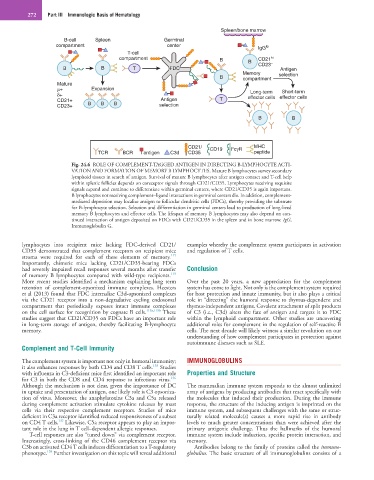
                        Fig. 24.6  ROLE OF COMPLEMENT-TAGGED ANTIGEN IN DIRECTING B-LYMPHOCYTE ACTI-
                        VATION AND FORMATION OF MEMORY B LYMPHOCYTES. Mature B lymphocytes survey secondary
                        lymphoid tissues in search of antigen. Survival of mature B lymphocytes after antigen contact and T-cell help
                        within splenic follicles depends on coreceptor signals through CD21/CD35. Lymphocytes receiving requisite
                        signals expand and continue to differentiate within germinal centers, where CD21/CD35 is again important.
                        B lymphocytes not receiving complement–ligand interactions in germinal centers die. In addition, complement-
                        mediated deposition may localize antigen to follicular dendritic cells (FDCs), thereby providing the substrate
                        for B-lymphocyte selection. Selection and differentiation in germinal centers lead to production of long-lived
                        memory B lymphocytes and effector cells. The lifespan of memory B lymphocytes may also depend on con-
                        tinued interaction of antigen deposited on FDCs with CD21/CD35 in the spleen and in bone marrow. IgG,
                        Immunoglobulin G.

        lymphocytes  into  recipient  mice  lacking  FDC-derived  CD21/  examples whereby the complement system participates in activation
        CD35 demonstrated that complement receptors on recipient mice   and regulation of T cells.
                                                         115
        stroma  were  required  for  each  of  these  elements  of  memory.
        Importantly,  chimeric  mice  lacking  CD21/CD35-bearing  FDCs
        had severely impaired recall responses several months after transfer   Conclusion
                                                         115
        of  memory  B  lymphocytes  compared  with  wild-type  recipients.
        More  recent  studies  identified  a  mechanism  explaining  long  term   Over  the  past  20  years,  a  new  appreciation  for  the  complement
        retention  of  complement-opsonized  immune  complexes.  Heesters   system has come to light. Not only is the complement system required
        et al (2013) found that FDC internalize C3d-opsonized complexes   for host protection and innate immunity, but it also plays a critical
        via  the  CD21  receptor  into  a  non-degradative  cycling  endosomal   role in “directing” the humoral response to thymus-dependent and
        compartment  that  periodically  exposes  intact  immune  complexes   thymus-independent antigens. Covalent attachment of split products
        on the cell surface for recognition by cognate B cells. 115a,115b  These   of  C3  (i.e.,  C3d)  alters  the  fate  of  antigen  and  targets  it  to  FDC
        studies suggest that CD21/CD35 on FDCs have an important role   within  the  lymphoid  compartment.  Other  studies  are  uncovering
        in  long-term  storage  of  antigen,  thereby  facilitating  B-lymphocyte     additional roles for complement in the regulation of self-reactive B
        memory.                                               cells. The next decade will likely witness a similar revolution on our
                                                              understanding of how complement participates in protection against
                                                              autoimmune diseases such as SLE.
        Complement and T-Cell Immunity

        The complement system is important not only in humoral immunity;   IMMUNOGLOBULINS
                                                   135
        it also enhances responses by both CD4 and CD8 T cells.  Studies
        with influenza in C3-deficient mice first identified an important role   Properties and Structure
                                                         136
        for C3 in both the CD8 and CD4 response to infectious virus.
        Although the mechanism is not clear, given the importance of DC   The mammalian immune system responds to the almost unlimited
        in uptake and presentation of antigen, one likely role is C3 opsoniza-  array of antigens by producing antibodies that react specifically with
        tion of virus. Moreover, the anaphylatoxins C3a and C5a released   the molecules that induced their production. During the immune
        during  complement  activation  stimulate  cytokine  releases  by  mast   response, the structure of the inducing antigen is imprinted on the
        cells  via  their  respective  complement  receptors.  Studies  of  mice   immune system, and subsequent challenges with the same or struc-
        deficient in C3a receptor identified reduced responsiveness of a subset   turally  related  molecule(s)  causes  a  more  rapid  rise  in  antibody
                    137
        on CD4 T cells.  Likewise, C5a receptor appears to play an impor-  levels to much greater concentrations than were achieved after the
        tant role in the lung in T cell–dependent allergic responses.  primary  antigenic  challenge.  Thus  the  hallmarks  of  the  humoral
           T-cell responses are also “tuned down” via complement receptor.   immune system include induction, specific protein interaction, and
        Interestingly,  cross-linking  of  the  CD46  complement  receptor  via   memory.
        C3b on activated CD4 T cells induces differentiation to a T-regulatory   Antibodies belong to the family of proteins called the immuno-
                138
        phenotype.  Further investigation on this topic will reveal additional   globulins. The basic structure of all immunoglobulins consists of a

