


Page 333 - Hematology_ Basic Principles and Practice ( PDFDrive )
P. 333
Chapter 24  Complement and Immunoglobulin Biology Leading to Clinical Translation  275


                                                                      IgG3
                                                                               V H
                                      IgG1             IgG2  V L                     IgG4
                                         V H             V H   C L           Cγ 1      V H
                                                                              3
                                      V L             V L                           V L
                                        C L             C L                           C L
                                              Cγ 1            Cγ 1                          Cγ 1
                                               1
                                                                                              2
                                                               2
                                                2               2              2              2
                                              Cγ 1            Cγ 2           Cγ 3           Cγ 4
                                 A            Cγ 1 3          Cγ 2 3         Cγ 3 3         Cγ 4 3

                                              V H  Cµ1
                                                           V L
                                                                                   Cα1
                                                         C L                       V H      V L
                                        Cµ3           Cµ2                                 C
                                        Cµ4                                                L

                                                                           Cα2
                                                                           Cα3
                                                                                           J chain
                                    J chain
                                                                                           Secretory
                                                                                           component


                             B                                             C
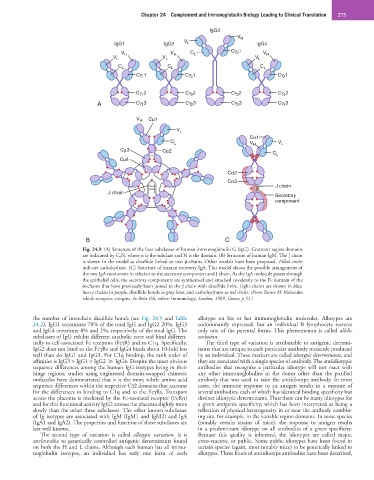
                            Fig. 24.9  (A) Structure of the four subclasses of human immunoglobulin G (IgG). Constant region domains
                            are indicated by C nN, where n is the subclass and N is the domain. (B) Structure of human IgM. The J chain
                            is shown in the model as disulfide linked to two µ-chains. Other models have been proposed. Filled circles
                            indicate carbohydrate. (C) Structure of human secretory IgA. This model shows the possible arrangement of
                            the two IgA monomers in relation to the secretory component and J chain. As the IgA molecule passes through
                            the epithelial cells, the secretory components are synthesized and attached covalently to the Fc domain of the
                            α-chains that have previously been joined to the J chain with disulfide links. Light chains are shown in blue,
                            heavy chains in purple, disulfide bonds as gray lines, and carbohydrates as red circles. (From Turner M: Molecules
                            which recognize antigens. In Roitt DK, editor: Immunology, London, 1989, Gower, p 51.)


            the number of interchain disulfide bonds (see Fig. 24.9 and Table   allotype  on  his  or  her  immunoglobulin  molecules.  Allotypes  are
            24.2). IgG1 constitutes 70% of the total IgG and IgG2 20%. IgG3   codominantly  expressed,  but  an  individual  B  lymphocyte  secretes
            and IgG4 constitute 8% and 2%, respectively, of the total IgG. The   only  one  of  the  parental  forms. This  phenomenon  is  called  allelic
            subclasses of IgG exhibit different catabolic rates and bind differen-  exclusion.
            tially to cell-associated Fc receptors (FcγR) and to C1q. Specifically,   The third type of variation is attributable to antigenic determi-
            IgG2 does not bind to the FcγRs and IgG4 binds about 10-fold less   nants that are unique to each particular antibody molecule produced
            well than do IgG1 and IgG3. For C1q binding, the rank order of   by an individual. These markers are called idiotypic determinants, and
            affinities is IgG3 > IgG1 > IgG2 ≫ IgG4. Despite the most obvious   they are associated with a single species of antibody. The antiidiotypic
            sequence differences among the human IgG isotypes being in their   antibodies  that  recognize  a  particular  idiotype  will  not  react  with
            hinge  regions,  studies  using  engineered  domain-swapped  chimeric   any  other  immunoglobulins  in  the  donor  other  than  the  purified
            molecules have demonstrated that it is the more subtle amino acid   antibody that was used to raise the antiidiotype antibody. In most
            sequence differences within the respective Cγ2 domains that account   cases,  the  immune  response  to  an  antigen  results  in  a  mixture  of
            for the differences in binding to C1q and to the FcγRs. Transport   several antibodies, each of which has identical binding specificity but
            across the placenta is mediated by the Fc-neonatal receptor (FcRn)   distinct idiotypic determinants. Thus there can be many idiotypes for
            and for this functional activity IgG2 crosses the placenta slightly more   a given antigenic specificity, which has been interpreted as being a
            slowly than the other three subclasses. The other known subclasses   reflection of physical heterogeneity in or near the antibody combin-
            of Ig isotypes are associated with IgM (IgM1 and IgM2) and IgA   ing site, for example, in the variable region domains. In some species
            (IgA1 and IgA2). The properties and function of these subclasses are   (notably  certain  strains  of  mice),  the  response  to  antigen  results
            less well known.                                      in  a  predominant  idiotype  on  all  antibodies  of  a  given  specificity.
              The  second  type  of  variation  is  called  allotypic  variation.  It  is   Because  this  quality  is  inherited,  the  idiotypes  are  called  major,
            attributable to genetically controlled antigenic determinants found   cross-reactive, or public. Some public idiotypes have been found in
            on both the H and L chains. Although each human has all immu-  certain species (again, most notably mice) to be genetically linked to
            noglobulin  isotypes,  an  individual  has  only  one  form  of  each   allotypes. Three kinds of antiidiotype antibodies have been described,

