


Page 332 - Hematology_ Basic Principles and Practice ( PDFDrive )
P. 332
274    Part III  Immunologic Basis of Hematology


        correspondence in amino acids, position for position, to the carboxy-  the total Ig in blood. It is present in normal adults at concentrations
        terminus. The H chains exhibit a similar pattern and can be divided   of 600 to 1500 mg/dL. IgG is designated γ2κ2 or γ2λ2. It is the only
        likewise into V H and C H1, C H2, and C H3. Comparison of the amino   class of Ig that crosses the placenta (Table 24.2). 142
        acid sequence of many V L s has revealed that whereas certain parts of   The isotype IgM is predominantly a pentamer consisting of five
        the variable region exhibit excess variability, others are less variable.   monomeric units disulfide linked at the C-terminus of the H chain.
        The  former  regions  are  called  hypervariable  or  complementarity-  Each  monomer  of  IgM  is  180 kDa  because  of  the  presence  of  an
        determining regions (CDRs). The latter framework regions function   additional C H domain, specifically the Cµ2 domain, which replaces
        as  a  structural  scaffold  to  support  the  CDRs.  Antigen  binding  is   the hinge segment. The complete protein has a sedimentation coef-
        mediated by six CDRs, three in each of the V H and V L  domains. The   ficient of 19 S, which corresponds to a molecular mass of 850 kDa.
        combining site for antigen  is  a  trough, cavity, or even  flat  surface   IgM is designated (µ2κ2) 5 or (µ2λ2) 5. IgM also contains a 15-kDa
        composed of parts of the hypervariable regions of both the H and L   protein called the J chain. In the current structural model of IgM,
        chains. It is a small region, representing only 25% of the antibody V   the J chain forms a disulfide-bonded clasp at the C-terminus of two
        region. The  region  that  interacts  directly  with  the  epitope  on  the   H chains (Fig. 24.9). 139
        antigen is even smaller and is formed by the association of the CDR   The structure of the other isotypes of immunoglobulins are sum-
        regions,  each  of  which  consists  of  approximately  20  amino  acids.   marized  as  follows.  The  isotype  IgA  has  a  variable  number  of
        Thus the variation in a few amino acids accounts for the specificity   monomeric units and is designated (α2κ2) n  or (α2λ2) n , where n =
        and diversity of antibodies with respect to antigen binding. 141  1–5. Serum IgA constitutes 20% of the total serum immunoglobulin,
           Immunoglobulins  exhibit  additional  physical  heterogeneity,   and 80% of this is monomeric. The remainder exists as polymers,
        which imparts to each immunoglobulin a special effector function   where n = 2–5. The other form of IgA is found in external secretions
        that is reflected in unique biologic properties independent of antigen-  such  as  saliva,  tracheobronchial  secretions,  colostrum,  milk,  and
        binding activity. In the pregenome era of immunochemical research,   genitourinary secretions. Secretory IgA consists of four components:
        heterologous and autologous antisera raised against immunoglobulins   a dimer of two monomeric molecules, a 70-kDa secretory component
        were used to classify three types of physical heterogeneity. The first   that binds noncovalently to the IgA dimer, and the 15-kDa J chain
        kind is based on the antigenic heterogeneity exhibited by immuno-  that is believed to form a disulfide-bonded clasp at the C-terminus
        globulin when it is used as an immunogen in other species. This is   of the H chains (see Fig. 24.9). The isotype IgD has a molecular mass
        called class or isotypic variation. In humans, five isotypes can be dis-  of  180 kDa.  Its  serum  concentration  is  very  low,  approximately
        tinguished based on unique antigenic (isotypic) determinants found   3 mg/dL. IgD apparently functions as a membrane molecule, being
        on the H chain. These are designated by capital Roman letters as IgG,   associated  on  mature  but  unstimulated  B  cells  in  association  with
        IgM, IgA, IgD, and IgE. The H chain of each class is designated by   IgM. IgE is the homocytotropic or reaginic Ig and mediates immedi-
        the lower-case Greek letter corresponding to the Roman letter of the   ate hypersensitivity. It has a molecular mass of 180 kDa and, similar
        class. Thus the H chain for IgG is γ, for IgM is µ, for IgA is α, for   to IgM, has four C domains. The Fc portion of IgE binds strongly
        IgD is δ, and for IgE is ε. Some of the immunoglobulin classes are   to a receptor on mast cells, FcεR, and this is how this immunoglobu-
        composed of polymers of the basic monomer. In humans, the two   lin exerts its particular activity. The overall properties of the immu-
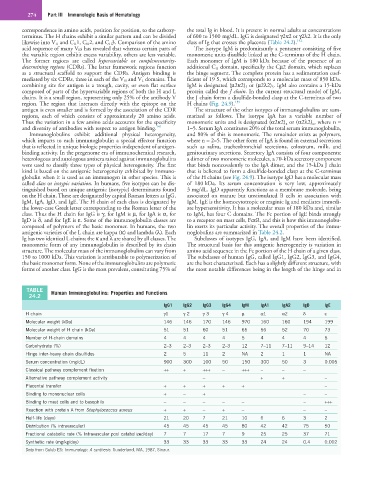
        antigenic varieties of the L chain are kappa (κ) and lambda (λ). Each   noglobulins are summarized in Table 24.2.
        Ig has two identical L chains; the κ and λ are shared by all classes. The   Subclasses of isotypes IgG, IgA, and IgM have been identified.
        monomeric form of any immunoglobulin is described by its chain   The structural basis for this antigenic heterogeneity is variation in
        structure. The molecular mass of the immunoglobulins can vary from   amino acid sequence in the Fc portion of the H chain of a given class.
        150 to 1000 kDa. This variation is attributable to polymerization of   The subclasses of human IgG, called IgG1, IgG2, IgG3, and IgG4,
        the basic monomer form. None of the immunoglobulins are polymeric   are the best characterized. Each has a slightly different structure, with
        forms of another class. IgG is the most prevalent, constituting 75% of   the most notable differences being in the length of the hinge and in


          TABLE   Human Immunoglobulins: Properties and Functions
          24.2
                                                       IgG1  IgG2  IgG3   IgG4  IgM   IgA1   IgA2   IgD    IgE
         H chain                                       γ1    γ 2   γ 3    γ 4   µ     α1     α2     δ      ε
         Molecular weight (kDa)                        146   146   170    146   970   160    160    194    199
         Molecular weight of H chain (kDa)             51    51    60     51    65    56     52     70     73
         Number of H-chain domains                     4     4     4      4     5     4      4      4      5
         Carbohydrate (%)                              2–3   2–3   2–3    2–3   12    7–11   7–11   9–14   12
         Hinge inter-heavy chain disulfides            2     5     11     2     NA    2      1      1      NA
         Serum concentration (mg/dL)                   900   300   100    50    150   300    50     3      0.005
         Classical pathway complement fixation         ++    +     +++    −     +++   −      −      −
         Alternative pathway complement activity                   −                  +      +             −
         Placental transfer                            +     +     +      +     +                          −
         Binding to mononuclear cells                  +     −     +                                −      −
         Binding to mast cells and to basophils        −     −     −      −     −                   −      +++
         Reaction with protein A from Staphylococcus aureus  +  +  −      +     −                   −      −
         Half-life (days)                              21    20    7      21    10    6      6      3      2
         Distribution (% intravascular)                45    45    45     45    80    42     42     75     50
         Fractional catabolic rate (% Intravascular pool catabolized/day)  7  7  17  7  9  25  25   37     71
         Synthetic rate (mg/kg/day)                    33    33    33     33    33    24     24     0.4    0.002
         Data from Golub ES: Immunology: A synthesis. Sunderland, MA, 1987, Sinaur.

