


Page 331 - Hematology_ Basic Principles and Practice ( PDFDrive )
P. 331
Chapter 24  Complement and Immunoglobulin Biology Leading to Clinical Translation  273


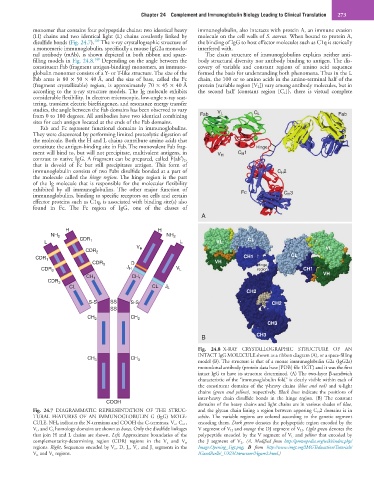
            monomer that contains four polypeptide chains: two identical heavy   immunoglobulin, also interacts with protein A, an immune evasion
            (H) chains and two identical light (L) chains covalently linked by   molecule on the cell walls of S. aureus. When bound to protein A,
                                139
            disulfide bonds (Fig. 24.7).  The x-ray crystallographic structure of   the binding of IgG to host effector molecules such as C1q is sterically
            a monomeric immunoglobulin, specifically a mouse IgG2a monoclo-  interfered with.
            nal antibody (mAb), is shown depicted in both ribbon and space-  The  chain  structure  of  immunoglobulins  explains  neither  anti-
                                140
            filling models in Fig. 24.8.  Depending on the angle between the   body structural diversity nor antibody binding to antigen. The dis-
            constituent Fab (fragment antigen-binding) monomers, an immuno-  covery  of  variable  and  constant  regions  of  amino  acid  sequence
            globulin monomer consists of a Y- or T-like structure. The size of the   formed the basis for understanding both phenomena. Thus in the L
            Fab  arms  is  80  ×  50  ×  40 Å,  and  the  size  of  base,  called  the  Fc   chain, the 100 or so amino acids in the amino-terminal half of the
            (fragment  crystallizable)  region,  is  approximately  70  ×  45  ×  40 Å   protein (variable region [V L ]) vary among antibody molecules, but in
            according  to  the  x-ray  structure  models. The  Ig  molecule  exhibits   the  second  half  (constant  region  [C L ]),  there  is  virtual  complete
            considerable flexibility. In electron microscopic, low-angle x-ray scat-
            tering, transient electric birefringence, and resonance energy transfer
            studies, the angle between the Fab domains has been observed to vary   V L
            from 0 to 180 degrees. All antibodies have two identical combining   Fab  C L                       Fab
            sites for each antigen located at the ends of the Fab domains.
              Fab  and  Fc  represent  functional  domains  in  immunoglobulins.
            They were discovered by performing limited proteolytic digestion of
            the molecule. Both the H and L chains contribute amino acids that
            constitute the antigen-binding site in Fab. The monovalent Fab frag-     Hinge
            ment will bind to, but will not precipitate, multivalent antigens, in   V H  C H 1
            contrast to native IgG. A fragment can be prepared, called F(ab′) 2,
            that  is  devoid  of  Fc  but  still  precipitates  antigen.  This  form  of
            immunoglobulin consists of two Fabs disulfide bonded at a part of               C H 2
            the  molecule  called  the  hinge  region. The  hinge  region  is  the  part
            of  the  Ig  molecule  that  is  responsible  for  the  molecular  flexibility
            exhibited  by  all  immunoglobulins.  The  other  major  function  of   Fc
            immunoglobulins, binding to specific receptors on cells and certain               C H 3
            effector proteins such as C1q, is associated with binding site(s) also
            found  in  Fc.  The  Fc  region  of  IgG,  one  of  the  classes  of
                                                                   A

                      H                              H
                  NH 2                                 NH 2
                L          CDR 1                            L           VL        CL
                                              V H                                                           VL
                             CDR 2
             CDR 1                                                               CH1            CL
                               CDR 3        D                          VH            Hinge
               CDR 2                      J H              V L                       region         CH1
                                                                                                           VH
                             CH 1           CH 1
                 CDR 3
                        CL                         CL  J L
                                                                                  CH2
                              S-S    SS     S-S                                           CH2
                                     SS
                              CH 2          CH 2
                                                                                         CH3

                                                                   B                 CH3

                                                                  Fig.  24.8  X-RAY  CRYSTALLOGRAPHIC  STRUCTURE  OF  AN
                                                                  INTACT IgG MOLECULE shown as a ribbon diagram (A), or a space-filling
                              CH 3          CH 3                  model (B). The structure is that of a mouse immunoglobulin G2a (IgG2a)
                                                                  monoclonal antibody (protein data base [PDB] file 1IGT) and it was the first
                                                                  intact IgG to have its structure determined. (A) The two-layer β-sandwich
                                                                  characteristic of the “immunoglobulin fold” is clearly visible within each of
                                                                  the  constituent  domains  of  the  γ-heavy  chains  (blue  and  red)  and  κ-light
                                                                  chains (green and yellow), respectively. Black lines indicate the positions of
                                                                  inter-heavy  chain  disulfide  bonds  in  the  hinge  region.  (B)  The  constant
                                    COOH
                                                                  domains of the heavy chains and light chains are in various shades of blue,
            Fig.  24.7  DIAGRAMMATIC  REPRESENTATION  OF  THE  STRUC-  and the glycan chain lining a region between apposing C H 2 domains is in
            TURAL  FEATURES  OF  AN  IMMUNOGLOBULIN  G  (IgG)  MOLE-  white.  The  variable  regions  are  colored  according  to  the  genetic  segment
            CULE. NH 2  indicates the N-terminus and COOH the C-terminus. V h , C h1 ,   encoding them. Dark green denotes the polypeptide region encoded by the
            V l , and C l  homology domains are shown as boxes. Only the disulfide linkages   V segment of V H  and orange the DJ segment of V H . Light green denotes the
            that join H and L chains are shown. Left, Approximate boundaries of the   polypeptide encoded by the V segment of V L  and yellow that encoded by
            complementarity-determining  region  (CDR)  regions  in  the  V l  and  V h    the  J  segment  of  V L.  (A,  Modified  from  http://proteopedia.org/wiki/index.php/
            regions. Right, Sequences encoded by V h , D, J h , V l, and J l segments in the   Image:Opening_1igt.png;  B  from  http://www.imgt.org/IMGTeducation/Tutorials/
            V h  and V l regions.                                 IGandBcells/_UK/3Dstructure/Figure2.html.)

