


Page 417 - Hematology_ Basic Principles and Practice ( PDFDrive )
P. 417
338    Part IV  Disorders of Hematopoietic Cell Development


                                                              megakaryocytes with BM stromal cells inhibits megakaryocyte dif-
                              VE-cadherin                     ferentiation.  These  mechanisms  are  likely  in  place  to  coordinate
              Vascular niche
                                                              terminal megakaryocyte maturation with vascular access, facilitating
                    Sinusoidal                Platelets       the efficient delivery of platelets into circulation.
                       vessel
                                                              CYTOKINE REGULATION OF THROMBOCYTOPOIESIS
           Progenitors
                               FGF-4. SDF-1
                                                              Thrombopoietin Signaling

                                                              Thrombopoietin
                           TPO            Physiologic stress
           Stem cell                    (marrow suppression)  It has been estimated that an adult human produces nearly 2 × 10
                                                                                                               11
             Osteoblastic niche                               platelets per day, and this number can increase fourfold to eightfold
                                                                                        11
                                                              during times of increased demand.  The regulation of this process
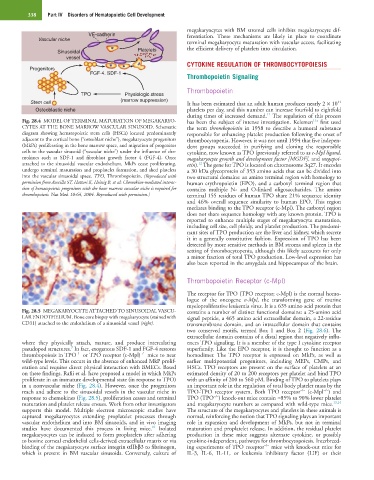
        Fig. 28.4  MODEL OF TERMINAL MATURATION OF MEGAKARYO-  has been the subject of intense investigation. Kelemen  first used
                                                                                                       11a
        CYTES AT THE BONE MARROW VASCULAR SINUSOID. Schematic   the  term  thrombopoietin  in  1958  to  describe  a  humoral  substance
        diagram  showing  hematopoietic  stem  cells  (HSCs)  located  predominantly   responsible for enhancing platelet production following the onset of
        adjacent to the cortical bone (“osteoblast niche”), megakaryocyte progenitors   thrombocytopenia. However, it was not until 1994 that five indepen-
        (MkPs) proliferating in the bone marrow space, and migration of progenitor   dent  groups  succeeded  in  purifying  and  cloning  the  responsible
        cells to the vascular sinusoid (“vascular niche”) under the influence of che-  cytokine, now known as TPO (previously referred to as c-Mpl ligand,
        mokines  such  as  SDF-1  and  fibroblast  growth  factor  4  (FGF-4).  Once   megakaryocyte growth and development factor [MGDF], and megapoi-
        attached to the sinusoidal vascular endothelium, MkPs cease proliferating,   etin).  The gene for TPO is located on chromosome 3q27. It encodes
                                                                  12
        undergo terminal maturation and proplatelet formation, and shed platelets   a 30 kDa glycoprotein of 353 amino acids that can be divided into
        into the vascular sinusoidal space. TPO, Thrombopoietin. (Reproduced with   two structural domains: an amino terminal region with homology to
        permission from Avecilla ST, Hattori K, Heissig B, et al: Chemokine-mediated interac-  human erythropoietin (EPO), and a carboxyl terminal region that
        tion of hematopoietic progenitors with the bone marrow vascular niche is required for   contains  multiple  N-  and  O-linked  oligosaccharides.  The  amino
        thrombopoiesis. Nat Med 10:64, 2004. Reproduced with permission.)  terminal 155 residues of human TPO share 21% sequence identity
                                                              and  46%  overall  sequence  similarity  to  human  EPO. This  region
                                                              mediates binding to the TPO receptor (c-Mpl). The carboxyl region
                                                              does not share sequence homology with any known protein. TPO is
                                                              reported to enhance multiple stages of megakaryocyte maturation,
                                                              including cell size, cell ploidy, and platelet production. The predomi-
                                                              nant sites of TPO production are the liver and kidney, which secrete
                                                              it in a generally constitutive fashion. Expression of TPO has been
                                                              detected by more sensitive methods in BM stroma and spleen in the
                                                              setting of thrombocytopenia, although this likely accounts for only
                                                              a minor fraction of total TPO production. Low-level expression has
                                                              also been reported in the amygdala and hippocampus of the brain.

                                                              Thrombopoietin Receptor (c-Mpl)

                                                              The receptor for TPO (TPO receptor; c-Mpl) is the normal homo-
                                                              logue  of  the  oncogene  v-Mpl,  the  transforming  gene  of  murine
                                                              myeloproliferative leukemia virus. It is a 635 amino acid protein that
        Fig. 28.5  MEGAKARYOCYTE ATTACHED TO SINUSOIDAL VASCU-  contains a number of distinct functional domains: a 25-amino acid
        LAR ENDOTHELIUM. Bone core biopsy with megakaryocyte (stained with   signal peptide, a 465 amino acid extracellular domain, a 22-residue
        CD31) attached to the endothelium of a sinusoidal vessel (right).   transmembrane domain, and an intracellular domain that contains
                                                              two  conserved  motifs,  termed  Box  1  and  Box  2  (Fig.  28.6). The
                                                              extracellular domain contains of a distal region that negatively influ-
        where  they  physically  attach,  mature,  and  produce  intercalating   ences TPO signaling. It is a member of the type I cytokine receptor
                        9
        pseudopod structures.  In fact, exogenous SDF-1 and FGF-4 restores   superfamily. Like the EPO receptor, it is thought to function as a
                          −/−
                                               −/−
        thrombopoiesis in TPO  or TPO receptor (c-Mpl)  mice to near   homodimer.  The  TPO  receptor  is  expressed  on  MkPs,  as  well  as
        wild-type levels. This occurs in the absence of enhanced MkP prolif-  earlier  multipotential  progenitors,  including  MEPs,  CMPs,  and
        eration and requires direct physical interaction with BMECs. Based   HSCs. TPO receptors are present on the surface of platelets at an
        on these findings, Rafii et al. have proposed a model in which MkPs   estimated density of 20 to 200 receptors per platelet and bind TPO
        proliferate in an immature developmental state (in response to TPO)   with an affinity of 200 to 560 pM. Binding of TPO to platelets plays
        in a nonvascular niche (Fig. 28.4). However, once the progenitors   an important role in the regulation of total body platelet mass by the
                                                                                                           −/−
                                                                                                   −/−
        reach and adhere to the sinusoidal vessels in the vascular niche in   TPO-TPO  receptor  system.  Both TPO  receptor   (c-Mpl )  and
                                                                       −/−
        response to chemokines (Fig. 28.5), proliferation ceases and terminal   TPO (TPO ) knock-out mice contain ≈85% to 90% lower platelet
        maturation and platelet release ensues. Work from other investigators   and megakaryocyte numbers as compared with wild-type mice. 13,14
        supports  this  model.  Multiple  electron  microscopic  studies  have   The structure of the megakaryocytes and platelets in these animals is
        captured  megakaryocytes  extending  proplatelet  processes  through   normal, reinforcing the notion that TPO signaling plays an important
        vascular endothelium and into BM sinusoids, and in vivo imaging   role  in  expansion  and  development  of  MkPs,  but  not  in  terminal
                                                   10
        studies  have  documented  this  process  in  living  mice.   Isolated   maturation and proplatelet release. In addition, the residual platelet
        megakaryocytes can be induced to form proplatelets after adhering   production  in  these  mice  suggests  alternate  cytokine,  or  possibly
        to bovine corneal endothelial cells-derived extracellular matrix or via   cytokine-independent, pathways for thrombocytopoiesis. Interbreed-
                                                                                       −/−
        binding of the megakaryocyte surface integrin αIIbβ3 to fibrinogen,   ing experiments of TPO receptor  mice with knock-out mice for
        which  is  present  in  BM  vascular  sinusoids.  Conversely,  culture  of   IL-3,  IL-6,  IL-11,  or  leukemia  inhibitory  factor  (LIF)  or  their

