


Page 416 - Hematology_ Basic Principles and Practice ( PDFDrive )
P. 416
Chapter 28  Thrombocytopoiesis  337


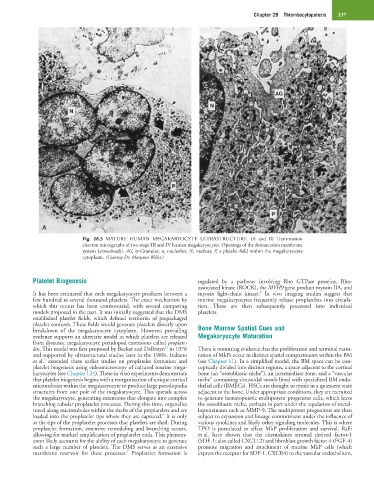
                            Fig.  28.3  MATURE  HUMAN  MEGAKARYOCYTE  ULTRASTRUCTURE.  (A  and  B)  Transmission
                            electron micrographs of two stage III and IV human megakaryocytes. Openings of the demarcation membrane
                            system (arrowheads). AG, α-Granules; n, nucleolus; N, nucleus; P, a platelet field within the megakaryocyte
                            cytoplasm. (Courtesy Dr. Maryann Weller.)


            Platelet Biogenesis                                   regulated  by  a  pathway  involving  Rho  GTPase  proteins,  Rho-
                                                                  associated kinase (ROCK), the MYH9 gene product myosin IIA, and
                                                                                      8
            It has been estimated that each megakaryocyte produces between a   myosin  light-chain  kinase.   In  vivo  imaging  studies  suggest  that
            few hundred to several thousand platelets. The exact mechanism by   murine megakaryocytes frequently release proplatelets into circula-
            which  this  occurs  has  been  controversial,  with  several  competing   tion.  These  are  then  subsequently  processed  into  individual
            models proposed in the past. It was initially suggested that the DMS   platelets.
            established  platelet  fields,  which  defined  territories  of  prepackaged
            platelet contents. These fields would generate platelets directly upon
            breakdown  of  the  megakaryocyte  cytoplasm.  However,  prevailing   Bone Marrow Spatial Cues and
            evidence supports an alternate model in which platelets are released   Megakaryocyte Maturation
            from dynamic megakaryocyte pseudopod extensions called proplate-
                                                       4a
            lets. This model was first proposed by Becker and DeBruyn  in 1976   There is mounting evidence that the proliferation and terminal matu-
            and supported by ultrastructural studies later in the 1980s. Italiano   ration of MkPs occur in distinct spatial compartments within the BM
               5
            et al.   extended  these  earlier  studies  on  proplatelet  formation  and   (see Chapter 11). In a simplified model, the BM space can be con-
            platelet biogenesis using videomicroscopy of cultured murine mega-  ceptually divided into distinct regions, a space adjacent to the cortical
            karyocytes (see Chapter 124). These in vitro experiments demonstrate   bone (an “osteoblastic niche”), an intermediate zone, and a “vascular
            that platelet biogenesis begins with a reorganization of unique cortical   niche” containing sinusoidal vessels lined with specialized BM endo-
            microtubules within the megakaryocyte to produce large pseudopodia   thelial cells (BMECs). HSCs are thought to reside in a quiescent state
            structures from one pole of the megakaryocyte. This spreads across   adjacent to the bone. Under appropriate conditions, they are recruited
            the megakaryocyte, generating extensions that elongate into complex   to generate hematopoietic multipotent progenitor cells, which leave
            branching tubular proplatelet processes. During this time, organelles   the osteoblastic niche, perhaps in part under the regulation of metal-
            travel along microtubules within the shafts of the proplatelets and are   loproteinases such as MMP-9. The multipotent progenitors are then
                                                      6
            loaded into the proplatelet tips where they are captured.  It is only   subject to expansion and lineage commitment under the influence of
            at the tips of the proplatelet processes that platelets are shed. During   various cytokines and likely other signaling molecules. This is where
            proplatelet  formation,  extensive  remodeling  and  branching  occurs,   TPO  is  postulated  to  affect  MkP  proliferation  and  survival.  Rafii
            allowing for marked amplification of proplatelet ends. This phenom-  et al.  have  shown  that  the  chemokines  stromal  derived  factor-1
            enon likely accounts for the ability of each megakaryocyte to generate   (SDF-1; also called CXCL12) and fibroblast growth factor-4 (FGF-4)
            such a large number of platelets. The DMS serves as an extensive   promote  migration  and  attachment  of  murine  MkP  cells  (which
                                          7
            membrane  reservoir  for  these  processes.   Proplatelet  formation  is   express the receptor for SDF-1, CXCR4) to the vascular endothelium,

