


Page 415 - Hematology_ Basic Principles and Practice ( PDFDrive )
P. 415
336    Part IV  Disorders of Hematopoietic Cell Development


         A                                B                                C


         D                         E                         F                           G           H
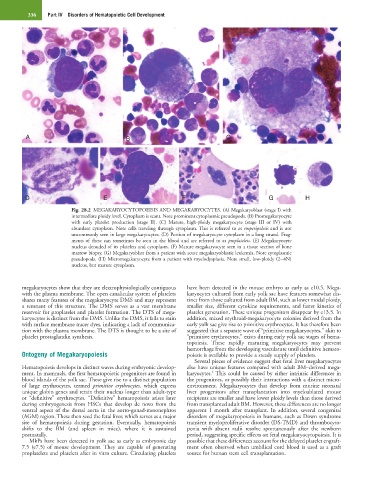
                        Fig. 28.2  MEGAKARYOCYTOPOEISIS AND MEGAKARYOCYTES. (A) Megakaryoblast (stage I) with
                        intermediate ploidy level. Cytoplasm is scant. Note prominent cytoplasmic pseudopods. (B) Promegakaryocyte
                        with  early  platelet  production  (stage  II).  (C)  Mature,  high-ploidy  megakaryocyte  (stage  III  or  IV)  with
                        abundant cytoplasm. Note cells traveling through cytoplasm. This is referred to as emperipolesis and is not
                        uncommonly seen in large megakaryocytes. (D) Portion of megakaryocyte cytoplasm in a long strand. Frag-
                        ments of these can sometimes be seen in the blood and are referred to as proplatelets. (E) Megakaryocyte
                        nucleus denuded of its platelets and cytoplasm. (F) Mature megakaryocyte seen in a tissue section of bone
                        marrow biopsy. (G) Megakaryoblast from a patient with acute megakaryoblastic leukemia. Note cytoplasmic
                        pseudopods. (H) Micromegakaryocyte from a patient with myelodysplasia. Note small, low-ploidy (2−4N)
                        nucleus, but mature cytoplasm.


        megakaryocytes show that they are electrophysiologically contiguous   have been detected in the mouse embryo as early as e10.5. Mega-
        with the plasma membrane. The open canalicular system of platelets   karyocytes cultured from early yolk sac have features somewhat dis-
        shares many features of the megakaryocyte DMS and may represent   tinct from those cultured from adult BM, such as lower modal ploidy,
        a remnant of this structure. The DMS serves as a vast membrane   smaller size, different cytokine requirements, and faster kinetics of
        reservoir for proplatelet and platelet formation. The DTS of mega-  platelet generation. These unique progenitors disappear by e13.5. In
        karyocytes is distinct from the DMS. Unlike the DMS, it fails to stain   addition, mixed erythroid-megakaryocyte colonies derived from the
        with surface membrane tracer dyes, indicating a lack of communica-  early yolk sac give rise to primitive erythrocytes. It has therefore been
        tion with the plasma membrane. The DTS is thought to be a site of   suggested that a separate wave of “primitive megakaryocytes,” akin to
        platelet prostaglandin synthesis.                     “primitive erythrocytes,” exists during early yolk sac stages of hema-
                                                              topoiesis.  These  rapidly  maturing  megakaryocytes  may  prevent
                                                              hemorrhage from the developing vasculature until definitive hemato-
        Ontogeny of Megakaryopoiesis                          poiesis is available to provide a steady supply of platelets.
                                                                 Several pieces of evidence suggest that fetal liver megakaryocytes
        Hematopoiesis develops in distinct waves during embryonic develop-  also have unique features compared with adult BM–derived mega-
                                                                      4
        ment. In mammals, the first hematopoietic progenitors are found in   karyocytes.  This could be caused by either intrinsic differences in
        blood islands of the yolk sac. These give rise to a distinct population   the progenitors, or possibly their interactions with a distinct micro-
        of  large  erythrocytes,  termed  primitive  erythrocytes,  which  express   environment.  Megakaryocytes  that  develop  from  murine  neonatal
        unique globin genes and retain their nucleus longer than adult-type   liver  progenitors  after  transplantation  into  myeloablated  mouse
        or  “definitive”  erythrocytes.  “Definitive”  hematopoiesis  arises  later   recipients are smaller and have lower ploidy levels than those derived
        during  embryogenesis  from  HSCs  that  develop  de  novo  from  the   from transplanted adult BM. However, these differences are no longer
        ventral  aspect  of  the  dorsal  aorta  in  the  aorto-gonad-mesonephros   apparent  1  month  after  transplant.  In  addition,  several  congenital
        (AGM) region. These then seed the fetal liver, which serves as a major   disorders of megakaryopoiesis in humans, such as Down syndrome
        site  of  hematopoiesis  during  gestation.  Eventually,  hematopoiesis   transient myeloproliferative disorder (DS-TMD) and thrombocyto-
        shifts  to  the  BM  (and  spleen  in  mice),  where  it  is  sustained   penia  with  absent  radii  resolve  spontaneously  after  the  newborn
        postnatally.                                          period, suggesting specific effects on fetal megakaryocytopoiesis. It is
           MkPs have been detected in yolk sac as early as embryonic day   possible that these differences account for the delayed platelet engraft-
        7.5  (e7.5)  of  mouse  development. They  are  capable  of  generating   ment often observed when umbilical cord blood is used as a graft
        proplatelets and platelets after in vitro culture. Circulating platelets   source for human stem cell transplantation.

