


Page 514 - Hematology_ Basic Principles and Practice ( PDFDrive )
P. 514
434    Part IV  Disorders of Hematopoietic Cell Development


        hypergammaglobulinemia and hypogammaglobulinemia and T- and   hematologic disorder requires a bone marrow examination that may
        NK-cell abnormalities of various causes (both inherited and acquired)   be consistent with an early form of aplastic anemia or MDS.
        can also be associated with neutropenia.
                                                              THERAPY
        Other Iatrogenic Forms of Neutropenia
                                                              For  secondary  neutropenias,  the  therapy  is  aimed  at  the  primary
        Hemodialysis can result in neutropenia. One important mechanism   disease.  If  potentially  offending  drugs  are  present,  they  should  be
        postulated is through activation of the plasma complement pathway   discontinued. G-CSF may be used for severe cases of both primary
        by dialyzer cellophane membranes and generation of C5a (desarg)   and secondary neutropenias. It may help to speed up recovery, but if
        that causes reversible neutrophil aggregation, resulting in transient   the  primary  cause  persists,  it  will  have  only  a  temporary  effect.
        neutropenia. Similar mechanisms to explain neutropenia have been   Primary or idiopathic neutropenias most often have an autoimmune
        suggested in other clinical settings, including leukapheresis and car-  cause.  Prednisone  may  be  used  as  first-line  therapy,  but  other  B
        diopulmonary bypass surgery.                          cell–targeted  agents  may  be  needed,  including  rituximab.  IVIg  is
                                                              effective in certain cases of PWCA. Finally, similar to the treatments
                                                              applied  for  T-LGL  leukemia,  T  cell–targeted  approaches,  such  as
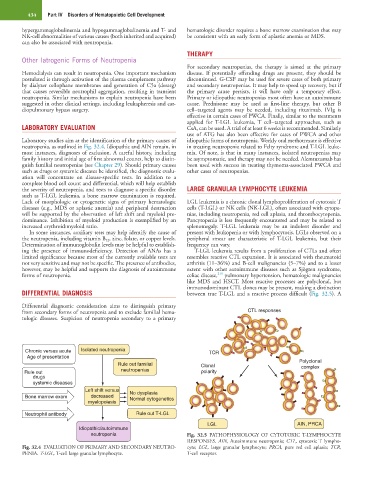
        LABORATORY EVALUATION                                 CsA, can be used. A trial of at least 6 weeks is recommended. Similarly
                                                              use  of  ATG  has  also  been  effective  for  cases  of  PWCA  and  other
        Laboratory studies aim at the identification of the primary causes of   idiopathic forms of neutropenia. Weekly oral methotrexate is effective
        neutropenia, as outlined in Fig. 32.4. Idiopathic and AIN remain, in   in treating neutropenia related to Felty syndrome and T-LGL leuke-
        most instances, diagnoses of exclusion. A careful history, including   mia. Of note, is that in many instances, isolated neutropenias may
        family history and initial age of first abnormal counts, help to distin-  be asymptomatic, and therapy may not be needed. Alemtuzumab has
        guish familial neutropenias (see Chapter 29). Should primary causes   been used with success in treating thymoma-associated PWCA and
        such as drugs or systemic diseases be identified, the diagnostic evalu-  other cases of neutropenias.
        ation  will  concentrate  on  disease-specific  tests.  In  addition  to  a
        complete blood cell count and differential, which will help establish
        the severity of neutropenia, and tests to diagnose a specific disorder   LARGE GRANULAR LYMPHOCYTE LEUKEMIA
        such as T-LGL leukemia, a bone marrow examination is required.
        Lack  of  morphologic  or  cytogenetic  signs  of  primary  hematologic   LGL leukemia is a chronic clonal lymphoproliferation of cytotoxic T
        diseases (e.g., MDS or aplastic anemia) and peripheral destruction   cells (T-LGL) or NK cells (NK-LGL), often associated with cytope-
        will be supported by the observation of left shift and myeloid pre-  nias, including neutropenia, red cell aplasia, and thrombocytopenia.
        dominance. Inhibition of myeloid production is exemplified by an   Pancytopenia is less frequently encountered and may be related to
        increased erythroid:myeloid ratio.                    splenomegaly.  T-LGL  leukemia  may  be  an  indolent  disorder  and
           In some instances, auxiliary tests may help identify the cause of   present with leukopenia or with lymphocytosis. LGLs observed on a
        the neutropenia, including vitamin B 12 , zinc, folate, or copper levels.   peripheral  smear  are  characteristic  of  T-LGL  leukemia,  but  their
        Determination of immunoglobulin levels may be helpful to establish-  frequency can vary.
        ing  the  presence  of  immunodeficiency.  Detection  of  ANAs  has  a   T-LGL leukemia results from a proliferation of CTLs and often
        limited significance because most of the currently available tests are   resembles reactive CTL expansion. It is associated with rheumatoid
        not very sensitive and may not be specific. The presence of antibodies,   arthritis (11–36%) and B-cell malignancies (5–7%) and to a lesser
        however, may be helpful and supports the diagnosis of autoimmune   extent with other autoimmune diseases such as Sjögren syndrome,
                                                                        219
        forms of neutropenia.                                 celiac disease,  pulmonary hypertension, hematologic malignancies
                                                              like  MDS  and  HSCT.  Most  reactive  processes  are  polyclonal,  but
                                                              immunodominant CTL clones may be present, making a distinction
        DIFFERENTIAL DIAGNOSIS                                between true T-LGL and a reactive process difficult (Fig. 32.5). A

        Differential  diagnostic  consideration  aims  to  distinguish  primary
        from secondary forms of neutropenia and to exclude familial hema-         CTL responses
        tologic  diseases.  Suspicion  of  neutropenia  secondary  to  a  primary


         Chronic versus acute  Isolated neutropenia                  TCR
          Age of presentation
                                        Rule out familial          Clonal                          Polyclonal
                                                                                                    complex
         Rule out                        neutropenias              polarity
            drugs
            systemic diseases
                             Left shift versus  No dysplasia
         Bone marrow exam      decreased   Normal cytogenetics
                              myelopoiesis

         Neutrophil antibody                  Rule out T-LGL
                                                                     LGL                          AIN, PRCA
                           Idiopathic/autoimmune
                               neutropenia                    Fig.  32.5  PATHOPHYSIOLOGY  OF  CYTOTOXIC T-LYMPHOCYTE
                                                              RESPONSES. AIN, Autoimmune neutropenia; CTL, cytotoxic T lympho-
        Fig. 32.4  EVALUATION OF PRIMARY AND SECONDARY NEUTRO-  cyte;  LGL,  large  granular  lymphocyte;  PRCA,  pure  red  cell  aplasia;  TCR,
        PENIA. T-LGL, T-cell large granular lymphocyte.       T-cell receptor.

