


Page 520 - Hematology_ Basic Principles and Practice ( PDFDrive )
P. 520
440    Part IV  Disorders of Hematopoietic Cell Development


                                                                            5

                                    Phagocytosis  Inflammatory              4
                                      of bacilli  TPO
          Macrophage                                                    Platelet mass turnover  (′10 6  fl/µl/day)  3

                                                  Steady state              2
                                                  TPO
                               TNF-α                                        1
                                                  Stromal cell
                                                   TPO                      0
                                                                            0   4   8  12  16  20  24  28
                                                                              Megakaryocyte cytoplasmic mass
           Fibroblast                                                            (×10  fl/kg body weight)
                                                                                     11
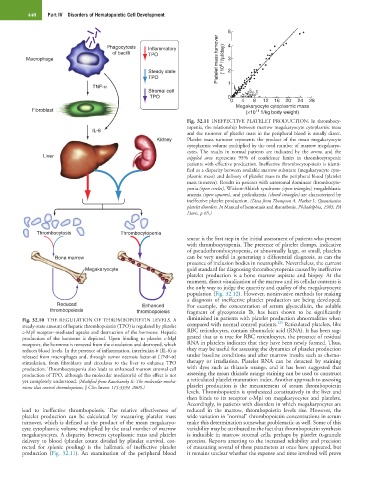
                                                              Fig. 32.11  INEFFECTIVE PLATELET PRODUCTION. In thrombocy-
                                                              topenia, the relationship between marrow megakaryocyte cytoplasmic mass
                               IL-6
                                                              and the turnover of platelet mass in the peripheral blood is usually direct.
                                                    Kidney    Platelet  mass  turnover  represents  the  product  of  the  mean  megakaryocyte
                                                              cytoplasmic volume multiplied by the total number of marrow megakaryo-
                                                              cytes. The  results  in  normal  patients  are  indicated  by  the  arrow,  and  the
               Liver                                          stippled  area  represents  95%  of  confidence  limits  in  thrombocytopenic
                                                              patients with effective production. Ineffective thrombocytopoiesis is identi-
                                                              fied as a disparity between available marrow substrate (megakaryocyte cyto-
                                                              plasmic mass) and delivery of platelet mass to the peripheral blood (platelet
                                                              mass turnover). Results in patients with autosomal dominant thrombocyto-
                                                              penia (open circles), Wiskott-Aldrich syndrome (open triangles), megaloblastic
                                                              anemia (open squares), and preleukemia (closed triangles) are characterized by
                                                              ineffective platelet production. (Data from Thompson A, Harker L: Quantitative
                                                              platelet disorders. In Manual of hemostasis and thrombosis, Philadelphia, 1983, FA
                                                              Davis, p 65.)


             Thrombocytosis             Thrombocytopenia
                                                              smear is the first step in the initial assessment of patients who present
                                                              with thrombocytopenia. The presence of platelet clumps, indicative
                                                              of pseudothrombocytopenia, or abnormally large, or small, platelets
                   Bone marrow                                can be very useful in generating a differential diagnosis, as can the
                                                              presence of inclusion bodies in neutrophils. Nevertheless, the current
                             Megakaryocyte                    gold standard for diagnosing thrombocytopenia caused by ineffective
                                                              platelet  production  is  a  bone  marrow  aspirate  and  biopsy.  At  the
                                                              moment, direct visualization of the marrow and its cellular contents is
                                                              the only way to judge the quantity and quality of the megakaryocyte
                                                              population (Fig. 32.12). However, noninvasive methods for making
                                                              a  diagnosis  of  ineffective  platelet  production  are  being  developed.
                    Reduced                     Enhanced      For  example,  the  concentration  of  serum  glycocalicin,  the  soluble
                 thrombopoiesis               thrombopoiesis  fragment  of  glycoprotein  Ib,  has  been  shown  to  be  significantly
        Fig. 32.10  THE REGULATION OF THROMBOPOIETIN LEVELS. A   diminished in patients with platelet production abnormalities when
                                                                                            225
        steady-state amount of hepatic thrombopoietin (TPO) is regulated by platelet   compared with normal control patients.  Reticulated platelets, like
        c-Mpl receptor–mediated uptake and destruction of the hormone. Hepatic   RBC reticulocytes, contain ribonucleic acid (RNA). It has been sug-
        production  of  the  hormone  is  depicted.  Upon  binding  to  platelet  c-Mpl   gested that as is true for RBC reticulocytes, the presence of residual
        receptors, the hormone is removed from the circulation and destroyed, which   RNA in platelets indicates that they have been newly formed. Thus,
        reduces blood levels. In the presence of inflammation, interleukin-6 (IL-6) is   they may be useful for assessing the dynamics of platelet production
        released from macrophages and, through tumor necrosis factor-α (TNF-α)   under baseline conditions and after marrow insults such as chemo-
        stimulation,  from  fibroblasts  and  circulates  to  the  liver  to  enhance  TPO   therapy  or  irradiation.  Platelet  RNA  can  be  detected  by  staining
        production. Thrombocytopenia also leads to enhanced marrow stromal cell   with  dyes  such  as  thiazole  orange,  and  it  has  been  suggested  that
        production of TPO, although the molecular mediator(s) of this effect is not   assessing the mean thiazole orange staining can be used to construct
        yet completely understood. (Modified from Kaushansky K: The molecular mecha-  a reticulated platelet maturation index. Another approach to assessing
        nisms that control thrombopoiesis. J Clin Invest 115:3339, 2005.)  platelet  production  is  the  measurement  of  serum  thrombopoietin
                                                              levels. Thrombopoietin is synthesized constitutively in the liver and
                                                              then binds to its receptor c-Mpl on megakaryocytes and platelets.
                                                              Accordingly, in patients with disorders in which megakaryocytes are
        lead  to  ineffective  thrombopoiesis.  The  relative  effectiveness  of   reduced  in  the  marrow,  thrombopoietin  levels  rise.  However,  the
        platelet  production  can  be  calculated  by  measuring  platelet  mass   wide variation in “normal” thrombopoietin concentrations in serum
        turnover, which is defined as the product of the mean megakaryo-  make this determination somewhat problematic as well. Some of this
        cyte cytoplasmic volume multiplied by the total number of marrow   variability may be attributed to the fact that thrombopoietin synthesis
        megakaryocytes. A disparity between cytoplasmic mass and platelet   is inducible in marrow stromal cells, perhaps by platelet α-granule
        delivery  to  blood  (platelet  count  divided  by  platelet  survival,  cor-  proteins. Reports attesting to the increased reliability and precision
        rected  for  splenic  pooling)  is  the  hallmark  of  ineffective  platelet   of measuring several of these parameters at once have appeared, but
        production  (Fig.  32.11).  An  examination  of  the  peripheral  blood   it remains unclear whether the expense and time involved will prove

