


Page 517 - Hematology_ Basic Principles and Practice ( PDFDrive )
P. 517
Chapter 32  Acquired Disorders of Red Cell, White Cell, and Platelet Production  437


                                                                                    CD8 Gate
                                                                       ECD


                                                                                                CD4 Gate

                                                                                       PCP
                                        CD4 Gate                           CD8 Gate


                                                                                    VB13.1 FITC
                                     FITC                                           VB13.2 FITC/PE


                                                                                        VB13.3 PE


                                                                      PE
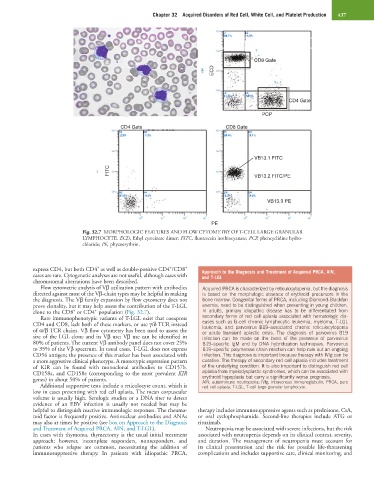
                            Fig. 32.7  MORPHOLOGIC FEATURES AND FLOW CYTOMETRY OF T-CELL LARGE GRANULAR
                            LYMPHOCYTE. ECD, Ethyl cysteinate dimer; FITC, fluorescein isothiocyanate; PCP, phencyclidine hydro-
                            chloride; PE, phycoerythrin.


                                                         +
                                                              +
                                 +
            express CD4, but both CD4  as well as double-positive CD4 /CD8    Approach to the Diagnosis and Treatment of Acquired PRCA, AIN,
            cases are rare. Cytogenetic analyses are not useful, although cases with   and T-LGL
            chromosomal aberrations have been described.
              Flow cytometric analysis of Vβ utilization pattern with antibodies   Acquired PRCA is characterized by reticulocytopenia, but the diagnosis
            directed against most of the Vβ-chain types may be helpful in making   is based on the morphologic absence of erythroid precursors in the
            the diagnosis. The Vβ family expansion by flow cytometry does not   bone marrow. Congenital forms of PRCA, including Diamond-Blackfan
            prove clonality, but it may help assess the contribution of the T-LGL   anemia, need to be distinguished when presenting in young children.
                         +
                                +
            clone to the CD8  or CD4  population (Fig. 32.7).      In  adults,  primary  idiopathic  disease  has  to  be  differentiated  from
              Rare immunophenotypic variants of T-LGL exist that coexpress   secondary forms of red cell aplasia associated with hematologic dis-
            CD4 and CD8, lack both of these markers, or use γ/δ TCR instead   eases such as B-cell chronic lymphocytic leukemia, myeloma, T-LGL
                                                                   leukemia,  and  parvovirus  B19–associated  chronic  reticulocytopenia
            of α/β TCR chains. Vβ flow cytometry has been used to assess the   or  acute  transient  aplastic  crisis.  The  diagnosis  of  parvovirus  B19
            size of the LGL clone and its Vβ use; Vβ use can be identified in   infection  can  be  made  on  the  basis  of  the  presence  of  parvovirus
            80% of patients. The current Vβ antibody panel does not cover 25%   B19–specific  IgM  and  by  DNA  hybridization  techniques.  Parvovirus
            to 35% of the Vβ spectrum. In usual cases, T-LGL does not express   B19–specific polymerase chain reaction can help rule out an ongoing
            CD56 antigen; the presence of this marker has been associated with   infection. This diagnosis is important because therapy with IVIg can be
            a more aggressive clinical phenotype. A monotypic expression pattern   curative. The therapy of secondary red cell aplasia includes treatment
            of  KIR  can  be  found  with  monoclonal  antibodies  to  CD157b,   of the underlying condition. It is also important to distinguish red cell
            CD158a,  and  CD158e  (corresponding  to  the  most  prevalent  KIR   aplasia from myelodysplastic syndromes, which can be associated with
            genes) in about 50% of patients.                       erythroid hypoplasia but carry a significantly worse prognosis.
                                                                   AIN, autoimmune neutropenia; IVIg, intravenous immunoglobulin; PRCA, pure
              Additional supportive tests include a reticulocyte count, which is   red cell aplasia; T-LGL, T-cell large granular lymphocyte.
            low in cases presenting with red cell aplasia. The mean corpuscular
            volume is usually high. Serologic studies or a DNA titer to detect
            evidence  of  an  EBV  infection  is  usually  not  needed  but  may  be
            helpful to distinguish reactive immunologic responses. The rheuma-  therapy includes immunosuppressive agents such as prednisone, CsA,
            toid factor is frequently positive. Antinuclear antibodies and ANAs   or  oral  cyclophosphamide.  Second-line  therapies  include  ATG  or
            may also at times be positive (see box on Approach to the Diagnosis   rituximab.
            and Treatment of Acquired PRCA, AIN, and T-LGL).        Neutropenia may be associated with severe infections, but the risk
            In cases with thymoma, thymectomy is the usual initial treatment   associated with neutropenia depends on its clinical context, severity,
            approach;  however,  incomplete  responders,  nonresponders,  and   and  duration. The  management  of  neutropenia  must  account  for
            patients  who  relapse  are  common,  necessitating  the  addition  of   its  clinical  presentation  and  the  risk  for  possible  life-threatening
            immunosuppressive  therapy.  In  patients  with  idiopathic  PRCA,   complications and includes supportive care, clinical monitoring, and

