


Page 515 - Hematology_ Basic Principles and Practice ( PDFDrive )
P. 515
Chapter 32  Acquired Disorders of Red Cell, White Cell, and Platelet Production  435


            reduction in the variability of the CTL repertoire can occur in older   constitutively express perforin and FasL and can suppress neutrophil
            adults, and clonal or oligoclonal expansion of CTL populations may   development in vitro. Typical clonal LGL cells seem to be terminally
            be more frequent in older individuals. If asymptomatic, this disorder   differentiated and cannot be effectively expanded in vitro by poly-
            has been termed monoclonal clonopathy of unclear significance.  clonal mitogens.
                                                                    It is likely that a polyclonal CTL response predates the outgrowth
                                                                  of the immunodominant T-LGL leukemia clone (see Fig. 32.3). The
            PATHOGENESIS                                          putative transforming event most likely involves a memory cell that
                                                                  feeds  into  the  mature  effector  CTL  compartment.  Under  normal
            Inciting Events                                       physiologic circumstances, activated effector T cells are deleted after
                                                                  antigen-driven expansion by Fas-mediated apoptosis. The failure of
            T-LGL leukemia frequently arises in the context of a reactive poly-  an activated memory and/or effector clone to undergo apoptosis may
            clonal CTL expansion undergoing transformation in a manner similar   result  in  its  persistent  expansion.  LGL  leukemia  cells  express  high
            to that proposed for CLL. It is possible also that in T-LGL leukemia   levels of Fas/FasL, yet themselves are resistant to Fas-mediated apop-
            one of the effector CTL clones may be initially driven by an inciting   tosis. It is conceivable that persistent LGL leukemia cell expansion
            antigen, may transform, and consequently the cells fail to undergo   may result from this resistance to homeostatic apoptosis. In addition
            apoptosis.  The  initial  or  initiating  polyclonal  response  may  be  a   to  the  high  surface  expression  of  Fas/FasL,  soluble  FasL  has  been
            component of the pathophysiologic process associated with infectious   detected in sera from T-LGL leukemia patients and may contribute
            agents, rheumatoid arthritis, or other autoimmune disorders.  to the induction of apoptosis of neutrophil precursors in the bone
              An initial T cell–mediated process may be responsible for cytope-  marrow.
            nias in the absence of clonal predominance. In concurrence with this   An LGL clone persists mostly in the G 0/G 1 phase of cell cycle,
            hypothesis,  the  clinical  spectrum  of  T-LGL  is  determined  by  the   and  clonal  transformation  may  also  be  because  of  a  constitutive
            specificity of the TCR: for example, if myeloid precursors are targets   overexpression of prosurvival and antiapoptotic transcription factors.
            of  clonal  CTL,  neutropenia  will  be  a  clinical  manifestation.  Con-  STAT3  has  been  shown  to  be  involved  in  cellular  transformation
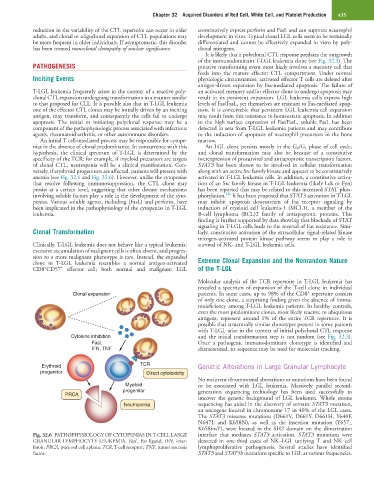
            versely, if erythroid progenitors are affected, patients will present with   along with an active Src family kinase and appears to be constitutively
            anemia (see Fig. 32.1 and Fig. 32.6). However, unlike the cytopenias   activated in T-LGL leukemia cells. In addition, a constitutive activa-
            that  resolve  following  immunosuppression,  the  CTL  clone  may   tion of an Src family kinase in T-LGL leukemia (likely Lck or Fyn)
            persist at a certain level, suggesting that other disease mechanisms   has been reported that may be related to this increased STAT phos-
                                                                           220
            involving soluble factors play a role in the development of the cyto-  phorylation.  It has been proposed that STAT3 activation in T-LGL
            penias. Various soluble agents, including (FasL) and perforin, have   may  inhibit  apoptosis  downstream  of  Fas  receptor  signaling  by
            been implicated in the pathophysiology of the cytopenias in T-LGL   induction  of  myeloid  cell  leukemia-1  (MCL1),  a  member  of  the
            leukemia.                                             B-cell  lymphoma  (BCL)2  family  of  antiapoptotic  proteins.  This
                                                                  finding is further supported by data showing that blockade of STAT
                                                                  signaling in T-LGL cells leads to the reversal of Fas resistance. Simi-
            Clonal Transformation                                 larly, constitutive activation of the extracellular signal-related kinase
                                                                  mitogen-activated  protein  kinase  pathway  seems  to  play  a  role  in
            Clinically, T-LGL leukemia does not behave like a typical leukemia:   survival of NK- and T-LGL leukemia cells.
            excessive accumulation of malignant cells is often absent, and progres-
            sion to a more malignant phenotype is rare. Instead, the expanded
            clone  in  T-LGL  leukemia  resembles  a  normal  antigen-activated   Extreme Clonal Expansion and the Nonrandom Nature
                     +
                +
            CD8 CD57   effector  cell;  both  normal  and  malignant  LGL   of the T-LGL
                                                                  Molecular  analysis  of  the TCR  repertoire  in T-LGL  leukemia  has
                                                                  revealed a spectrum of expansion of the T-cell clone in individual
                                                                                                      +
                         Clonal expansion                         patients. In some cases, up to 98% of the CD8  repertoire consists
                                                                  of only one clone, a surprising finding given the absence of immu-
                                                                  nodeficiency among T-LGL leukemia patients. In healthy controls,
                                                                  even the most predominant clones, most likely reactive to ubiquitous
                                                                  antigens,  represent  around  1%  of  the  entire TCR  repertoire.  It  is
                                                                  possible that structurally similar clonotypes present in some patients
                                                                  with T-LGL arise in the context of initial polyclonal CTL response
                        Cytokine inhibition                       and  the  initial  transformation  step  is  not  random  (see  Fig.  32.3).
                               FasL                               Once  a  pathogenic  immunodominant  clonotype  is  identified  and
                               IFN, TNF                           characterized, its sequence may be used for molecular tracking.


               Erythroid                       TCR                Genetic Alterations in Large Granular Lymphocyte
              progenitor                         Direct cytotoxicity
                                                                  No recurrent chromosomal aberrations or mutations have been found
                                          Myeloid                 to  be  associated  with  LGL  leukemia.  Massively  parallel  second-
                                         progenitor               generation  sequencing  technology  has  been  used  successfully  to
                      PRCA
                                                                  uncover  the  genetic  background  of  LGL  leukemia.  Whole  exome
                                         Neutropenia              sequencing has aided in the discovery of somatic STAT3 mutation,
                                                                  an oncogene located in chromosome 17 in 40% of the LGL cases.
                                                                  The STAT3 missense mutations (D661V, D661Y, D661H, Y640F,
                                                                  N647I,  and  K658N),  as  well  as  the  insertion  mutation  (Y657_
                                                                  K658insY),  were  located  in  the  SH2  domain  on  the  dimerization
            Fig. 32.6  PATHOPHYSIOLOGY OF CYTOPENIAS IN T-CELL LARGE   interface  that  mediates  STAT3  activation.  STAT3  mutations  were
            GRANULAR LYMPHOCYTE LEUKEMIA. FasL, Fas ligand; IFN, inter-  detected  in  one-third  cases  of  NK–LGL  unifying T  and  NK  cell
            feron; PRCA, pure red cell aplasia; TCR, T-cell receptor; TNF, tumor necrosis   lymphoproliferative  pathogenesis.  Several  studies  have  identified
            factor.                                               STAT3 and STAT5b mutations specific to LGL at various frequencies.

