


Page 519 - Hematology_ Basic Principles and Practice ( PDFDrive )
P. 519
Chapter 32  Acquired Disorders of Red Cell, White Cell, and Platelet Production  439


            cyclophosphamide was 64% following initial methotrexate therapy.   cell junctions into the lumen of marrow capillaries. The pseudopods
            Therapy  with  cyclophosphamide  in  neutropenic  patients  may  be   fracture, because of shear stress in the lumen of these capillaries, and
            difficult because of myelosuppression. In most refractory cases, ATG   release shards of megakaryocytic cytoplasm, or proplatelets, that are
            has also been used with success. In recent years, successful therapy   the  immediate  antecedents  of  circulating  platelets.  A  fully  mature
                                                                                                                    3
            with alemtuzumab has been reported. CD52 expression determined   megakaryocyte is estimated to produce approximately 1–1.5 × 10
            by flow cytometry is an important predictive factor for response to   platelets. The molecular regulation of this process is beginning to be
            alemtuzumab.  High  response  rates  with  the  Janus-activated  kinase   better understood. It has been shown, for example, that the apoptosis-
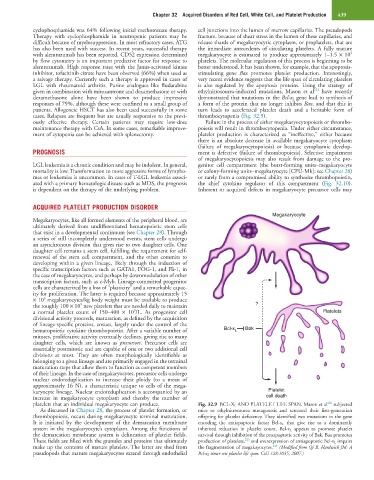
            inhibitor, tofacitinib citrate have been observed (66%) when used as   stimulating  gene  Bax  promotes  platelet  production.  Interestingly,
            a salvage therapy. Currently such a therapy is approved in cases of   very recent evidence suggests that the life span of circulating platelets
            LGL  with  rheumatoid  arthritis.  Purine  analogues  like  fludarabine   is  also  regulated  by  the  apoptosis  proteins.  Using  the  strategy  of
                                                                                                        222
            given in combination with mitoxantrone and dexamethasone or with   ethylnitrosourea-inducted  mutations,  Mason  et  al   have  recently
            dexamethasone  alone  have  been  shown  to  produce  impressive   demonstrated that mutations in the Bcl-x L  gene lead to synthesis of
            responses of 79%, although these were confined to a small group of   a form of the protein that no longer inhibits Bax, and that this in
            patients. Allogeneic HSCT has also been used successfully in some   turn  leads  to  accelerated  platelet  death  and  a  heritable  form  of
            cases. Relapses are frequent but are usually responsive to the previ-  thrombocytopenia (Fig. 32.9).
            ously  effective  therapy.  Certain  patients  may  require  low-dose   Failure in the process of either megakaryocytopoiesis or thrombo-
            maintenance therapy with CsA. In some cases, remarkable improve-  poiesis will result in thrombocytopenia. Under either circumstance,
            ment of cytopenia can be achieved with splenectomy.   platelet  production  is  characterized  as  “ineffective,”  either  because
                                                                  there is an absolute decrease in available megakaryocyte cytoplasm
                                                                  (failure  of  megakaryocytopoiesis)  or  because  cytoplasmic  develop-
            PROGNOSIS                                             ment is defective (failure of thrombopoiesis). Selective impairment
                                                                  of  megakaryocytopoiesis  may  also  result  from  damage  to  the  pro-
            LGL leukemia is a chronic condition and may be indolent. In general,   genitor  cell  compartment  (the  burst-forming  units–megakaryocyte
            mortality is low. Transformation to more aggressive forms of lympho-  or colony-forming units–megakaryocyte [CFU-Mk]; see Chapter 28)
            mas or leukemias is uncommon. In cases of T-LGL leukemia associ-  or rarely from a compromised ability to synthesize thrombopoietin,
            ated with a primary hematologic disease such as MDS, the prognosis   the  chief  cytokine  regulator  of  this  compartment  (Fig.  32.10).
            is dependent on the therapy of the underlying problem.  Inherent or acquired defects in megakaryocyte precursor cells may

            ACQUIRED PLATELET PRODUCTION DISORDER
                                                                                          Megakaryocyte
            Megakaryocytes, like all formed elements of the peripheral blood, are
            ultimately  derived  from  undifferentiated  hematopoietic  stem  cells
            that exist in a developmental continuum (see Chapter 28). Through
            a series of still incompletely understood events, stem cells undergo
            an asynchronous division that gives rise to two daughter cells. One
            daughter cell remains a stem cell, fulfilling the requirement for self-
            renewal  of  the  stem  cell  compartment,  and  the  other  commits  to
            developing within a given lineage, likely through the induction of
            specific transcription factors such as GATA1, FOG-1, and Fli-1, in
            the case of megakaryocytes, and perhaps by downmodulation of other
            transcription factors, such as c-Myb. Lineage-committed progenitor
            cells are characterized by a loss of “plasticity” and a remarkable capac-
            ity for proliferation. The latter is required because approximately 15
               6
            × 10  megakaryocytes/kg body weight must be available to produce
                           9
            the roughly 100 × 10  new platelets that are needed daily to maintain    ?
                                             9
            a  normal  platelet  count  of  150–400  ×  10 /L.  As  progenitor  cell                       Platelets
            divisional activity proceeds, maturation, as defined by the acquisition
            of lineage-specific proteins, ensues, largely under the control of the
            hematopoietic cytokine thrombopoietin. After a variable number of   Bcl-x L  Bak
            mitoses, proliferative activity eventually declines, giving rise to many
            daughter  cells,  which  are  known  as  precursors.  Precursor  cells  are
            essentially postmitotic and are capable of one or two additional cell
            divisions  at  most.  They  are  often  morphologically  identifiable  as
            belonging to a given lineage and are primarily engaged in the terminal
            maturation steps that allow them to function as competent members
            of their lineage. In the case of megakaryocytes, precursor cells undergo
            nuclear  endoreduplication  to  increase  their  ploidy  (to  a  mean  of
            approximately 16 N), a characteristic unique to cells of the mega-
            karyocyte lineage. Nuclear endoreduplication is accompanied by an            Platelet
            increase  in  megakaryocyte  cytoplasm  and  thereby  the  number  of       cell death
            platelets that an individual megakaryocyte can produce.  Fig. 32.9  BCL-X L  AND PLATELET LIFE SPAN. Mason et al  subjected
                                                                                                            222
              As discussed in Chapter 28, the process of platelet formation, or   mice  to  ethylnitrosourea  mutagenesis  and  screened  their  first-generation
            thrombopoiesis, occurs during megakaryocyte terminal maturation.   offspring for platelet deficiency. They identified two mutations in the gene
            It  is  initiated  by  the  development  of  the  demarcation  membrane   encoding  the  antiapoptotic  factor  Bcl-x L   that  give  rise  to  a  dominantly
            system in the megakaryocyte’s cytoplasm. Among the functions of   inherited  reduction  in  platelet  count.  Bcl-x L   appears  to  promote  platelet
            the demarcation membrane system is delineation of platelet fields.   survival through inhibition of the proapoptotic activity of Bak. Bax promotes
            These fields are filled with the granules and proteins that ultimately   production of platelets,  and overexpression of antiapoptotic Bcl-x L  impairs
                                                                                 223
            make up the contents of mature platelets. The latter are shed from   the fragmentation of megakayocytes.  (Modified from Qi B, Hardwick JM: A
                                                                                          224
            pseudopods that mature megakaryocytes extend through endothelial   Bcl-x L  timer sets platelet life span. Cell 128:1035, 2007.)

