


Page 516 - Hematology_ Basic Principles and Practice ( PDFDrive )
P. 516
436    Part IV  Disorders of Hematopoietic Cell Development


        Of interest, patients with STAT3 mutations were more likely to have   may  provide  a  rational  target  for  immunosuppressive  therapy.  In
        autoimmune  conditions  and  neutropenia  and  tend  to  respond  to   MDS, T-LGL  leukemia  has  been  reported  to  negatively  affect  the
        treatment. Sequencing of STAT3 wildtype cases revealed activating   outcome of therapy directed against the CTL clone. LGL leukemia
        mutations in STAT5b in 2% of the cases. STAT3 and STAT5b muta-  has also been described in conjunction with hemolytic anemia fol-
        tions can be used as molecular markers for LGL leukemia diagnostics,   lowing  bone  marrow  transplantation,  perhaps  a  process  initially
        and they present novel therapeutic targets for STAT3 and STAT5b   driven by an alloantigen or infectious agent such as EBV. As with
        inhibitors. Interestingly not only STAT mutations were identified in   infections, distinction between an LGL leukemia and reactive lym-
        aplastic anemia and MDS cases with concomitant LGL but they were   phoproliferation may be blurred. For example, neutropenia may be
        small clones in 7% of cases without clinical evidence of LGL.  associated with various degrees of clonality, with an LGL leukemia
                                                              representing the most extreme form of this process.
        CLINICAL PRESENTATION AND PHYSICAL FEATURES
                                                              LABORATORY DIAGNOSIS
        Patients with T-LGL leukemia present at a median age of about 55
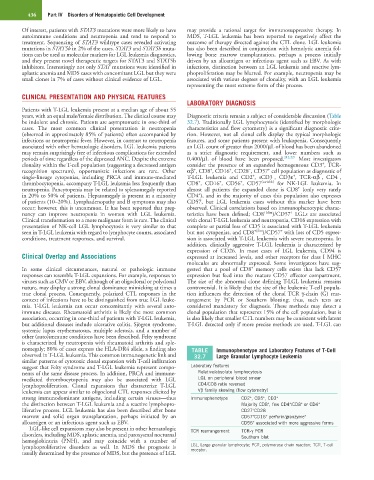
        years, with an equal male/female distribution. The clinical course may   Diagnostic criteria remain a subject of considerable discussion (Table
        be indolent and chronic. Patients are asymptomatic in one-third of   32.7). Traditionally LGL lymphocytosis (identified by morphologic
        cases.  The  most  common  clinical  presentation  is  neutropenia   characteristics and flow cytometry) is a significant diagnostic crite-
        (observed in approximately 85% of patients) often accompanied by   rion. However, not all clonal cells display the typical morphologic
        infections or neutropenic fever. However, in contrast to neutropenia   features, and some patients present with leukopenia. Consequently
        associated with other hematologic disorders, LGL leukemia patients   an LGL count of greater than 2000/µL of blood has been abandoned
        may remain surprisingly free of infectious complications for extended   as  a  strict  diagnostic  requirement,  and  lower  numbers  such  as
        periods of time regardless of the depressed ANC. Despite the extreme   0.400/µL  of  blood  have  been  proposed. 212,221   Most  investigators
                                                                                                          +
        clonality within the T-cell population (suggesting a decreased antigen   consider  the  presence  of  an  expanded  homogeneous  CD3 , TCR-
                                                                            +
                                                                                         +
                                                                                  −
                                                                +
                                                                      +
        recognition  spectrum),  opportunistic  infections  are  rare.  Other   αβ , CD8 , CD16 , CD28 , CD57  cell population as diagnostic of
                                                                                                          −
                                                                                          −
                                                                                                               −
                                                                                                 +
                                                                                    +
        single-lineage  cytopenias,  including  PRCA  and  immune-mediated   T-LGL  leukemia  and  CD2 ,  sCD3 ,  CD3ε ,  TCR-αβ ,  CD4 ,
                                                                                +
                                                                  +
                                                                         +
        thrombocytopenia, accompany T-LGL leukemia less frequently than   CD8 ,  CD16 ,  CD56 ,  CD57 (variable)   for  NK-LGL  leukemia.  In
                                                                                                  +
        neutropenia. Pancytopenia may be related to splenomegaly reported   almost  all  patients  the  expanded  clone  is  CD8   (only  very  rarely
                                                                  +
        in 20% to 50% of patients. Hepatomegaly is present in a minority   CD4 ), and in the majority of cases this population also expresses
        of patients (10–20%). Lymphadenopathy and B symptoms may also   CD57,  but  LGL  leukemia  cases  without  this  marker  have  been
        occur; however, this is uncommon. It has been reported that preg-  observed. Clinical correlations based on immunophenotypic charac-
                                                                                                +
        nancy  can  improve  neutropenia  in  women  with  LGL  leukemia.   teristics  have  been  defined;  CD8 +(dim )/CD57   LGLs  are  associated
        Clinical transformation to a more malignant form is rare. The clinical   with clonal T-LGL leukemia and neutropenia, CD16 expression with
        presentation of NK-cell LGL lymphocytosis is very similar to that   complete or partial loss of CD5 is associated with T-LGL leukemia
                                                                                             +
        seen in T-LGL leukemia with regard to lymphocyte counts, associated   but not cytopenias, and CD8 +(dim )/CD57  with loss of CD5 expres-
        conditions, treatment responses, and survival.        sion is associated with T-LGL leukemia with severe neutropenia. In
                                                              addition,  clinically  aggressive  T-LGL  leukemia  is  characterized  by
                                                              expression  of  CD26.  In  most  cases  of  LGL  leukemia,  CD94  is
        Clinical Overlap and Associations                     expressed at increased levels, and other receptors for class I MHC
                                                              molecules  are  abnormally  expressed.  Some  investigators  have  sug-
                                                                                   +
        In  some  clinical  circumstances,  natural  or  pathologic  immune   gested  that  a  pool  of  CD8   memory  cells  exists  that  lack  CD57
        responses can resemble T-LGL expansions. For example, responses to   expression  but  feed  into  the  mature  CD57  effector  compartment.
        viruses such as CMV or EBV, although of an oligoclonal or polyclonal   The size of the abnormal clone defining T-LGL leukemia remains
        nature, may display a strong clonal dominance mimicking at times a   controversial. It is likely that the size of the leukemic T-cell popula-
        true clonal process. Consequently, polarized CTL responses in the   tion  influences  the  detection  of  the  clonal TCR  γ-chain  (G)  rear-
        context of infections have to be distinguished from true LGL leuke-  rangement  by  PCR  or  Southern  blotting;  thus,  such  tests  are
        mia. T-LGL  leukemia  can  occur  concomitantly  with  several  auto-  considered  mandatory  for  diagnosis. These  methods  may  detect  a
        immune diseases. Rheumatoid arthritis is likely the most common   clonal population that represents 15% of the cell population, but it
        association, occurring in one-third of patients with T-LGL leukemia,   is also likely that smaller CTL numbers may be consistent with latent
        but additional diseases include ulcerative colitis, Sjögren syndrome,   T-LGL detected only if more precise methods are used. T-LGL can
        systemic lupus erythematosus, multiple sclerosis, and a number of
        other (auto)immune conditions have been described. Felty syndrome
        is characterized by neutropenia with rheumatoid arthritis and sple-
        nomegaly; 80% of cases express the HLA-DR4 allele, a finding also   TABLE   Immunophenotype and Laboratory Features of T-Cell
        observed in T-LGL leukemia. This common immunogenetic link and   32.7   Large Granular Lymphocyte Leukemia
        similar patterns of cytotoxic clonal expansion with T-cell infiltration
        suggest that Felty syndrome and T-LGL leukemia represent compo-  Laboratory features
        nents of the same disease process. In addition, PRCA and immune-  Relative/absolute lymphocytosis
        mediated  thrombocytopenia  may  also  be  associated  with  LGL   LGL on peripheral blood smear
        lymphoproliferation.  Clonal  expansions  that  characterize  T-LGL   CD4/CD8 ratio reversed
        leukemia can appear similar to oligoclonal CTL responses elicited by   Vβ family skewing (flow cytometry)
        strong immunodominant antigens, including certain viruses—thus   Immunophenotype  CD2 , CD5 , CD3 +
                                                                                       +
                                                                                   +
        the distinction between T-LGL leukemia and a reactive lymphopro-        Majority CD8 , few CD4 /CD8  or CD4 +
                                                                                                   +
                                                                                         +
                                                                                                +
        liferative process. LGL leukemia has also been described after bone     CD27 CD28 −
                                                                                    +
        marrow  and  solid  organ  transplantation,  perhaps  initiated  by  an   CD57 CD16  perforin/granzyme +
                                                                                    +
                                                                                        +
        alloantigen or an infectious agent such as EBV.                         CD56  associated with more aggressive forms
                                                                                    +
           LGL-like cell expansions may also be present in other hematologic   TCR rearrangement  TCR-γ PCR
        disorders, including MDS, aplastic anemia, and paroxysmal nocturnal     Southern blot
        hemoglobinuria  (PNH),  and  may  coincide  with  a  number  of
        lymphoproliferative  disorders  as  well.  In  MDS  the  prognosis  is   LGL, Large granular lymphocyte; PCR, polymerase chain reaction; TCR, T-cell
                                                               receptor.
        usually determined by the presence of MDS, but the presence of LGL

