


Page 518 - Hematology_ Basic Principles and Practice ( PDFDrive )
P. 518
438    Part IV  Disorders of Hematopoietic Cell Development


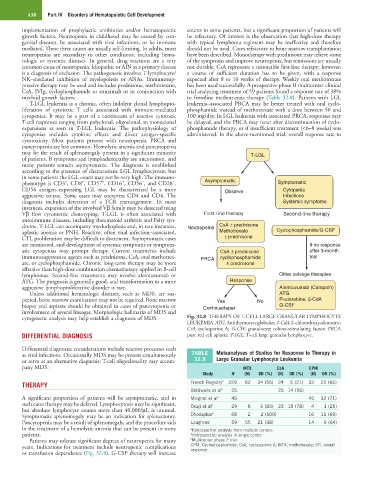
        implementation  of  prophylactic  antibiotics  and/or  hematopoietic   counts in some patients, but a significant proportion of patients will
        growth  factors.  Neutropenia  in  childhood  may  be  caused  by  con-  be refractory. Of interest is the observation that high-dose therapy
        genital  diseases,  be  associated  with  viral  infections,  or  be  immune   with  typical  lymphoma  regimens  may  be  ineffective  and  therefore
        mediated. These three causes are usually self-limiting. In adults, most   should not be used. Cases refractory to bone marrow transplantation
        neutropenias  are  secondary  to  other  conditions,  including  hema-  have been described. Monotherapy with prednisone may relieve some
        tologic  or  systemic  diseases.  In  general,  drug  reactions  are  a  very   of the symptoms and improve neutropenia, but remissions are usually
        common cause of neutropenia. Idiopathic or AIN as a primary disease   not durable. CsA represents a reasonable first-line therapy; however,
        is a diagnosis of exclusion. The pathogenesis involves T-lymphocyte/  a  course  of  sufficient  duration  has  to  be  given,  with  a  response
        NK–mediated  inhibition  of  myelopoiesis  or  ANAs.  Immunosup-  expected after 8 to 10 weeks of therapy. Weekly oral methotrexate
        pressive therapy may be used and includes prednisone, methotrexate,   has been used successfully. A prospective phase II multicenter clinical
        CsA, IVIg, cyclophosphamide or rituximab or in conjunction with   trial analyzing treatment of 59 patients found a response rate of 38%
        myeloid growth factors.                               to frontline methotrexate therapy (Table 32.8). Patients with LGL
           T-LGL leukemia is a chronic, often indolent clonal lymphopro-  leukemia–associated  PRCA  may  be  better  treated  with  oral  cyclo-
        liferation  of  cytotoxic  T  cells  associated  with  immune-mediated   phosphamide instead of methotrexate with a dose between 50 and
        cytopenias.  It  may  be  a  part  of  a  continuum  of  reactive  cytotoxic   100 mg/day. In LGL leukemia with associated PRCA, responses may
        T-cell responses ranging from polyclonal, oligoclonal, to monoclonal   be delayed, and the PRCA may recur after discontinuation of cyclo-
        expansions  as  seen  in  T-LGL  leukemia.  The  pathophysiology  of   phosphamide therapy, or if insufficient treatment (<6–8 weeks) was
        cytopenias  includes  cytokine  effects  and  direct  antigen-specific   administered. In the above-mentioned trial, overall response rate to
        cytotoxicity.  Most  patients  present  with  neutropenia.  PRCA  and
        pancytopenia are less common. Hemolytic anemia and pancytopenia
        may be the result of splenomegaly present in a significant minority        T-LGL
        of patients. B symptoms and lymphadenopathy are uncommon, and
        many  patients  remain  asymptomatic.  The  diagnosis  is  established
        according to the presence of characteristic LGL lymphocytosis, but
        in some patients the LGL count may not be very high. The immuno-
                                  +
                            +
                                               −
                      +
                                                         −
                                         +
        phenotype is CD3 , CD8 , CD57 , CD16 , CD56 , and CD28 .    Asymptomatic            Symptomatic
        CD56  antigen–expressing  LGL  may  be  characterized  by  a  more   Observe          Cytopenia
        aggressive  course.  Some  cases  may  coexpress  CD4  and  CD8. The                  Infections
        diagnosis  includes  detection  of  a  TCR  rearrangement.  In  most                  Systemic symptoms
        instances, expansion of the involved Vβ family may be detected using
        Vβ  flow  cytometric  clonotyping.  T-LGL  is  often  associated  with   First-line therapy  Second-line therapy
        autoimmune diseases, including rheumatoid arthritis and Felty syn-
        drome. T-LGL can accompany myelodysplasia and, in rare instances,   Neutropenia  CsA ± prednisone
        aplastic anemia or PNH. Reactive, often viral infection–associated,   Methotrexate  Cyclophosphamide/G-CSF
        CTL proliferation may be difficult to document. Asymptomatic cases       ± prednisone
        are monitored, and development of systemic symptoms or symptom-                               If no response
        atic  cytopenias  may  prompt  therapy.  Current  treatments  include   CsA ± prednisone      after 3-month
        immunosuppressive agents such as prednisone, CsA, oral methotrex-  PRCA  cyclophosphamide     trial
        ate, or cyclophosphamide. Chronic long-term therapy may be more        ± prednisone
        effective than high-dose combination chemotherapy applied in B-cell
        lymphomas.  Second-line  treatments  may  involve  alemtuzumab  or                  Other salvage therapies
        ATG. The prognosis is generally good, and transformation to a more   Response
        aggressive lymphoproliferative disorder is rare.                                    Alemtuzumab (Campath)
           Unless  additional  hematologic  diseases,  such  as  MDS,  are  sus-            ATG
        pected, bone marrow examination may not be required. Bone marrow   Yes       No     Fludarabine, 2-CdA
        biopsy and aspirate should be obtained in cases of pancytopenia or   Continue/taper  G-CSF
        involvement of several lineages. Morphologic hallmarks of MDS and
        cytogenetic analysis may help establish a diagnosis of MDS.  Fig. 32.8  THERAPY OF T-CELL LARGE GRANULAR LYMPHOCYTE
                                                              LEUKEMIA. ATG, Antithymocyte globulin; 2-CdA, 2-chlorodeoxyadenosine;
                                                              CsA, cyclosporine A; G-CSF, granulocyte colony-stimulating factor; PRCA,
        DIFFERENTIAL DIAGNOSIS                                pure red cell aplasia; T-LGL, T-cell large granular lymphocyte.
        Differential diagnostic considerations include reactive processes such
        as viral infections. Occasionally MDS may be present simultaneously   TABLE   Metaanalyses of Studies for Response to Therapy in
        or serve as an alternative diagnosis; T-cell oligoclonality may accom-  32.8   Large Granular Lymphocyte Leukemia
        pany MDS.                                                                MTX        CsA       CPM
                                                                   Study     N   (N)  OR (%)  (N)  OR (%)  (N)  OR (%)
        THERAPY                                                French Registry a  229  62  34 (55)  24  5 (21)  32  21 (66)
                                                               Battiwalla et al b  25       25 14 (56)
        A  significant  proportion  of  patients  will  be  asymptomatic,  and  in   Moignet et al a  45  45  32 (71)
        such cases therapy may be delayed. Lymphocytosis may be significant,   Osuji et al a  29  8  6 (85) 23 18 (78)  4  1 (25)
        but absolute lymphocyte counts more than 40,000/µL is unusual.   b
        Symptomatic splenomegaly may be an indication for splenectomy.   Dhodapkar  68  2  2 (100)    16  11 (69)
        Pancytopenia may be a result of splenomegaly, and the procedure aids   Loughran c  59  55  21 (38)  14  9 (64)
        in the treatment of a hemolytic anemia that can be present in some   a Retrospective analysis from multiple centers.
        patients.                                              b Retrospective analysis in single center.
           Patients may tolerate significant degrees of neutropenia for many   c Multicenter phase 2 trial.
        years. Indications for treatment include neutropenic complications   CPM, Cyclophosphamide; CsA, cyclosporine A; MTX, methotrexate; OR, overall
                                                               response.
        or transfusion dependence (Fig. 32.8). G-CSF therapy will increase

