


Page 546 - Hematology_ Basic Principles and Practice ( PDFDrive )
P. 546
Chapter 34  Approach to Anemia in the Adult and Child  461


             TABLE   Comparison of the More Common Causes of Anemia in Children and Adult
              34.3
             Type of Anemia  Children                                    Adults
             Hypoproliferative  •  Nutritional deficiency (most commonly iron deficiency)  •  Iron deficiency
                             •  Acute inflammation                       •  Anemia of inflammation (anemia of chronic disease)
                             •  Transient erythroblastopenia of childhood  •  Anemia of renal disease
                             •  Acquired aplastic anemia                 •  Folate or vitamin B 12  deficiency
                             •  Marrow replacement caused by malignancy  •  Drugs or toxins
                                                                         •  Pure RBC aplasia (viral or idiopathic)
                                                                         •  MDS
             Hemolytic       •  Inherited hemoglobinopathies             •  Inherited hemoglobinopathies with milder manifestations
                             •  Inherited membrane disorders             •  Inherited membrane disorders with milder manifestations
                             •  Autoimmune hemolytic anemia              •  G6PD deficiency
                             •  Microangiopathic hemolytic anemia        •  Autoimmune hemolytic anemia
                                                                         •  Microangiopathic hemolytic anemia (DIC, TTP, HUS, aHUS)
             aHUS, Atypical hemolytic uremic syndrome; DIC, disseminated intravascular coagulation; G6PD, glucose-6-phosphate dehydrogenase; HUS, hemolytic uremic syndrome;
             MDS, myelodysplastic syndrome; RBC, red blood cell; TTP, thrombotic thrombocytopenic purpura.


                                                      For a newborn review:
                                                      1. Complete blood cell count
                                                      2. Reticulocyte count
                                                      3. Peripheral blood smear
                                     Reticulocyte count                    Reticulocyte count
                            Corrected reticulocyte count <2% or absolute  Corrected reticulocyte count >2% or absolute
                                 reticulocyte count <100,000/uL        reticulocyte count ≥100,000/uL

                                 Congenital hypoplastic anemia           Direct antiglobulin test
                                 Transcobalamin II deficiency
                                                             Negative             Positive
                                                                                  Immune hemolytic anemia
                                                                                      ABO
                                                               MCV                    Rh
                                                                                      Minor blood group
                                       Low                       Normal or elevated
                                       Chronic intrauterine blood loss
                                       α-Thalassemia syndrome    Review of peripheral blood smear

                                                   Normal                  Abnormal
                                                   Blood loss              Membrane disorders
                                                       Iatrogenic (blood sampling)      Hereditary spherocytosis
                                                       Fetomaternal/fetoplacental      Hereditary elliptocytosis
                                                       Twin-to-twin            Hereditary stomatocytosis
                                                       Internal hemorrhage  Metabolic disorders
                                                       Galactosemia            G6PD deficiency
                                                   Infection                   Pyruvate kinase deficiency
                                                       Bacterial           Infection
                                                       Viral                   Disseminated intravascular
                                                       Toxoplasmosis              coagulation
                                                       Congenital syphilis
                                                   Rare causes
                                                       Hexokinase deficiency
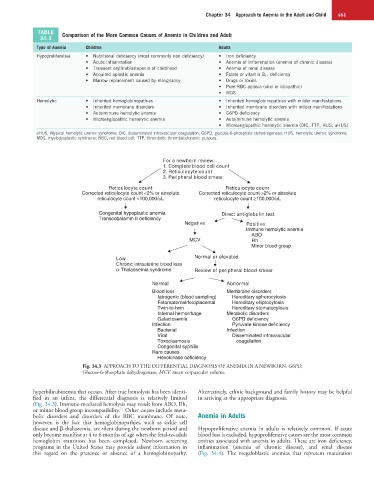
                            Fig. 34.3  APPROACH TO THE DIFFERENTIAL DIAGNOSIS OF ANEMIA IN A NEWBORN. G6PD,
                            Glucose-6-phosphate dehydrogenase; MCV, mean corpuscular volume.


            hyperbilirubinemia that occurs. After true hemolysis has been identi-  Alternatively, ethnic background and family history may be helpful
            fied  in  an  infant,  the  differential  diagnosis  is  relatively  limited     in arriving at the appropriate diagnosis.
            (Fig. 34.3). Immune-mediated hemolysis may result from ABO, Rh,
                                        17
            or minor blood group incompatibility.  Other causes include meta-
            bolic  disorders  and  disorders  of  the  RBC  membrane.  Of  note,   Anemia in Adults
            however,  is  the  fact  that  hemoglobinopathies,  such  as  sickle  cell
            disease and β-thalassemia, are silent during the newborn period and   Hypoproliferative  anemia  in  adults  is  relatively  common.  If  acute
            only become manifest at 4 to 6 months of age when the fetal-to-adult   blood loss is excluded, hypoproliferative causes are the most common
            hemoglobin  transition  has  been  completed.  Newborn  screening   entities associated with anemia in adults. These are iron deficiency,
            programs in the United States may provide salient information in    inflammation  (anemia  of  chronic  disease),  and  renal  disease
            this  regard  on  the  presence  or  absence  of  a  hemoglobinopathy.   (Fig.  34.4).  The  megaloblastic  anemias  that  represent  maturation

