


Page 547 - Hematology_ Basic Principles and Practice ( PDFDrive )
P. 547
462    Part V  Red Blood Cells


                                                For a child or adult review:
                                                1. Complete blood cell count
                                                2. Reticulocyte count
                                                3. Peripheral blood smear

                               Reticulocyte count                           Reticulocyte count
                      Corrected reticulocyte count <2% or absolute  Corrected reticulocyte count >2% or absolute
                           reticulocyte count <100,000/uL               reticulocyte count ≥100,000/uL

                         Hypoproliferative anemia                     Response to blood loss or
                                                                      hemolytic anemia
                         Categorize based on MCV and RDW
                         Low MCV,   =  Anemia of chronic disease      Review peripheral blood smear
                         Normal RDW
                         Normal MCV, =  Anemia of chronic disease
                         Normal RDW                                   Send specific diagnostic tests as
                                                                      appropriate
                         High MCV,  =  Chemotherapy/antivirals/alcohol
                         Normal RDW    Aplastic anemia                Differential diagnoses/
                         Low MCV,   =  Iron deficiency anemia         tests to obtain:
                         High RDW
                                                                      Hemoglobinopathies/
                         Normal MCV, =  Early iron, folate, or vitamin B 12  deficiency      hemoglobin electrophoresis
                         High RDW     Myelodysplasia                  Immune hemolytic anemias/
                                      Dimorphic anemia                    direct antiglobulin test
                         High MCV,  =  Folate or vitamin B 12  deficiency  Infectious causes of hemolysis/
                         High RDW     Myelodysplasia                      thick smear, serology
                                                                      Membrane abnormalities/
                         Review peripheral blood smear                    osmotic fragility; PNH screen
                                                                      Metabolic abnormalities/
                                                                          Heinz body prep; G6PD assay
                         Send specific diagnostic tests as appropriate (iron  Mechanical hemolysis/coagulation
                         studies, folate and B  levels, erythropoietin level)      tests
                                        12
                         Proceed to bone marrow examination if diagnosis
                         remains unclear
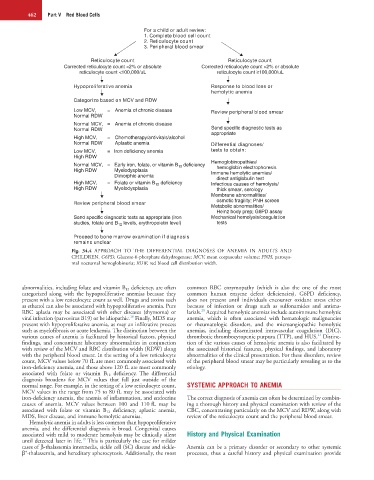
                        Fig.  34.4  APPROACH  TO  THE  DIFFERENTIAL  DIAGNOSES  OF  ANEMIA  IN  ADULTS  AND
                        CHILDREN. G6PD, Glucose-6-phosphate dehydrogenase; MCV, mean corpuscular volume; PNH, paroxys-
                        mal nocturnal hemoglobinuria; RDW, red blood cell distribution width.


        abnormalities, including folate and vitamin B 12  deficiency, are often   common  RBC  enzymopathy  (which  is  also  the  one  of  the  most
        categorized  along  with  the  hypoproliferative  anemias  because  they   common  human  enzyme  defect  deficiencies),  G6PD  deficiency,
        present with a low reticulocyte count as well. Drugs and toxins such   does  not  present  until  individuals  encounter  oxidant  stress  either
        as ethanol can also be associated with hypoproliferative anemia. Pure   because  of  infection  or  drugs  such  as  sulfonamides  and  antima-
                                                                   20
        RBC  aplasia  may  be  associated  with  other  diseases  (thymoma)  or   larials.  Acquired hemolytic anemias include autoimmune hemolytic
                                            18
        viral infection (parvovirus B19) or be idiopathic.  Finally, MDS may   anemia,  which  is  often  associated  with  hematologic  malignancies
        present with hypoproliferative anemia, as may an infiltrative process   or  rheumatologic  disorders,  and  the  microangiopathic  hemolytic
        such as myelofibrosis or acute leukemia. The distinction between the   anemias,  including  disseminated  intravascular  coagulation  (DIC),
                                                                                                         21
        various causes of anemia is facilitated by historical factors, physical   thrombotic thrombocytopenic purpura (TTP), and HUS.  Distinc-
        findings, and concomitant laboratory abnormalities in conjunction   tion of the various causes of hemolytic anemia is also facilitated by
        with review of the MCV and RBC distribution width (RDW) along   the  associated  historical  features,  physical  findings,  and  laboratory
        with the peripheral blood smear. In the setting of a low reticulocyte   abnormalities of the clinical presentation. For these disorders, review
        count, MCV values below 70 fL are most commonly associated with   of the peripheral blood smear may be particularly revealing as to the
        iron-deficiency anemia, and those above 120 fL are most commonly   etiology.
        associated  with  folate  or  vitamin  B 12   deficiency.  The  differential
        diagnosis  broadens  for  MCV  values  that  fall  just  outside  of  the
        normal range. For example, in the setting of a low reticulocyte count,   SYSTEMIC APPROACH TO ANEMIA
        MCV values in the range from 75 to 80 fL may be associated with
        iron-deficiency anemia, the anemia of inflammation, and endocrine   The correct diagnosis of anemia can often be determined by combin-
        causes  of  anemia.  MCV  values  between  100  and  110 fL  may  be   ing a thorough history and physical examination with review of the
        associated  with  folate  or  vitamin  B 12  deficiency,  aplastic  anemia,   CBC, concentrating particularly on the MCV and RDW, along with
        MDS, liver disease, and immune hemolytic anemias.     review of the reticulocyte count and the peripheral blood smear.
           Hemolytic anemia in adults is less common than hypoproliferative
        anemia,  and  the  differential  diagnosis  is  broad.  Congenital  causes
        associated with mild to moderate hemolysis may be clinically silent   History and Physical Examination
                            19
        until detected later in life.  This is particularly the case for milder
        cases of β-thalassemia intermedia, sickle cell (SC) disease and sickle-  Anemia can be a primary disorder or secondary to other systemic
         +
        β -thalassemia, and hereditary spherocytosis. Additionally, the most   processes,  thus  a  careful  history  and  physical  examination  provide

