


Page 548 - Hematology_ Basic Principles and Practice ( PDFDrive )
P. 548
Chapter 34  Approach to Anemia in the Adult and Child  463


            valuable insight into the potential cause. Fatigue often accompanies   can accompany or even predate the anemia associated with vitamin
            anemia,  but  it  is  very  nonspecific  and  may  be  related  to  systemic   B 12 deficiency, findings such as loss of vibration or position sense in
            illness.  Nonetheless,  determining  the  concomitant  presence  of  a   the extremities may be relevant. 24
            systemic inflammatory disorder, infection, or malignancy that may
            be associated with fatigue can be critical in determining the underly-
            ing causes of anemia in both adults and children. The medical history   Reticulocyte Count
            may  also  be  quite  informative.  For  example,  a  history  of  diabetes
            mellitus can be associated with significantly impaired renal produc-  As  a  marker  of  RBC  production,  the  reticulocyte  count  provides
            tion of erythropoietin even in the setting of only a mildly elevated   essential information in directing the initial investigation of anemia.
            creatinine level. Because certain medications may be associated with   Modern flow cytometers accurately determine the reticulocyte count
            BM  depression  or,  alternatively,  the  development  of  autoimmune   using fluorescent probes that bind to the residual ribonucleic acid
                                                                                          25
            hemolytic anemia, all pharmacologic agents, prescribed and over the   present  in  newly  released  RBCs.  These  measurements  are  useful,
            counter, including alternative medicines, should be reviewed. Occu-  accurate, and reflect the state of erythropoiesis. However, when sig-
            pational history is occasionally relevant, as in the case of individuals,   nificant numbers of nucleated RBCs or nuclear debris are present in
            such  as  welders,  who  might  have  been  exposed  to  lead  or  other   the peripheral blood, this diagnostic accuracy declines, and manual
            potentially  BM  toxic  agents.  Social  history  can  be  important.  A   counting methods are generally preferable.
            history of intravenous drug use might suggest the possibility of virally   When the reticulocyte count is reported as a percentage, it needs
            transmitted  diseases,  such  as  HIV,  which  may  be  associated  with   to be adjusted for the total number of RBCs present. This correction
            anemia. Dietary history is also very important, particularly in young   can be made by multiplying the reticulocyte count by the patient’s
            and elderly individuals with anemia. The finding of pica in adults   hematocrit divided by an age- and sex-appropriate normal hematocrit.
            (most commonly ice chips or cornstarch) is well known to be associ-  No  such  correction  is  necessary  when  the  reticulocyte  count  is
                                      22
            ated  with  iron-deficiency  anemia.   Ingestion  of  paint  chips  may   reported as an absolute number or when it is converted to an absolute
            suggest the need to investigate the possibility of toxic lead ingestion.   number  by  multiplying  the  percentage  by  the  RBC  number  (in
            A  family  history  of  anemia  is  highly  relevant  in  the  evaluation  of   RBC/µL).
            children with anemia. However, it is also relevant in adults because   In the absence of anemia, the normal absolute reticulocyte count
                                                        +
            certain congenital anemias, such as milder forms of sickle β  thalas-  is  between  25,000  and  75,000/µL.  In  the  presence  of  anemia,  an
            semia and hereditary spherocytosis, occasionally first become clini-  absolute reticulocyte count of less than 75,000/µL is indicative of a
            cally apparent in adulthood.                          hypoproliferative  process,  and  an  absolute  reticulocyte  count  of
              The significance of pallor on physical examination is in many ways   greater than 100,000/µL is indicative of hemolysis or an appropriate
            similar to the historic feature of fatigue: it is a common but nonspe-  erythropoietic response to blood loss (see Table 34.2). Reticulocyte
            cific finding. More specific findings may be found in certain types of   counts between 75,000 and 100,000/µL require interpretation in the
            anemia. For example, angular cheilitis (cracking at the edges of the   context  of  other  available  clinical  data,  including  the  severity  of
            lips) and koilonychia (spooning of the nails) may accompany iron-  anemia present.
            deficiency  anemia.  Splenomegaly  may  be  present  in  patients  with
            anemia arising from a wide variety of different causes. When present
            early in life, it is suggestive of a congenital hemolytic anemia, such   Mean Corpuscular Volume and Red Blood Cell
            as thalassemia, sickle cell disease, or hereditary spherocytosis. When   Distribution Width From the Complete Blood Count
            found for the first time later in life, splenomegaly may indicate an
            acquired disorder, such as autoimmune hemolytic anemia, lympho-  Automated  cell  counters  provide  a  wealth  of  information  regard-
            proliferative disease, or a myeloproliferative disease such as myelofi-  ing  the  size,  shape,  and  hemoglobin  content  of  RBCs.  The  two
            brosis. Other physical findings can also sometimes provide insight   parameters most useful in classifying anemia are the MCV and the
            relevant to the investigation of anemia when combined with historical   RDW. MCV is reported in femtoliters (fL) and reflects average cell
            features and laboratory data. Although anemia itself may lead to the   size. RDW is often reported in percent and represents the standard
            presence  of  systolic  cardiac  murmurs,  the  finding  of  an  increased   deviation of RBC volume divided by the mean volume. It reflects
                                                                                                          26
            cardiac murmur in an anemic patient with a prosthetic aortic valve   the  variation  in  cell  size  in  the  population  of  RBCs.  These  two
            and new microangiopathic change on peripheral smear may indicate   parameters  are  useful  because  relatively  reproducible  changes  in
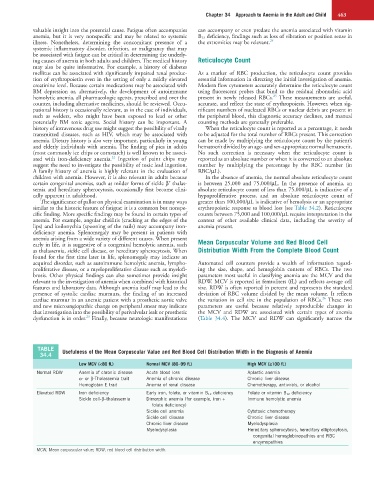
            that investigation into the possibility of perivalvular leak or prosthetic   the  MCV  and  RDW  are  associated  with  certain  types  of  anemia
                             23
            dysfunction is in order.  Finally, because neurologic manifestations   (Table  34.4).  The  MCV  and  RDW  can  significantly  narrow  the


             TABLE   Usefulness of the Mean Corpuscular Value and Red Blood Cell Distribution Width in the Diagnosis of Anemia
              34.4
                           Low MCV (<80 fL)      Normal MCV (80–99 fL)            High MCV (≥100 fL)
             Normal RDW    Anemia of chronic disease  Acute blood loss            Aplastic anemia
                           α- or β-Thalassemia trait  Anemia of chronic disease   Chronic liver disease
                           Hemoglobin E trait    Anemia of renal disease          Chemotherapy, antivirals, or alcohol
             Elevated RDW  Iron deficiency       Early iron, folate, or vitamin B 12  deficiency  Folate or vitamin B 12  deficiency
                           Sickle cell-β–thalassemia  Dimorphic anemia (for example, iron +   Immune hemolytic anemia
                                                   folate deficiency)
                                                 Sickle cell anemia               Cytotoxic chemotherapy
                                                 Sickle cell disease              Chronic liver disease
                                                 Chronic liver disease            Myelodysplasia
                                                 Myelodysplasia                   Hereditary spherocytosis, hereditary elliptocytosis,
                                                                                    congenital hemoglobinopathies and RBC
                                                                                    enzymopathies
             MCW, Mean corpuscular value; RDW, red blood cell distribution width.

