


Page 545 - Hematology_ Basic Principles and Practice ( PDFDrive )
P. 545
460    Part V  Red Blood Cells


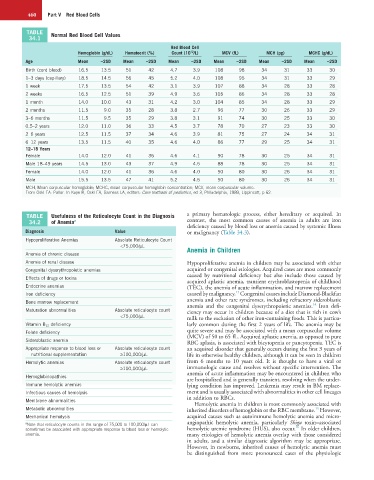
          TABLE   Normal Red Blood Cell Values
          34.1
                                                         Red Blood Cell
                           Hemoglobin (g/dL)  Hematocrit (%)  Count (10 /L)  MCV (fL)   MCH (pg)      MCHC (g/dL)
                                                               12
         Age               Mean   –2SD   Mean    –2SD   Mean    –2SD   Mean   –2SD    Mean   –2SD    Mean   –2SD
         Birth (cord blood)  16.5  13.5   51      42     4.7    3.9    108     98      34     31     33      30
         1–3 days (capillary)  18.5  14.5  56     45     5.2    4.0    108     95      34     31     33      29
         1 week            17.5   13.5    54      42     3.1    3.9    107     88      34     28     33      28
         2 weeks           16.5   12.5    51      39     4.9    3.6    105     86      34     28     33      28
         1 month           14.0   10.0    43      31     4.2    3.0    104     85      34     28     33      29
         2 months          11.5    9.0    35      28     3.8    2.7     96     77      30     26     33      29
         3–6 months        11.5    9.5    35      29     3.8    3.1     91     74      30     25     33      30
         0.5–2 years       12.0   11.0    36      33     4.5    3.7     78     70      27     23     33      30
         2–6 years         12.5   11.5    37      34     4.6    3.9     81     75      27     24     34      31
         6–12 years        13.5   11.5    40      35     4.6    4.0     86     77      29     25     34      31
         12–18 Years
         Female            14.0   12.0    41      36     4.6    4.1     90     78      30     25     34      31
         Male 18–49 years  14.5   13.0    43      37     4.9    4.5     88     78      30     25     34      31
         Female            14.0   12.0    41      36     4.6    4.0     90     80      30     26     34      31
         Male              15.5   13.5    47      41     5.2    4.5     90     80      30     26     34      31
         MCH, Mean corpuscular hemoglobin; MCHC, mean corpuscular hemoglobin concentration; MCV, mean corpuscular volume.
         From Oski FA: Pallor. In Kaye R, Oski FA, Barness LA, editors: Core textbook of pediatrics, ed 3, Philadelphia, 1989, Lippincott, p 62.


          TABLE   Usefulness of the Reticulocyte Count in the Diagnosis   a  primary  hematologic  process,  either  hereditary  or  acquired.  In
          34.2    of Anemia a                                 contrast,  the  most  common  causes  of  anemia  in  adults  are  iron
                                                              deficiency caused by blood loss or anemia caused by systemic illness
         Diagnosis                     Value                  or malignancy (Table 34.3).
         Hypoproliferative Anemias     Absolute Reticulocyte Count
                                        <75,000/µL            Anemia in Children
         Anemia of chronic disease
         Anemia of renal disease                              Hypoproliferative anemia in children may be associated with either
         Congenital dyserythropoietic anemias                 acquired or congenital etiologies. Acquired cases are most commonly
                                                              caused  by  nutritional  deficiency  but  also  include  those  caused  by
         Effects of drugs or toxins
                                                              acquired aplastic anemia, transient erythroblastopenia of childhood
         Endocrine anemias                                    (TEC), the anemia of acute inflammation, and marrow replacement
                                                                              13
         Iron deficiency                                      caused by malignancy.  Congenital causes include Diamond-Blackfan
         Bone marrow replacement                              anemia and other rare syndromes, including refractory sideroblastic
                                                                                                       14
                                                              anemia  and  the  congenital  dyserythropoietic  anemias.   Iron  defi-
         Maturation abnormalities      Absolute reticulocyte count   ciency may occur in children because of a diet that is rich in cow’s
                                        <75,000/µL            milk to the exclusion of other iron-containing foods. This is particu-
         Vitamin B 12  deficiency                             larly common during the first 2 years of life. The anemia may be
         Folate deficiency                                    quite severe and may be associated with a mean corpuscular volume
         Sideroblastic anemia                                 (MCV) of 50 to 65 fL. Acquired aplastic anemia, as opposed to pure
                                                              RBC aplasia, is associated with bicytopenia or pancytopenia. TEC is
         Appropriate response to blood loss or   Absolute reticulocyte count   an acquired disorder that generally occurs during the first 3 years of
           nutritional supplementation  ≥100,000/µL           life in otherwise healthy children, although it can be seen in children
         Hemolytic anemias             Absolute reticulocyte count   from  6  months  to  10  years  old.  It  is  thought  to  have  a  viral  or
                                        ≥100,000/µL           immunologic cause and resolves without specific intervention. The
                                                              anemia of acute inflammation may be encountered in children who
         Hemoglobinopathies
                                                              are hospitalized and is generally transient, resolving when the under-
         Immune hemolytic anemias                             lying condition has improved. Leukemia may result in BM replace-
         Infectious causes of hemolysis                       ment and is usually associated with abnormalities in other cell lineages
                                                              in addition to RBCs.
         Membrane abnormalities
                                                                 Hemolytic anemia in children is most commonly associated with
         Metabolic abnormalities                              inherited disorders of hemoglobin or the RBC membrane.  However,
                                                                                                        15
         Mechanical hemolysis                                 acquired causes such as autoimmune hemolytic anemia and micro-
         a Note that reticulocyte counts in the range of 75,000 to 100,000/µL can   angiopathic  hemolytic  anemia,  particularly  Shiga  toxin–associated
                                                                                                  16
         sometimes be associated with appropriate response to blood loss or hemolytic   hemolytic uremic syndrome (HUS), also occur.  In older children,
         anemia.                                              many etiologies of hemolytic anemia overlap with those considered
                                                              in  adults,  and  a  similar  diagnostic  algorithm  may  be  appropriate.
                                                              However, in newborns, inherited causes of hemolytic anemia must
                                                              be  distinguished  from  more  pronounced  cases  of  the  physiologic

