


Page 549 - Hematology_ Basic Principles and Practice ( PDFDrive )
P. 549
464    Part V  Red Blood Cells


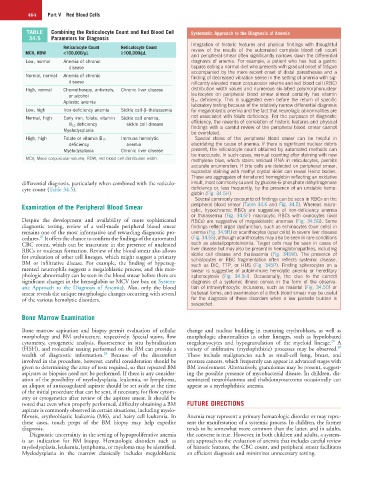
          TABLE   Combining the Reticulocyte Count and Red Blood Cell   Systematic Approach to the Diagnosis of Anemia
          34.5    Parameters for Diagnosis
                                                                Integration  of  historic  features  and  physical  findings  with  thoughtful
                      Reticulocyte Count   Reticulocyte Count   review  of  the  results  of  the  automated  complete  blood  cell  count
         MCV, RDW     <100,000/µL        ≥100,000/µL
                                                                and peripheral smear often significantly narrows down the differential
         Low, normal  Anemia of chronic                         diagnosis  of  anemia.  For  example,  a  patient  who  has  had  a  gastric
                        disease                                 bypass eating a normal diet who presents with gradual onset of fatigue
                                                                accompanied by the more recent onset of distal paresthesias and a
         Normal, normal  Anemia of chronic                      finding of decreased vibration sense in the setting of anemia with sig-
                        disease                                 nificantly elevated mean corpuscular volume and red blood cell (RBC)
         High, normal  Chemotherapy, antivirals,   Chronic liver disease  distribution width values and numerous six-lobed polymorphonuclear
                        or alcohol                              leukocytes  on  peripheral  blood  smear  almost  certainly  has  vitamin
                      Aplastic anemia                           B 12   deficiency.  This  is  suggested  even  before  the  return  of  specific
                                                                laboratory testing because of the relatively narrow differential diagnosis
         Low, high    Iron-deficiency anemia  Sickle cell-β–thalassemia  for megaloblastic anemia and the fact that neurologic abnormalities are
         Normal, high  Early iron, folate, vitamin   Sickle cell anemia,   not associated with folate deficiency. For the purposes of diagnostic
                        B 12  deficiency  sickle cell disease   efficiency, the rewards of correlation of historic features and physical
                      Myelodysplasia                            findings  with  a  careful  review  of  the  peripheral  blood  smear  cannot
                                                                be overstated.
         High, high   Folate or vitamin B 12    Immune hemolytic   Special  stains  of  the  peripheral  blood  smear  can  be  helpful  in
                        deficiency        anemia                elucidating the cause of anemia. If there is significant nuclear debris
                      Myelodysplasia     Chronic liver disease  present, the reticulocyte count obtained by automated methods can
                                                                be inaccurate. In such cases, manual counting after staining with new
         MCV, Mean corpuscular volume; RDW, red blood cell distribution width.  methylene  blue,  which  stains  residual  RNA  in  reticulocytes,  permits
                                                                accurate enumeration. If bite cells are detected on peripheral smear,
                                                                supravital staining with methyl crystal violet can reveal Heinz bodies.
                                                                These are aggregates of denatured hemoglobin reflecting an oxidative
        differential diagnosis, particularly when combined with the reticulo-  insult, most commonly caused by glucose-6-phosphate dehydrogenase
        cyte count (Table 34.5).                                deficiency or, less frequently, by the presence of an unstable hemo-
                                                                globin (Fig. 34.5H).
                                                                 Several commonly encountered findings can be seen in RBCs on the
        Examination of the Peripheral Blood Smear               peripheral blood smear (Table 34.6 and Fig. 34.5). Whereas micro-
                                                                cytic,  hypochromic  RBCs  are  suggestive  of  iron-deficiency  anemia
                                                                or  thalassemia  (Fig.  34.5F)  macrocytic  RBCs  with  ovalocytes  (oval
        Despite  the  development  and  availability  of  more  sophisticated   RBCs)  are  suggestive  of  megaloblastic  anemias  (Fig.  34.5G).  Some
        diagnostic  testing,  review  of  a  well-made  peripheral  blood  smear   findings reflect organ dysfunction, such as echinocytes (burr cells) in
        remains one of the most informative and rewarding diagnostic pro-  uremia (Fig. 34.5R) or acanthocytes (spur cells) in severe liver disease
              27
        cedures.  It offers the chance to confirm the findings of the automated   (Fig. 34.5S), although acanthocytes may also be seen in rare conditions
        CBC count, which can be inaccurate in the presence of nucleated   such  as  abetalipoproteinemia.  Target  cells  may  be  seen  in  cases  of
        RBCs or rouleaux formation. Review of the blood smear also allows   liver disease but may also be present in hemoglobinopathies, including
        for evaluation of other cell lineages, which might suggest a primary   sickle  cell  disease  and  thalassemia  (Fig.  345W).  The  presence  of
                                                                schistocytes  or  RBC  fragmentation  often  reflects  systemic  disease,
        BM  or  infiltrative  disease.  For  example,  the  finding  of  hyperseg-  such  as  DIC,  TTP,  or  HUS  (Fig.  345P).  Finding  spherocytes  on  a
        mented neutrophils suggests a megaloblastic process, and this mor-  smear  is  suggestive  of  autoimmune  hemolytic  anemia  or  hereditary
        phologic abnormality can be seen in the blood smear before there are   spherocytosis  (Fig.  34.5H).  Occasionally,  the  clue  to  the  correct
        significant changes in the hemoglobin or MCV (see box on System-  diagnosis  of  a  systemic  illness  comes  in  the  form  of  the  observa-
        atic  Approach  to  the  Diagnosis  of  Anemia).  Also,  only  the  blood   tion  of  intraerythrocytic  inclusions,  such  as  malarial  (Fig.  34.5O)  or
        smear reveals the unique morphologic changes occurring with several   babesial forms, and examination of a thick blood smear may be useful
        of the various hemolytic disorders.                     for  the  diagnosis  of  these  disorders  when  a  low  parasite  burden  is
                                                                suspected.

        Bone Marrow Examination

        Bone  marrow  aspiration  and  biopsy  permit  evaluation  of  cellular   change  and  nuclear  budding  in  maturing  erythroblasts,  as  well  as
        morphology and BM architecture, respectively. Special stains, flow   morphologic  abnormalities  in  other  lineages,  such  as  hypolobated
                                                                                                             29
        cytometry,  cytogenetic  analysis,  fluorescence  in  situ  hybridization   megakaryocytes  and  hypogranulation  of  the  myeloid  lineage.   A
                                                                                                               30
        (FISH), and molecular testing performed on the BM can provide a   variety  of  infiltrative  (myelophthisic)  processes  may  be  observed.
                                   28
        wealth  of  diagnostic  information.   Because  of  the  discomfort   These  include  malignancies  such  as  small-cell  lung,  breast,  and
        involved in the procedure, however, careful consideration should be   prostate cancers, which frequently can appear in advanced stages with
        given to determining the array of tests required, so that repeated BM   BM involvement. Alternatively, granulomas may be present, suggest-
        aspirates or biopsies need not be performed. If there is any consider-  ing the possible presence of mycobacterial disease. In children, dis-
        ation of the possibility of myelodysplasia, leukemia, or lymphoma,   seminated neuroblastoma and rhabdomyosarcoma occasionally can
        an aliquot of anticoagulated aspirate should be set aside at the time   appear as a myelophthisic anemia.
        of the initial procedure that can be sent, if necessary, for flow cytom-
        etry or cytogenetics after review of the aspirate smear. It should be
        noted that even when properly performed, difficulty obtaining a BM   FUTURE DIRECTIONS
        aspirate is commonly observed in certain situations, including myelo-
        fibrosis,  erythroblastic  leukemia  (M6),  and  hairy  cell  leukemia.  In   Anemia may represent a primary hematologic disorder or may repre-
        these  cases,  touch  preps  of  the  BM  biopsy  may  help  expedite   sent the manifestation of a systemic process. In children, the former
        diagnosis.                                            tends to be somewhat more common than the latter, and in adults,
           Diagnostic uncertainty in the setting of hypoproliferative anemia   the converse is true. However, in both children and adults, a system-
        is  an  indication  for  BM  biopsy.  Hematologic  disorders  such  as   atic approach to the evaluation of anemia that includes careful review
        myelodysplasia, leukemia, lymphoma, or myeloma may be identified.   of historic features, the CBC count, and peripheral smear facilitates
        Myelodysplasia  in  the  marrow  classically  includes  megaloblastic   an efficient diagnosis and minimizes unnecessary testing.

