


Page 550 - Hematology_ Basic Principles and Practice ( PDFDrive )
P. 550
Chapter 34  Approach to Anemia in the Adult and Child  465


                          A               B               C               D              E


                          F               G               H              I               J


                          K               L               M               N              O


                          P               Q               R              S               T


                          U               V               W               X               Y

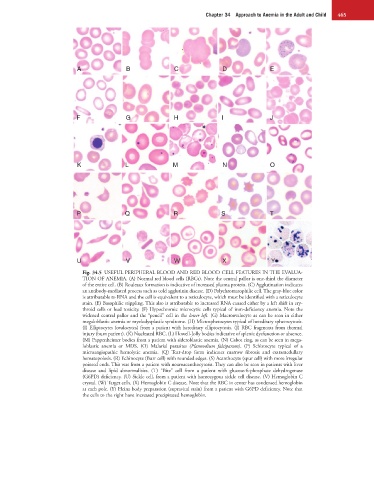
                            Fig. 34.5  USEFUL PERIPHERAL BLOOD AND RED BLOOD CELL FEATURES IN THE EVALUA-
                            TION OF ANEMIA. (A) Normal red blood cells (RBCs). Note the central pallor is one-third the diameter
                            of the entire cell. (B) Rouleaux formation is indicative of increased plasma protein. (C) Agglutination indicates
                            an antibody-mediated process such as cold agglutinin disease. (D) Polychromatophilic cell. The gray-blue color
                            is attributable to RNA and the cell is equivalent to a reticulocyte, which must be identified with a reticulocyte
                            stain. (E) Basophilic stippling. This also is attributable to increased RNA caused either by a left shift in ery-
                            throid cells or lead toxicity. (F) Hypochromic microcytic cells typical of iron-deficiency anemia. Note the
                            widened central pallor and the “pencil” cell in the lower left. (G) Macroovalocyte as can be seen in either
                            megaloblastic anemia or myelodysplastic syndrome. (H) Microspherocytes typical of hereditary spherocytosis.
                            (I) Elliptocytes (ovalocytes) from a patient with hereditary elliptocytosis. (J) RBC fragments from thermal
                            injury (burn patient). (K) Nucleated RBC. (L) Howell-Jolly bodies indicative of splenic dysfunction or absence.
                            (M) Pappenheimer bodies from a patient with sideroblastic anemia. (N) Cabot ring, as can be seen in mega-
                            loblastic  anemia  or  MDS.  (O)  Malarial  parasites  (Plasmodium  falciparum).  (P)  Schistocyte  typical  of  a
                            microangiopathic  hemolytic  anemia.  (Q)  Tear-drop  form  indicates  marrow  fibrosis  and  extramedullary
                            hematopoiesis. (R) Echinocyte (Burr cell) with rounded edges. (S) Acanthocyte (spur cell) with more irregular
                            pointed ends. This was from a patient with neuroacanthocytosis. They can also be seen in patients with liver
                            disease  and  lipid  abnormalities.  (T)  “Bite”  cell  from  a  patient  with  glucose-6-phosphate  dehydrogenase
                            (G6PD) deficiency. (U) Sickle cell, from a patient with homozygous sickle cell disease. (V) Hemoglobin C
                            crystal. (W) Target cells. (X) Hemoglobin C disease. Note that the RBC in center has condensed hemoglobin
                            at each pole. (Y) Heinz body preparation (supravital stain) from a patient with G6PD deficiency. Note that
                            the cells to the right have increased precipitated hemoglobin.

