


Page 557 - Hematology_ Basic Principles and Practice ( PDFDrive )
P. 557
472    Part V  Red Blood Cells


        circumvents  translational  repression  through  the  iron-responsive   is finally extruded through the erythroblast membrane with the loss
        element, iron regulatory protein system, thereby permitting export   of about 5% to 10% of the hemoglobin that had been synthesized
        of iron from erythroid precursor cells during the critical period when   previously. The resultant reticulocyte continues to synthesize hemo-
        cells commit to proliferation and differentiation, express high levels of   globin for another 2 to 3 days until the cellular supply of mRNA is
        transferrin receptor 1, and rapidly accumulate iron. As a consequence,   exhausted,  producing  as  much  as  30%  of  the  total  hemoglobin
        erythropoiesis may be partially suppressed when nonerythropoietic   complement of the RBC. Eventually, the reticulocyte is released from
        tissues risk developing iron deficiency. Iron export from erythroblasts   the marrow, remodeled, and pitted of siderotic granules and debris
        via  FPN1B  may  account  for  the  development  of  iron  deficiency   within the spleen to emerge as a mature RBC dedicated to oxygen
        anemia as an initial, early manifestation of systemic iron deficiency.   delivery over its lifespan of 3 to 4 months.
        Nonetheless, when the cells begin to produce hemoglobin, FPN1B
        expression diminishes and FPN1A predominates, allowing erythroid
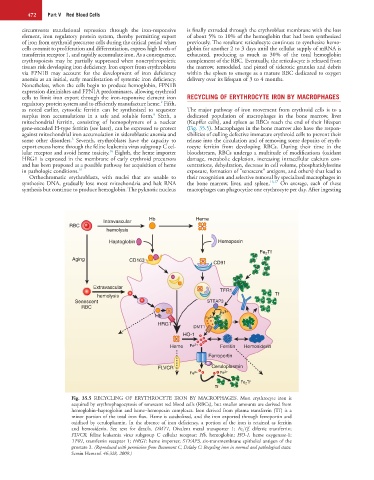
        cells to limit iron export through the iron-responsive element iron   RECYCLING OF ERYTHROCYTE IRON BY MACROPHAGES
                                                      2
        regulatory protein system and to efficiently manufacture heme.  Fifth,
        as  noted  earlier,  cytosolic  ferritin  can  be  synthesized  to  sequester   The major pathway of iron movement from erythroid cells is to a
                                                   6
        surplus  iron  accumulations  in  a  safe  and  soluble  form.   Sixth,  a   dedicated  population  of  macrophages  in  the  bone  marrow,  liver
        mitochondrial  ferritin,  consisting  of  homopolymers  of  a  nuclear   (Kupffer cells), and spleen as RBCs reach the end of their lifespan
        gene-encoded H-type ferritin (see later), can be expressed to protect   (Fig. 35.5). Macrophages in the bone marrow also have the respon-
        against mitochondrial iron accumulation in sideroblastic anemia and   sibilities of culling defective immature erythroid cells to prevent their
                         6
        some  other  disorders.   Seventh,  erythroblasts  have  the  capacity  to   release into the circulation and of removing some deposits of eryth-
        export excess heme through the feline leukemia virus subgroup C cel-  rocyte  ferritin  from  developing  RBCs.  During  their  time  in  the
                                     16
        lular receptor and avoid heme toxicity.  Eighth, the heme importer   bloodstream, RBCs undergo a multitude of modifications (oxidant
        HRG1 is expressed in the membrane of early erythroid precursors   damage,  metabolic  depletion,  increasing  intracellular  calcium  con-
        and has been proposed as a possible pathway for acquisition of heme   centrations, dehydration, decrease in cell volume, phosphatidylserine
        in pathologic conditions. 16                          exposure, formation of “senescent” antigens, and others) that lead to
           Orthochromatic  erythroblasts,  with  nuclei  that  are  unable  to   their recognition and selective removal by specialized macrophages in
        synthesize DNA, gradually lose most mitochondria and halt RNA   the  bone  marrow,  liver,  and  spleen. 16,17   On  average,  each  of  these
        synthesis but continue to produce hemoglobin. The pyknotic nucleus   macrophages can phagocytize one erythrocyte per day. After ingesting


                                   Intravascular  Hb             Heme
                        RBC
                                    hemolysis

                                     Haptoglobin                        Hemopexin
                                                                                      Fe 2 Tf
                         Aging             CD163
                                                                       CD91


                                Extravascular
                                                                         TFR1
                                 hemolysis                                                 Tf
                          Senescent                                  STEAP3
                            RBC
                                                                         Fe 3+
                                                    Hb              Fe 2+
                                                     HRG1
                                                                DMT1
                                                             HO-1
                                                         Heme  Fe 2+     Ferritin  Hemosiderin
                                                                     Ferroportin
                                                     FLVCR            Ceruloplasmin
                                                               Fe 2+     Fe 3+
                                                                                Fe 2 Tf
                                                                       Tf

                        Fig.  35.5  RECYCLING  OF  ERYTHROCYTE  IRON  BY  MACROPHAGES.  Most  erythrocyte  iron  is
                        acquired by erythrophagocytosis of senescent red blood cells (RBCs), but smaller amounts are derived from
                        hemoglobin–haptoglobin and heme–hemopexin complexes. Iron derived from plasma transferrin (Tf) is a
                        minor portion of the total iron flux. Heme is catabolized, and the iron exported through ferroportin and
                        oxidized  by  ceruloplasmin.  In  the  absence  of  iron  deficiency,  a  portion  of  the  iron  is  retained  as  ferritin
                        and  hemosiderin.  See  text  for  details.  DMT1,  Divalent  metal  transporter  1;  Fe 2 Tf,  diferric  transferrin;
                        FLVCR,  feline  leukemia  virus  subgroup  C  cellular  receptor;  Hb,  hemoglobin;  HO-1,  heme  oxygenase-1;
                        TFR1, transferrin receptor 1; HRG1: heme importer; STEAP3, six-transmembrane epithelial antigen of the
                        prostate 3. (Reproduced with permission from Beaumont C, Delaby C: Recycling iron in normal and pathological states.
                        Semin Hematol 46:328, 2009.)

