


Page 560 - Hematology_ Basic Principles and Practice ( PDFDrive )
P. 560
Chapter 35  Pathophysiology of Iron Homeostasis  475


                              Erythropoiesis                Iron status
                                                   Circulating iron  Iron stores
                                RBCs
                                                   Diferric transferrin
                                                                      Hemojuvelin
                             pO 2
                                                                      Neogenin
                              −                                        BMP-6                  Inflammation
                                                                                   Soluble
                         Erythropoietin                                          hemojuvelin    Interleukin-6
                                      Erythroferrone              ?
                                                                                         Interleukin-6
                                     ?                HFE                                   receptor

                                                               TFR2
                                               TFR1     ?           BMPR   Matriptase-2
                                         −                ERK          I-II                Soluble
                         Hepatocellular                                 SMAD         Furin  hemojuvelin
                           membrane
                                               ?     +        +                                   JAK-STAT
                                                                          +         HIF
                                                                                  Oxygen
                                                       Nucleus                    tension   +
                                                    ?            ?
                                              ?
                                                       Promoter
                                     HAMP

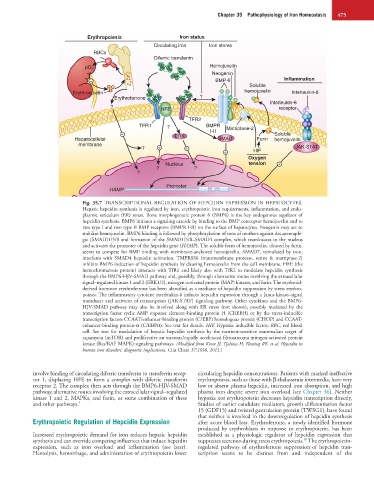
                            Fig. 35.7  TRANSCRIPTIONAL REGULATION OF HEPCIDIN EXPRESSION IN HEPATOCYTES.
                            Hepatic hepcidin synthesis is regulated by iron, erythropoietic iron requirements, inflammation, and endo-
                            plasmic reticulum (ER) stress. Bone morphogenetic protein 6 (BMP6) is the key endogenous regulator of
                            hepcidin synthesis. BMP6 initiates a signaling cascade by binding to the BMP coreceptor hemojuvelin and to
                            two type I and two type II BMP receptors (BMPR I-II) on the surface of hepatocytes. Neogenin may act to
                            stabilize hemojuvelin. BMP6 binding is followed by phosphorylation of sons of mothers against decapentaple-
                            gic (SMAD)1/5/8 and formation of the SMAD1/5/8–SMAD4 complex, which translocates to the nucleus
                            and activates the promoter of the hepcidin gene (HAMP). The soluble form of hemojuvelin, cleaved by furin,
                            seems to compete for BMP binding with membrane-anchored hemojuvelin. SMAD7, stimulated by iron,
                            interferes  with  SMAD4  hepcidin  activation. TMPRSS6  (transmembrane  protease,  serine  6;  matriptase-2)
                            inhibits BMP6 induction of hepcidin synthesis by cleaving hemojuvelin from the cell membrane. HFE (the
                            hemochromatosis  protein)  interacts  with TfR1  and  likely  also  with TfR2  to  modulate  hepcidin  synthesis
                            through the BMP6-HJV-SMAD pathway and, possibly, through alternative routes involving the extracellular
                            signal–regulated kinase 1 and 2 (ERK1/2), mitogen-activated protein (MAP) kinases, and furin. The erythroid-
                            derived hormone erythroferrone has been identified as a mediator of hepcidin suppression by stress erythro-
                            poiesis. The inflammatory cytokine interleukin-6 induces hepcidin expression through a Janus kinase–signal
                            transducer and activator of transcription (JAK-STAT) signaling pathway. Other cytokines and the BMP6-
                            HJV-SMAD  pathway  may  also  be  involved  along  with  ER  stress  (not  shown),  possibly  mediated  by  the
                            transcription factor cyclic AMP response element–binding protein H (CREBH) or by the stress-inducible
                            transcription factors CCAAT/enhancer-binding protein (C/EBP) homologous protein (CHOP) and CCAAT-
                            enhancer-binding protein-α (C/EBPα). See text for details. HIF, Hypoxia inducible factor; RBC, red blood
                            cell.  See  text  for  modulation  of  hepatic  hepcidin  synthesis  by  the  nutrient-sensitive  mammalian  target  of
                            rapamycin (mTOR) and proliferative rat sarcoma/rapidly accelerated fibrosarcoma mitogen-activated protein
                            kinase (Ras/RAF MAPK) signaling pathways. (Modified from Kroot JJ, Tjalsma H, Fleming RE, et al: Hepcidin in
                            human iron disorders: diagnostic implications. Clin Chem 57:1650, 2011.)


            involve binding of circulating diferric transferrin to transferrin recep-  circulating hepcidin concentrations. Patients with marked ineffective
            tor 1, displacing HFE to form a complex with diferric transferrin   erythropoiesis, such as those with β-thalassemia intermedia, have very
            receptor 2. The complex then acts through the BMP6-HJV-SMAD   low or absent plasma hepcidin, increased iron absorption, and high
            pathway, alternative routes involving the extracellular signal−regulated   plasma iron despite severe iron overload (see Chapter 36). Neither
            kinase 1 and 2, MAPKs, and furin, or some combination of these   hypoxia nor erythropoietin decreases hepcidin transcription directly.
            and other pathways. 4                                 Studies of earlier candidate mediators, growth differentiation factor
                                                                  15 (GDF15) and twisted gastrulation protein (TWSG1), have found
                                                                  that neither is involved in the downregulation of hepcidin synthesis
            Erythropoietic Regulation of Hepcidin Expression      after acute blood loss. Erythroferrone, a newly identified hormone
                                                                  produced  by  erythroblasts  in  response  to  erythropoietin,  has  been
            Increased erythropoietic demand for iron reduces hepatic hepcidin   established  as  a  physiologic  regulator  of  hepcidin  expression  that
                                                                                                    26
            synthesis and can override competing influences that induce hepcidin   suppresses secretion during stress erythropoiesis.  The erythropoietin-
            expression,  such  as  iron  overload  and  inflammation  (see  later).   regulated  pathway  of  erythroferrone  suppression  of  hepcidin  tran-
            Hemolysis, hemorrhage, and administration of erythropoietin lower   scription  seems  to  be  distinct  from  and  independent  of  the

