


Page 554 - Hematology_ Basic Principles and Practice ( PDFDrive )
P. 554
Chapter 35  Pathophysiology of Iron Homeostasis  469


                          Reticuloendothelial                     of iron delivery during its lifetime in the circulation. Apotransferrin
                            macrophages                           is a true carrier that is not lost in delivering iron; the half-life of the
                                                  Muscle, other   protein is about 8 days. In an iron-replete 70-kg man, the amount
                                                parenchymal cells  of  transferrin-bound  iron  in  the  plasma  at  any  given  time  is  only
                                                                  about  3 mg,  but  more  than  30 mg  of  iron  moves  through  this
                                                                  transport compartment each day (see Fig. 35.1). Most (approximately
                 Circulating                         GI           24 mg Fe/d) of this iron is used for erythropoiesis.
                  red blood         Tf              tract           Transferrin receptors on the cell surface selectively bind monofer-
                   cells                                          ric or diferric transferrin. Two different isoforms of the transferrin
                                                                  receptor exist, encoded by two separate genes. The two glycoproteins
                                                                  have similar extracellular structures but distinct roles in iron homeo-
                                                                  stasis. Transferrin receptor 1 is ubiquitously expressed and functions
                             Erythroid         Hepatocytes        as the physiologic transferrin iron importer on all iron-requiring cells.
                              marrow                              Transferrin receptor 2 is expressed only in hepatocytes, functioning
                                                                  in the control of iron supply by regulating hepcidin expression (see
                                                                  later), and in erythroid precursors, coordinating erythropoiesis with
                 Functional iron                                  iron availability (see later).  Transferrin receptor 1 is a transmem-
                                                                                      11
                 Macrophage storage iron                          brane glycoprotein dimer composed of two identical subunits linked
                 Hepatocyte storage iron                          by a disulfide bond. Each transferrin receptor 1 can bind two mol-
                 Transport iron                                   ecules of transferrin; if each transferrin is diferric, the dimeric receptor
                 Sites of hepcidin control                        can carry a total of four atoms of transferrin-bound iron. The affinity
                 of iron entry into plasma                        of  transferrin  receptor  1  for  transferrin  depends  both  on  the  iron
                                                                  content of transferrin and on the pH. With amounts of iron-bearing
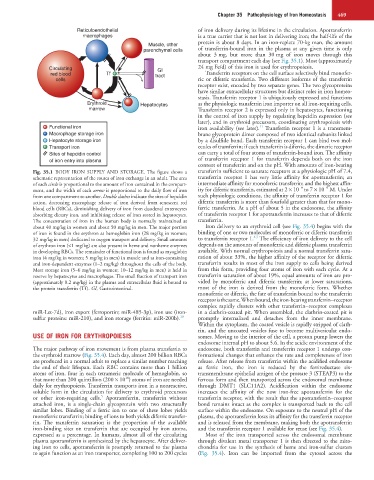
            Fig.  35.1  BODY  IRON  SUPPLY  AND  STORAGE. The  figure  shows  a   transferrin sufficient to saturate receptors at a physiologic pH of 7.4,
            schematic representation of the routes of iron exchange in an adult. The area   transferrin  receptor  1  has  very  little  affinity  for  apotransferrin;  an
            of each circle is proportional to the amount of iron contained in the compart-  intermediate affinity for monoferric transferrin; and the highest affin-
                                                                                                   −9
                                                                                                           −9
            ment, and the width of each arrow is proportional to the daily flow of iron   ity for diferric transferrin, estimated at 2 × 10  to 7 × 10  M. Under
            from one compartment to another. Double slashes indicate the sites of hepcidin   such physiologic conditions, the affinity of transferrin receptor 1 for
            action,  decreasing  macrophage  release  of  iron  derived  from  senescent  red   diferric transferrin is more than fourfold greater than that for mono-
            blood cells (RBCs), diminishing delivery of iron from duodenal enterocytes   ferric transferrin. At a pH of about 5 in the endosome, the affinity
            absorbing dietary iron, and inhibiting release of iron stored in hepatocytes.   of transferrin receptor 1 for apotransferrin increases to that of diferric
            The  concentration  of  iron  in  the  human  body  is  normally  maintained  at   transferrin.
            about 40 mg/kg in women and about 50 mg/kg in men. The major portion   Iron delivery to an erythroid cell (see Fig. 35.4) begins with the
            of iron is found in the erythron as hemoglobin iron (28 mg/kg in women;   binding of one or two molecules of monoferric or diferric transferrin
                                                                                    4,5
            32 mg/kg in men) dedicated to oxygen transport and delivery. Small amounts   to transferrin receptor 1.  The efficiency of iron delivery to the cell
            of erythron iron (<1 mg/kg) are also present in heme and nonheme enzymes   depends on the amounts of monoferric and diferric plasma transferrin
            in developing RBCs. The remainder of functional iron is found as myoglobin   available. With normal erythropoiesis and a normal transferrin satu-
            iron (4 mg/kg in women; 5 mg/kg in men) in muscle and as iron-containing   ration of about 33%, the higher affinity of the receptor for diferric
            and iron-dependent enzymes (1–2 mg/kg) throughout the cells of the body.   transferrin results in most of the iron supply to cells being derived
            Most storage iron (5–6 mg/kg in women; 10–12 mg/kg in men) is held in   from this form, providing four atoms of iron with each cycle. At a
            reserve by hepatocytes and macrophages. The small fraction of transport iron   transferrin saturation of about 19%, equal amounts of iron are pro-
            (approximately 0.2 mg/kg) in the plasma and extracellular fluid is bound to   vided  by  monoferric  and  diferric  transferrin;  at  lower  saturations,
            the protein transferrin (Tf). GI, Gastrointestinal.   most  of  the  iron  is  derived  from  the  monoferric  form.  Whether
                                                                  monoferric or diferric, the fate of transferrin bound to the transferrin
                                                                  receptor is the same. When bound, the iron-bearing transferrin−receptor
                                                                  complex rapidly clusters with other transferrin−receptor complexes
            miR-Let-7d), iron export (ferroportin; miR-485-3p), iron use (iron-  in a clathrin-coated pit. When assembled, the clathrin-coated pit is
            sulfur proteins: miR-210), and iron storage (ferritin: miR-200b). 10  promptly  internalized  and  detaches  from  the  inner  membrane.
                                                                  Within the cytoplasm, the coated vesicle is rapidly stripped of clath-
                                                                  rin, and the uncoated vesicles fuse to become multivesicular endo-
            USE OF IRON FOR ERYTHROPOIESIS                        somes. Moving to the interior of the cell, a proton pump lowers the
                                                                  endosome internal pH to about 5.6. In the acidic environment of the
            The major pathway of iron movement is from plasma transferrin to   endosome, both transferrin and transferrin receptor 1 undergo con-
            the erythroid marrow (Fig. 35.4). Each day, almost 200 billion RBCs   formational changes that enhance the rate and completeness of iron
            are produced in a normal adult to replace a similar number reaching   release. After release from transferrin within the acidified endosome
            the end of their lifespan. Each RBC contains more than 1 billion   as  ferric  iron,  the  iron  is  reduced  by  the  ferrireductase  six-
            atoms of iron, four in each tetrameric molecule of hemoglobin, so   transmembrane epithelial antigen of the prostate 3 (STEAP3) to the
                                          18
            that more than 200 quintillion (200 × 10 ) atoms of iron are needed   ferrous form and then transported across the endosomal membrane
            daily for erythropoiesis. Transferrin transports iron in a nonreactive,   through  DMT1  (SLC11A2).  Acidification  within  the  endosome
            soluble form in the circulation for delivery to erythroid precursors     increases  the  affinity  of  the  now  iron-free  apotransferrin  for  the
                                  5
            or  other  iron-requiring  cells.   Apotransferrin,  transferrin  without   transferrin receptor, with the result that the apotransferrin−receptor
            attached  iron,  is  a  single-chain  glycoprotein  with  two  structurally   bond remains intact as the complex is transported back to the cell
            similar  lobes.  Binding  of  a  ferric  ion  to  one  of  these  lobes  yields   surface within the endosome. On exposure to the neutral pH of the
            monoferric transferrin; binding of ions to both yields diferric transfer-  plasma, the apotransferrin loses its affinity for the transferrin receptor
            rin.  The  transferrin  saturation  is  the  proportion  of  the  available   and is released from the membrane, making both the apotransferrin
            iron-binding  sites  on  transferrin  that  are  occupied  by  iron  atoms,   and the transferrin receptor 1 available for reuse (see Fig. 35.4).
            expressed as a percentage. In humans, almost all of the circulating   Most  of  the  iron  transported  across  the  endosomal  membrane
            plasma apotransferrin is synthesized by the hepatocyte. After deliver-  through divalent metal transporter 1 is then directed to the mito-
            ing iron to cells, apotransferrin is promptly returned to the plasma   chondria  for  use  in  the  synthesis  of  heme  and  iron-sulfur  clusters
            to again function as an iron transporter, completing 100 to 200 cycles   (Fig.  35.4).  Iron  can  be  imported  from  the  cytosol  across  the

